Latest
INEC rejects demand for Amupitan’s removal, explains decision on ADC leadership
The Independent National Electoral Commission (INEC) has rejected calls by the African Democratic Congress (ADC) for its Chairman, Prof. Joash Amupitan, to resign, insisting that the commission acted strictly in line with constitutional provisions and subsisting court judgments.
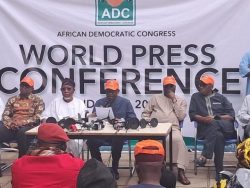
The ADC, during a World Press Conference in Abuja on Thursday, had demanded the resignation or removal of the INEC Chairman, alleging partisan bias following the commission’s decision to remove the names of the party’s leaders from its official portal.
The party, through its National Chairman, David Mark, accused the electoral body of undermining internal party processes.
However, INEC, in a statement signed by its Chief Press Secretary, Adedayo Oketola, described the demand as a “direct assault” on the independence of the electoral umpire.
The commission emphasized that it is a creation of the Constitution of the Federal Republic of Nigeria, adding that the appointment, tenure, and removal of its Chairman and National Commissioners are clearly stipulated under Section 157 of the 1999 Constitution (as amended).
“The Chairman does not hold office at the pleasure of any political party or interest group,” the statement read. “Any call for removal outside the established constitutional process is not only a distraction but a direct assault on the independence of the nation’s electoral umpire.”
INEC clarified that its decision regarding the ADC leadership records was in compliance with a recent Court of Appeal judgment and a preservative order issued by a Federal High Court.
According to the commission, monitoring the congress and convention of the David Mark-led faction would have amounted to disobedience of a court order restraining it from supervising any meeting or convention of the party.
READ ALSO: ADC’s David Mark calls out INEC, demands Chairman Amupitan be sacked
The commission further explained that it opted to comply fully with the Court of Appeal ruling to avoid a recurrence of situations experienced in Zamfara and Plateau states, where elected officials were removed by election tribunals due to non-compliance with court judgments.

INEC noted that it had only approved the ADC executive led by Mark on September 9, 2025 — seven days after the matter had already been filed at the Federal High Court — making strict adherence to the order to maintain status quo ante bellum imperative.
Citing Section 287(2) of the Constitution, the commission stressed that every authority in Nigeria is mandated not only to obey but also to enforce judgments of the Court of Appeal.
Responding to allegations that its actions undermine Nigeria’s multi-party system, INEC said it has in fact expanded democratic space under the leadership of Prof.
Amupitan. It pointed to the recent registration and recognition of new political parties, including the Democratic Leadership Alliance (DLA), the Nigeria Democratic Congress (NDC), and the National Democratic Party (NDP), bringing the total number of active political parties in the country to 22.
“INEC remains a neutral regulator, not a participant in political competition,” the statement added, stressing that updates to party leadership records are strictly anchored on compliance with court orders and statutory provisions under the Electoral Act 2026.
The commission also addressed concerns surrounding the planned nationwide voter revalidation exercise, describing attempts to politicise the initiative as unfounded. It said the exercise predates the appointment of Prof. Amupitan and is intended to strengthen the integrity of the National Register of Voters, which contains data spanning from 2011 to 2024.
INEC clarified that the revalidation exercise is an administrative audit, not a fresh registration, and is designed to confirm voter status, address issues of transfers, multiple registrations, and deceased persons, while enhancing the reliability of voter data nationwide.
“It is not targeted at any region, party, or demographic,” the commission stated, assuring that the process will be conducted uniformly across all Local Government Areas and Polling Units with digital options available for accessibility.
The commission further said it remains focused on preparations for the forthcoming Ekiti (June 2026) and Osun (August 2026) off-cycle governorship elections and would not be distracted by what it described as unfounded allegations of bias.
Reaffirming its commitment to transparency, fairness, and the rule of law, INEC maintained that its decisions are guided solely by constitutional mandates and aimed at ensuring free, fair, and credible elections in Nigeria.