Business
Oyo emerges third in Nigeria’s VAT generation, records N253.67bn in H1 2026
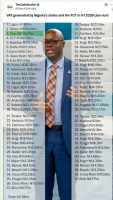

Oyo State has emerged as Nigeria’s third-highest Value Added Tax (VAT) generating state in the first half of 2026, recording N253.67 billion between January and June, according to data released by the Federation Account Allocation Committee (FAAC) and compiled by TheCable Index.
The figures show that Oyo ranked behind only Lagos, which generated ₦1.81 trillion, and Rivers State with N560.04 billion, while surpassing the Federal Capital Territory (FCT), Bayelsa, Delta and other states.
Overall, Nigeria’s 36 states and the FCT generated a combined N3.78 trillion in VAT during the six-month period.
Analysts attributed Oyo’s impressive performance to sustained economic reforms, increased business activity and investment-friendly policies implemented under the administration of Governor Seyi Makinde.
According to the data, the top 10 VAT-generating states and the FCT in the first half of 2026 are:
Lagos – N1.81 trillion
Rivers – N560.04 billion
Oyo – N253.67 billion
FCT – N182.93 billion
Bayelsa – N103.14 billion
Delta – N102.06 billion
Kano – N65.21 billion
Akwa Ibom – N52.89 billion
Edo – N51.91 billion
Borno – N38.38 billion
READ ALSO: Fitch, IMF flag risks over Nigeria’s proposed $5bn derivative swap deal
Business analysts said the ranking reflects growing investor confidence and expanding commercial activities across Oyo State.
Economic analyst, Dr. Tunde Adebayo, said Oyo’s performance suggests that deliberate investments in infrastructure and ease of doing business are beginning to translate into stronger economic outcomes.
“VAT generation is often a reflection of the volume of taxable economic activities taking place within a state. Oyo’s position indicates increased commercial transactions, stronger consumer spending and improved business formalisation,” he said.
Another economist, Mrs. Funmi Adeyemi, noted that while VAT rankings should not be viewed as the sole measure of economic success, they remain a useful indicator of the health of a state’s economy.
“States that consistently improve their VAT generation usually have policies that encourage enterprise development, support small and medium-sized businesses and attract private investment. Sustaining these reforms will be critical for long-term growth,” she said.
In a statement, business analysts also described the achievement as evidence that the Makinde administration’s economic policies are yielding measurable results.
“The numbers speak for themselves. This achievement reflects a thriving economy and the hard work of the people of Oyo State,” the statement said.
“It also demonstrates that sustained economic planning and investment-friendly policies can deliver tangible outcomes. While political debates continue, the state’s economic indicators point to increased productivity and revenue generation.”
The state government attributed the growth to ongoing efforts to formalise businesses, expand the tax net, strengthen support for small and medium-sized enterprises (SMEs), improve market infrastructure and create an enabling environment for investors.
Observers say maintaining the current momentum through continued infrastructure development, industrial expansion and job creation will be key to sustaining Oyo State’s economic growth in the coming years.