
Business
NGX loses N3trn in three days as Dangote Cement, Aradel, Banks lead sell-off

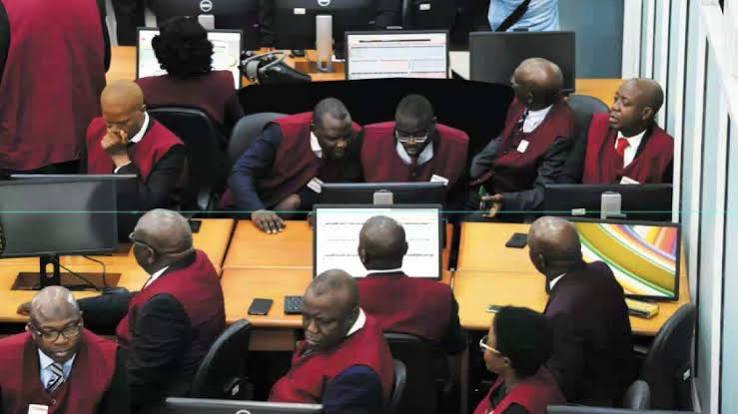
Nigeria’s equity market has shed approximately N3 trillion in market capitalisation following three consecutive sessions of aggressive profit-taking, as investors retreated from heavyweight industrial, energy and banking stocks after a strong rally earlier in November.
The sell-off has reversed part of the gains recorded during the market’s recent bullish run, with the Nigerian Exchange Limited (NGX) All-Share Index (ASI) declining from 254,763.34 points to 248,286.56 points.
The downturn reflects growing investor caution, liquidity rotation and concerns over domestic and international macroeconomic conditions, with market participants increasingly repositioning their portfolios ahead of anticipated investment opportunities.
The latest bearish trend has particularly affected large-cap stocks that previously provided significant upward momentum to the market.
Dangote Cement triggered one of the sharpest corrections on Tuesday after its share price plunged 9.99 per cent in a single trading session, falling from N1,469.90 to N1,323.
The decline in the cement manufacturer’s valuation significantly contributed to the erosion of market capitalisation, reinforcing the negative sentiment surrounding heavyweight industrial stocks.
The pressure subsequently spread to the energy sector during Wednesday’s trading session, November 18, with Aradel Holdings leading the decline.
Aradel lost the maximum daily limit of 10 per cent to close at N1,166.40 per share, dragging the NGX Oil and Gas Index down by 3.47 per cent.
Banking stocks, which had also played a major role in the market’s earlier rally, came under sustained selling pressure as investors moved to lock in profits.
READ ALSO; NGX Group profit jumps 83% to N20.6bn in nine months
Zenith Bank, Guaranty Trust Holding Company (GTCO), Access Holdings and First HoldCo were among the major lenders affected by increased sell orders, pushing the NGX Banking Index lower.
The retreat comes after several consecutive sessions of gains during the first part of November, with investors increasingly opting to convert accumulated paper profits into cash.
Beyond routine profit-taking, market commentators have identified a possible shift in investment positioning ahead of the anticipated Initial Public Offering (IPO) of Dangote Petroleum Refinery as another factor influencing trading activities.
Expectations surrounding the proposed offering have encouraged some investors to raise liquidity by reducing exposure to existing blue-chip equities.
The anticipated scale of the refinery IPO and expectations of substantial investor participation have heightened interest in cash positions, potentially leaving the secondary market vulnerable to further corrections.
Macroeconomic developments have also added to the pressure on Nigerian equities.
Internationally, Brent crude prices have retreated from a one-month high of approximately $96 per barrel recorded in mid-November, settling within the $92.45 to $92.88 range.
The decline has raised fresh concerns about the valuation outlook for domestic oil and gas companies, including Aradel Holdings and Oando, while potentially affecting expectations surrounding Nigeria’s foreign exchange earnings and reserve accumulation.
The naira has also faced renewed pressure following a decline in weekly foreign exchange inflows.
At the official Central Bank of Nigeria/Nigerian Foreign Exchange Market window, the currency reportedly weakened to N1,380 per dollar from N1,353 at the beginning of the week, while the parallel market rate exceeded N1,450 per dollar.
The depreciation presents additional challenges for companies with significant foreign currency obligations and dependence on imported inputs.
For industrial manufacturers such as Dangote Cement, a weaker naira could increase the cost of imported raw materials, machinery and equipment, alongside the naira burden of servicing foreign currency-denominated debt.
Foreign portfolio investors may equally become more cautious as exchange-rate volatility threatens the dollar value of their Nigerian equity investments.
Although the long-term fundamentals of several leading companies remain relevant to investment decisions, the latest market correction suggests that short-term investor sentiment has become increasingly sensitive to liquidity conditions, currency movements and expected corporate transactions.
Attention is now turning to whether the 248,000-point level will provide sufficient psychological support for the All-Share Index or whether continued profit-taking will trigger further losses.
Investors will also monitor developments surrounding the proposed Dangote Petroleum Refinery IPO, movements in crude oil prices, foreign exchange liquidity and year-end portfolio adjustents.
The direction of these factors could determine whether the recent sell-off represents a temporary correction following an exceptional rally or the beginning of a more prolonged period of weakness on the Nigerian stock market.


-

 Featured7 days ago
Nigeria’s youth unemployment paradox: Graduates struggle as millions survive in informal jobs
-

 Business1 week ago
Nigerian Banks earn N521.8bn from E-banking, card fees in nine months
-

 Energy7 days ago
Nigeria’s power crisis deepens as ₦639bn unpaid gas debt threatens electricity supply
-

 Latest1 week ago
Dalung claims ‘message from Buhari’s grave’ urges Nigerians to vote Atiku in 2027
-
 Featured6 days ago
Tinubu’s Renewed Hope: Reforms, hardship and the unanswered question of a second term
-

 Featured5 days ago
The cost of Renewed Hope: How Nigeria’s economic reforms are reshaping everyday family life
-

 Latest7 days ago
Ondo shuts ponmo processing centre after discovery of human waste
-

 Education7 days ago
Nigeria’s education crisis deepens as schools battle infrastructure deficits