Featured
SUGAR TAX: Not all that froths is liquid
Nigeria is leaving no drink untasted in its 2022 revenue push. Even in an industry where consumption is all a fizz
Elijah Olusegun
Armed with snippets of stats and gut feelings, Nigeria has slammed its citizens in their sugar teeth, and flung a wrench in the industry juicing up carbonated drinks for Nigerians.
Below its veneer of public health motivation, the decision, many believe, reveals how the government is going for broke to generate revenue for 2022: just itching to hit pay dirt in the most unlikely of places.
Except for its quest for more at all costs, Nigeria is already making sweet money from sugar itself—as much as its consumption permits. The Nigeria Sugar Act empowers the National Sugar Development Council (NSDC) to slice off 10 percent from every sugar import, the nation’s major source of sugar. No fewer than 21.9 million metric tons (compared to 598,000 metric tons produced) of sugar were imported between 1990 and 2020. The import costs in the period add up to about N10 billion, NSDC data indicates. That was N1 billion in 27 years. A cash-strapped government will sure want to do more.
Marcel Okeke, a public finance analyst, thinks it’s all good. “I believe the government has good intentions, and the right to determine how to generate revenues,” he told the National Daily.
But going ahead to levy N10/litre excise duty on Nigeria’s sweet beverage manufacturers (over 100 of them) isn’t promising more money. Not when they now have to squeeze final consumers (after VAT), adjust production, and shrink business. For one, the government forecast that a sweet spot for sugar tax exists in the population might just be a mirage. And the market sentiment about the levy is not even saccharine.
On the world sugar map, Africa’s biggest market in the carbonated soft drinks (CSD) industry is not occupying a pride of place yet. Nigeria ranks 130, a universe behind the UAE, Djibouti, Saudi Arabia, and others in the top 20, according to data sourced from the USDA, Euromonitor International, AB Sugar, Statista, MDPI, HelgiLibrary and The Washington.
Per capita annually, an average Nigerian consumes 8kg, which is about 2,068 spoonfuls. That is 3.3 percent of the UAE per capita consumption in a year, which stands at 243kg, about 53,591 table spoonfuls.
The federal government sugar figures are no better.
The NSDC estimates an average Nigerian consumes 7.7kg in 2020—up from 5.9kg in 1993, and about the 1998 figure. That is 30.5 percent increase in 27 years.
But Dr. Ifeanyi M. Nsofor said the Nigeria per capita consumption of 7.7kg could be an average. ‘There are Nigerians who consume 20kg of carbonated drinks. “Even though our average per capita consumption is low, the government needs to deter citizens from consuming sugar,” the senior vice president for Africa, Human Health Education and Research Foundation, told the National Daily.
Nigeria’s sugar consumption fares lower compared to most benchmarks, including the WHO, which is 50g (0.05kg) daily—between five and 10 table spoonfuls. Or about 3600 table spoonfuls yearly.
The prospect of making a kill in the market dims further when the tax collector considers the figure: a population of 202 million drank just over 39 million bottles of CSDs in 2016, as Euromonitor, a trend forecasting group, found out. So with a surcharge of N10 per bottle, the sugar tax can only rake in about N300 million annually for Nigeria.
That’s a crude estimate, though, and it’s miserable. On that, Okeke insisted “government has information that we may not have”.
Finance Minister Zenab Ahmed said there are billions of naira to be made. Even when the figures are fussy.
Per size, the industry tested $2 billion in 2015. And Market Research projects it will grow at 17 percent to $9.6 billion in 2025. A lot has changed though, in terms of market decline. Statista projects $1.4 billion in 2022.

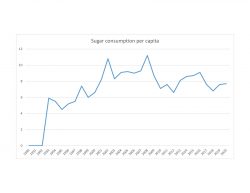
Nigeria’s sugar consumption per capita from1990-2020