Latest
Wike–APC governors’ rift exposes Tinubu’s 2027 power struggle
….Is Wike replicating PDP strategy
By odunewu olusegun
The growing confrontation between Federal Capital Territory (FCT) Minister Nyesom Wike and governors of the All Progressives Congress (APC) is increasingly revealing tensions over the political structure and alliances President Bola Tinubu may depend on as the 2027 elections draw closer.
The dispute, which extends beyond the personalities of Wike and APC Governors’ Forum Chairman Hope Uzodimma, is raising questions about party loyalty, cross-party alliances, presidential strategy and the distribution of political influence within the ruling coalition.
At the centre of the dispute is Wike’s “Rainbow Coalition”, a cross-party political structure he says is designed to mobilise support for Tinubu’s re-election, while allowing the Peoples Democratic Party (PDP) and other parties to field candidates against APC candidates in governorship and legislative elections.
APC governors, led by Imo State Governor and Progressive Governors’ Forum Chairman Hope Uzodimma, see the arrangement differently.
On September 14, the governors resolved not to support any alliance capable of weakening the APC or its candidates. Uzodimma said their campaign commitment would remain exclusively with APC candidates.
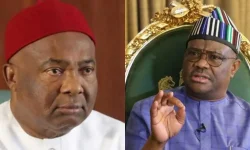

The clash raises several questions: Is Wike reproducing inside the APC-led government the same independent power strategy that made him a formidable force within the PDP? Why has his relationship with Uzodimma deteriorated? And how much political space can Tinubu give an influential ally who is not an APC member without alienating the governors who control the party’s state machinery?
READ ALSO; Wike vs APC governors: Fayose examines interests behind 2027 dispute
From PDP Rebel to Tinubu Ally
Wike’s current position cannot be understood without examining his role in the PDP’s 2022 presidential crisis.
He contested the PDP presidential primary against Atiku Abubakar and finished second with 237 votes to Atiku’s 371. After the primary, Wike and four other PDP governors formed the G5 and demanded the resignation of then-PDP National Chairman Iyorchia Ayu as a condition for supporting Atiku.
The dispute ultimately contributed to the PDP’s fractured campaign in 2023. Wike and members of the G5 did not support Atiku’s presidential bid and subsequently backed Tinubu at the presidential level. Wike later became a minister in Tinubu’s administration, taking charge of the FCT in 2023.
That history is now important because the political formula is remarkably similar: Wike is again supporting a presidential candidate while maintaining political autonomy over other contests.
In 2022, the argument was about PDP control and the presidential ticket. In 2026, the fault line is between presidential loyalty and party loyalty.
Why Uzodimma and Wike Are Fighting
Uzodimma’s objection is fundamentally about party structure.
The APC Governors’ Forum has declared that supporting Tinubu means supporting APC candidates at other levels. Wike rejects that interpretation.
He says his coalition is deliberately cross-party and is intended to help Tinubu at the presidential level without preventing the PDP or other parties from contesting governorship and legislative seats.
That creates a direct conflict of interests.
APC governors need to defend their party structures, preferred candidates and succession arrangements in their respective states. Wike’s coalition, by contrast, could potentially work with politicians from opposition parties challenging APC candidates while simultaneously campaigning for Tinubu.
Wike has also challenged Uzodimma’s 2023 record, pointing to the fact that Tinubu won more than 230,000 votes in Rivers under Wike’s political influence, while Tinubu received less than 15 per cent of the presidential vote in Imo despite APC’s strength there.
READ ALSO; Rainbow coalition dispute deepens as Wike slams APC governors
Uzodimma’s camp has not accepted Wike’s logic. The APC governors’ position is that the ruling party cannot operate with competing political structures while seeking to retain the presidency and its state-level offices.
Is Wike Replicating His PDP Strategy?
There is a striking similarity between Wike’s previous PDP strategy and his present role.
In the PDP, he demonstrated that a governor could build a bloc powerful enough to challenge the party’s presidential leadership without leaving the party. The G5 became a separate centre of political influence within the opposition.
Now, as an FCT minister serving under an APC president, Wike is again operating across party lines rather than submitting completely to the organisational logic of the ruling party.
The difference is that he is no longer an elected governor with control of a state political structure. His current influence comes from his ministerial position, relationships developed during his Rivers tenure, his political network and his involvement in the 2027 presidential mobilisation.
Whether that amounts to excessive power is ultimately a political judgement. What is demonstrable is that his activities have become significant enough for the APC Governors’ Forum to publicly oppose the political arrangement he is promoting.
The Tinubu Factor
President Tinubu occupies the most difficult position in the dispute.
Wike insists that Tinubu is aware of the Rainbow Coalition’s activities. At the same time, APC governors control the party’s structures in their states and are central to grassroots mobilisation. Nationadaily reports that the confrontation has placed Tinubu in a delicate position because Wike and the governors have competing interpretations of what supporting the President means.
This is particularly important because Tinubu needs both networks: Wike’s cross-party relationships and the APC’s formal political machinery.
A political analyst quoted by BusinessDay argued that Wike’s 2023 contribution in Rivers gives him continuing relevance to Tinubu, noting that Tinubu won more than 230,000 votes in Rivers while receiving 66,000 in APC-controlled Imo.
Public affairs analyst Paschal Mbawuike offered a different perspective, describing the confrontation as potentially healthy because politicians should ultimately be judged by their performance rather than political influence.
Katchy Ononuju, Director-General of the Abuja Heritage Centre, warned that the dispute could become an internal APC crisis if the interests of Wike and the governors are not reconciled. He argued that Tinubu needs both sides but must also prevent the conflict from destabilising the ruling party.
Can One Presidential Campaign Have Two Political Architectures?
That is now the central issue.
Wike’s argument is that Nigerians can vote differently in presidential and state elections. His example is the 2023 election, when voters in several states split their choices between presidential and legislative candidates.
The APC governors’ concern is that deliberately supporting opposition candidates at state level could weaken the same party machinery being relied upon to mobilise votes for Tinubu.
The dispute therefore goes beyond personalities.
It is a contest between two models: a presidential campaign built around a broad coalition that cuts across party lines, or a campaign driven primarily through the ruling party’s established structures.
READ ALSO; 2027: Rivers ADC fires back at Wike, says boasts won’t decide elections
What Happens If Tinubu Does Nothing?
Reports indicate that pressure is already building for Tinubu to intervene. The APC Presidential Campaign Council has publicly urged the President to address the dispute, while reports suggest discussions with the governors are being considered.
The President’s calculation is complicated by the fact that the dispute involves people who could each claim political usefulness to his 2027 campaign.
If Wike is given unrestricted space, APC governors could interpret that as a weakening of party authority. If the governors’ position is allowed to prevail completely, Wike’s independent network could be diminished and the President could lose a cross-party mobilisation channel he considers useful.
The immediate question is therefore not simply “Wike versus Uzodimma.”
It is whether Tinubu can reconcile personal political alliances, presidential ambition and party discipline without allowing the competition between his allies to become a larger crisis inside the ruling coalition.
And with 2027 approaching, the answer could shape not only the campaign structure but also the balance of power within Nigeria’s governing coalition.