Latest
Sanwo-Olu’s waste emergency faces fresh test as refuse piles up across Lagos
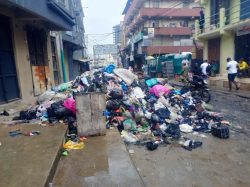
Lagos is once again confronting a familiar environmental crisis: heaps of refuse are reappearing on streets, road medians, drainage channels and bus stops across the metropolis despite repeated government interventions and promises of improved waste collection.
Findings from communities including Igando, Odo-Eran, Egbeda, Iyana-Ipaja, Idimu and other parts of Alimosho indicate that the problem is not simply indiscriminate dumping.
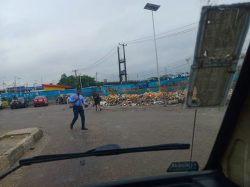

Interviews with residents, waste operators and community stakeholders point to a deeper breakdown involving delayed collection, inadequate equipment, rising operating costs, disposal bottlenecks and weak compliance by some residents and operators.
The crisis has become sufficiently serious for Governor Babajide Sanwo-Olu to declare a state of emergency on waste management after inspecting the Olusosun dumpsite in September.
He acknowledged that waste collection had slowed considerably and linked part of the problem to the inability of some Private Sector Participation (PSP) operators to meet their obligations.
The Refuse That Never Leaves
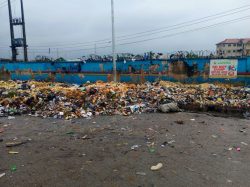
At MITV Bus Stop near the Lagos State Government Secretariat, residents and commuters have been confronted with accumulated nylons, plastic bottles and household waste around a facility intended for passengers.
Residents said the refuse had remained for weeks, creating offensive odours and turning a public space into an informal dumpsite.
Similar complaints are emerging from residential communities.
Taiwo Adewale, a resident of Alhaji Ede, said irregular collection leaves households with few options.
“Sometimes we keep our refuse for several days because the collector does not come when expected. When the waste starts smelling, people look for the nearest place to dispose of it.”
READ ALSO; Lagos waste crisis deepens as refuse heaps return to streets, roadsides
Rasheedat Balogun said affordability is another problem, particularly for low-income households.
“People know dumping in the drainage is wrong, but some families cannot continue paying when collection is not regular.”
Chief Tunde Akinola, a community leader in Idimu, said residents must accept responsibility, but government and operators must also make legitimate disposal convenient.
“We have repeatedly told people not to throw refuse into the drainage, but the government also needs to make proper disposal convenient.”
The Operators’ Side of the Story
Waste operators say the economics of collection have changed dramatically.
Joseph Edet, a PSP operator serving parts of Egbeda and Iyana-Ipaja, said fuel, vehicle maintenance, spare parts and the distance to disposal facilities are affecting collection schedules.
“Fuel, maintenance and the distance to disposal points affect what we spend on every trip. When trucks are delayed or roads are difficult to access, collection schedules suffer.”

His explanation is consistent with concerns previously acknowledged by waste-management authorities. LAWMA says inadequate numbers of compactors, difficulties collecting service charges and poor road infrastructure are among the challenges affecting the PSP system.
A June report also found residents complaining about weeks-long collection delays while PSP operators sought higher fees, citing diesel, maintenance and logistics costs.
A System Under Pressure
The numbers reveal the scale of the challenge.
LAWMA reported evacuating 418,500 tonnes of waste in May 2026—an average of about 13,200 tonnes daily. Yet the continuing accumulation of refuse demonstrates that evacuation capacity is struggling to keep pace with waste generation and operational disruptions.
LAWMA’s own documentation identifies insufficient compactors, poor road infrastructure, difficulty collecting waste-service charges and residents’ waste-handling practices as threats to efficient collection.
The agency has also taken enforcement action against operators. In May, LAWMA withdrew licences from underperforming PSP operators and realigned collection routes in areas where waste generation had increased.
But removing weak operators does not immediately solve the capacity gap. It can also create transitional problems if replacement operators lack the trucks and resources required to absorb additional routes.
The Dumpsite Bottleneck
One of the most revealing aspects of the latest crisis is what happens after refuse has been collected.
READ ALSO; Lagos Waste Crisis: Sanwo-Olu declares ‘Small State of Emergency’, orders 160 new trucks
Sanwo-Olu said trucks have faced slow turnaround at disposal sites, meaning collection vehicles can spend hours waiting to discharge their loads instead of returning to residential areas for another trip. Reports indicate that the state has been receiving roughly 250 to 350 waste trucks daily at Olusosun and wants to raise capacity to between 350 and 450.

The governor has ordered measures including road rehabilitation around dumpsites, additional tipping points and the procurement of 160 new compactor trucks. The state also plans additional transfer-loading and material-recovery infrastructure.
These measures address an important part of the problem, but they raise another question: How long will it take before the additional capacity reaches the streets where residents are currently living with accumulated waste?
Residents Are Part of the Problem Too
Stakeholders also caution against placing the entire responsibility on government.
LAWMA’s framework specifically identifies the attitude of Lagos residents toward waste handling as a challenge.
Director of Environmental Health Services for Alimosho Local Government, Mrs Odu Elizabeth Olubusola, said residents must also take responsibility for maintaining clean communities.
Indiscriminate dumping can quickly undermine collection efforts. A cleared roadside can become another illegal dump within days when households and businesses dispose of waste outside approved arrangements.
This creates a vicious cycle: delayed collection encourages illegal dumping; illegal dumping increases the volume of waste in unauthorised locations; and the resulting congestion makes environmental enforcement more difficult.
Is the PSP Model Working?
The deeper question is whether Lagos’ public-private waste collection model is sufficiently resilient for a rapidly expanding megacity.
LAWMA says the PSP system has operated in Lagos for decades and is built around designated service areas and operators selected according to technical capacity.
But the current crisis has exposed weaknesses at several points in the chain—collection, financing, truck availability, road access, disposal capacity and enforcement.
The Lagos State Government has therefore begun discussing reforms with waste operators. In August, LAWMA and the Association of Waste Managers of Nigeria agreed to develop a reform agenda aimed at creating a more sustainable and accountable PSP sector.
The Question Lagos Must Answer
The return of refuse to Lagos streets is therefore not the result of a single failure.
It is a chain problem.
If households dump indiscriminately, collection becomes harder. If operators lack functional trucks, waste remains at homes. If trucks cannot access or quickly discharge at dumpsites, collection schedules collapse. If disposal infrastructure is inadequate, more pressure is transferred back to the streets. And if supervision and enforcement fail, the cycle becomes permanent.
Sanwo-Olu’s emergency intervention—160 new compactors, improved dumpsite access, additional disposal capacity and planned transfer stations—could address some of these weaknesses.
But residents interviewed for this report want to know when those interventions will translate into a basic service they can see every day: a waste collector arriving when promised, refuse leaving their streets on schedule and public spaces remaining free of illegal dumps.
Until that happens, Lagos’ recurring waste crisis will remain less a problem of clearing refuse than a question of whether the entire collection-and-disposal system is capable of keeping pace with the city it is supposed to serve.