Latest
The Politics of influence: Examining claims of powerful cabals around Tinubu
Fresh claims that multiple power blocs are operating within President Bola Tinubu’s administration have reignited a long-running national conversation about the influence of unelected actors in Nigeria’s seat of power, raising questions about transparency, decision-making and the phenomenon political scientists describe as “state capture.”
The latest indication came from author and public affairs analyst Charles Omole, who claimed that no fewer than five distinct power centres exist within the Presidency, each allegedly wielding significant influence over government appointments and policy direction.
Omole made the assertions during an appearance on Channels Television’s Politics Today, just days after unveiling his book, From Soldier to Statesman – The Legacy of Muhammadu Buhari, in Abuja.
However, his remarks remain personal opinions and analyses. Neither the Presidency nor any of the individuals mentioned has publicly responded to the allegations, and no independent evidence has been presented to substantiate the existence of the alleged factions.
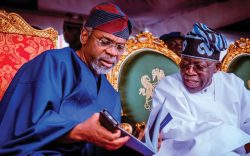

The Anatomy of Alleged Power Blocs
According to Omole, every administration naturally has advisers and trusted associates surrounding the president, but he argued that systems should exist to prevent excessive concentration of influence in the hands of informal groups.
READ ALSO: Tinubu reshuffles key agencies, appoints Fayose, Ex-lawmakers, others to strategic boards
“The president will always have people around him. But you need to put systems in place to avoid state capture or presidential capture because, for example, the current government has, from what I can see, at least five cabals within the presidency,” he said.
He further claimed that one of those groups is effectively led by President Bola Tinubu himself.
Based on his analysis, Omole identified what he described as several influential circles, including one allegedly centred around the Chief of Staff to the President, Femi Gbajabiamila, which he claimed includes Federal Capital Territory Minister Nyesom Wike and National Security Adviser Nuhu Ribadu.
He also alleged the existence of another bloc associated with Seyi Tinubu, the President’s son, comprising individuals he claimed benefited from appointments facilitated through his influence.
A separate group, according to Omole, revolves around First Lady Oluremi Tinubu.
Beyond naming the alleged factions, Omole did not present documentary evidence or official records supporting the claims, nor did he specify the identities of the remaining alleged groups.
What Is a Political Cabal?
The term “cabal” has become one of Nigeria’s most enduring political expressions.


It generally refers to a small, influential group of individuals believed to exercise significant power behind the scenes, often outside formal constitutional structures.
Although the word frequently dominates political discourse, governance experts note that proving the existence of such networks is considerably more difficult than alleging them.
READ ALSO: Tinubu hails Wike’s transformation of Abuja after 31-day project commissioning marathon
In democratic systems, presidents naturally rely on trusted advisers, cabinet members and political allies.
The challenge, according to constitutional scholars, lies in distinguishing legitimate advisory structures from informal networks that allegedly exercise disproportionate influence without public accountability.
The Buhari Parallel
Omole extended his criticism to the administration of former President Muhammadu Buhari, arguing that similar allegations of behind-the-scenes influence characterised that government.
According to him, despite Buhari’s well-known habit of reading newspapers daily, there were persistent reports that individuals around the former president allegedly curated specially prepared versions of newspapers containing selected stories.
The allegation has circulated in Nigeria’s political space for years but has never been officially substantiated.
No conclusive public evidence has emerged to establish that Buhari routinely received altered newspaper editions.
The former president, who governed Nigeria from 2015 to 2023, died in London on July 13, aged 82.
Why Informal Power Networks Matter
Political analysts say discussions about informal centres of influence extend beyond personalities.
They touch on broader issues of governance, institutional strength and democratic accountability.
Where decision-making becomes concentrated within unelected circles, experts argue, formal institutions risk becoming weakened.
Such arrangements can create uncertainty regarding who truly shapes government policy and how major national decisions are reached.
Conversely, analysts caution that every administration inevitably develops trusted inner circles, making it important not to confuse political proximity with unconstitutional influence.
Experts Offer Different Perspectives
Political scientist Prof. Jideofor Adibe says allegations of presidential cabals are not unique to the Tinubu administration.
According to him, virtually every Nigerian government has faced similar claims because political power naturally attracts competing centres of influence.
“Every presidency has an inner circle. The important question is whether formal institutions remain strong enough to ensure that decisions are taken through established constitutional processes rather than through informal networks.”
Constitutional lawyer Mike Ozekhome (SAN) has repeatedly argued in public interventions that democratic governance depends on institutional supremacy rather than individual influence.
According to him, the effectiveness of government should be measured by whether constitutional procedures guide appointments and policy implementation.
READ ALSO: Rotimi Amaechi walked into a political trap in ADC—Wike
Governance analyst Dr. Muda Yusuf, Chief Executive Officer of the Centre for the Promotion of Private Enterprise (CPPE), believes investor confidence depends more on policy consistency than on political speculation.
“Investors pay close attention to policy stability, institutional credibility and implementation. Discussions about internal political influence become significant only if they begin to affect governance outcomes and economic policy.”
Similarly, public affairs analyst Prof. Sylvester Odion Akhaine notes that perceptions of informal power often emerge where transparency around government decision-making is limited.
He argues that greater openness regarding appointments, policy formulation and executive processes could help reduce speculation surrounding alleged power blocs.
A Familiar Conversation in Nigerian Politics
The debate over presidential cabals has resurfaced under successive administrations—from the military era through civilian governments led by Olusegun Obasanjo, Umaru Musa Yar’Adua, Goodluck Jonathan, Muhammadu Buhari and now Bola Tinubu.
While the names and personalities may change, the underlying questions remain remarkably consistent: Who truly influences presidential decisions? How transparent are the mechanisms of executive power? And how can democratic institutions ensure that governance remains accountable to the Constitution rather than to informal networks?
As Nigeria continues to strengthen its democratic institutions, analysts say the answers to those questions will remain central to public trust in government and the credibility of its democratic processes.