Crime
The Secret warehouse: Inside one of Edo’s biggest drug seizures
A quiet residential building along Benin City’s busy Sapele Road had allegedly become the centre of a sophisticated narcotics distribution network—until intelligence gathered by operatives of the National Drug Law Enforcement Agency (NDLEA) brought the operation to an abrupt end.
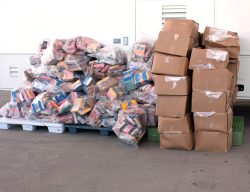
The discovery of more than 412 kilograms of cannabis products, including high-grade synthetic cannabis popularly known as Canadian Loud, has not only resulted in the arrest of a husband and wife but has also exposed the evolving tactics of drug traffickers who increasingly conceal large-scale operations within residential neighbourhoods.
The Edo State Command of the NDLEA described the seizure as one of its largest drug interceptions in the state this year, highlighting the growing challenge posed by illicit drug trafficking networks operating across Nigeria.

Intelligence Operation Leads to Residential Warehouse
According to the Edo State Commander of the NDLEA, Mitchell Ofoyeju, the operation followed credible intelligence indicating that a couple had converted their residence into a storage and distribution centre for illegal drugs.
READ ALSO; NDLEA declares four wanted over Imo meth lab, freezes N9.84bn in drug proceeds
Acting on the intelligence, NDLEA operatives raided the property located along Sapele Road in Benin City, where they arrested Christian Chukwuka, 32, and his wife, Nwanneka Christian, 33, both natives of Ndokwa in Delta State.
Investigators allege that the residence served as a warehouse from which narcotics were stored and distributed to different destinations.
During the search, officers recovered 22 bags of skunk cannabis weighing 219.5 kilograms, alongside compressed blocks of Canadian Loud weighing 192.67 kilograms, bringing the total quantity of seized drugs to 412.17 kilograms.
Authorities believe the volume recovered suggests an operation extending beyond street-level retailing, although investigations are continuing to determine the full scope of the alleged distribution network and identify other possible collaborators.
A Growing Threat Hidden in Residential Communities
The latest seizure underscores an emerging trend identified by anti-narcotics agencies—drug traffickers increasingly using residential buildings rather than isolated warehouses to evade law enforcement detection.
Security analysts say such tactics make enforcement more challenging because illicit storage facilities are concealed within ordinary neighbourhoods, reducing suspicion while facilitating easier distribution.
READ ALSO; NDLEA nabs South African woman With 5.75kg heroin at Abuja Airport
The NDLEA has in recent years intensified intelligence-led operations targeting such hidden networks across Nigeria as traffickers continue to adapt their methods.
Commander Ofoyeju said the agency remains committed to dismantling drug trafficking organisations operating within Edo State.
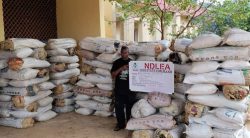

“Our efforts to combat drug trafficking remain unwavering. We will thoroughly investigate this case and ensure that justice is served,” he said.
Poverty or Criminal Enterprise?
One of the more striking aspects of the case was the explanation offered by one of the suspects.
According to the NDLEA, Christian Chukwuka admitted participating in the alleged drug trade, attributing his involvement to unemployment and financial hardship.
The suspect, who described himself as a secondary school graduate and truck driver, claimed he was introduced to drug trafficking by a friend after struggling to secure stable employment.
He said the responsibility of raising twin children compounded his financial difficulties.
“I am a secondary school graduate and a truck driver, but joblessness made a friend introduce me to drug trafficking. My wife and I have twins to cater for and the financial pressure was too much. If given another chance, I will not go back to drugs,” he was quoted as saying.
His statement has once again brought into focus the complex relationship between economic hardship and organised crime in Nigeria.
READ ALSO; NDLEA seizes 43,980 Tramadol capsules hidden in vehicle fuel tanks
However, criminologists caution that while unemployment may increase vulnerability to recruitment by criminal networks, it does not excuse violations of the law.
Experts Raise Concern Over Synthetic Cannabis
Drug policy experts say the recovery of Canadian Loud, a highly potent form of cannabis, reflects changing patterns in Nigeria’s illegal drug market.
Unlike traditional cannabis, synthetic or highly concentrated cannabis products often command higher prices and are associated with stronger psychoactive effects.
According to public health experts, the increasing circulation of such substances poses heightened risks, particularly among young people, including addiction, mental health disorders and behavioural problems.
Security experts also warn that proceeds from narcotics trafficking frequently finance broader organised criminal activities.
Commander Ofoyeju confirmed that investigations are ongoing to determine the source of the seized narcotics, identify additional suspects and establish whether the operation was linked to a wider trafficking syndicate.
He added that the couple would be charged to court upon the conclusion of investigations.
The NDLEA maintained that the seizure represents one of the agency’s most significant operations in Edo State this year and reaffirmed its determination to dismantle drug trafficking networks operating within local communities.
As investigations progress, the case is expected to provide further insight into the structure, financing and distribution channels of illicit drug operations in the state, while reinforcing ongoing efforts to curb the growing threat posed by narcotics trafficking across Nigeria