
Latest
Buhari’s exit reshapes 2027 political landscape amid rising opposition to Tinubu, APC

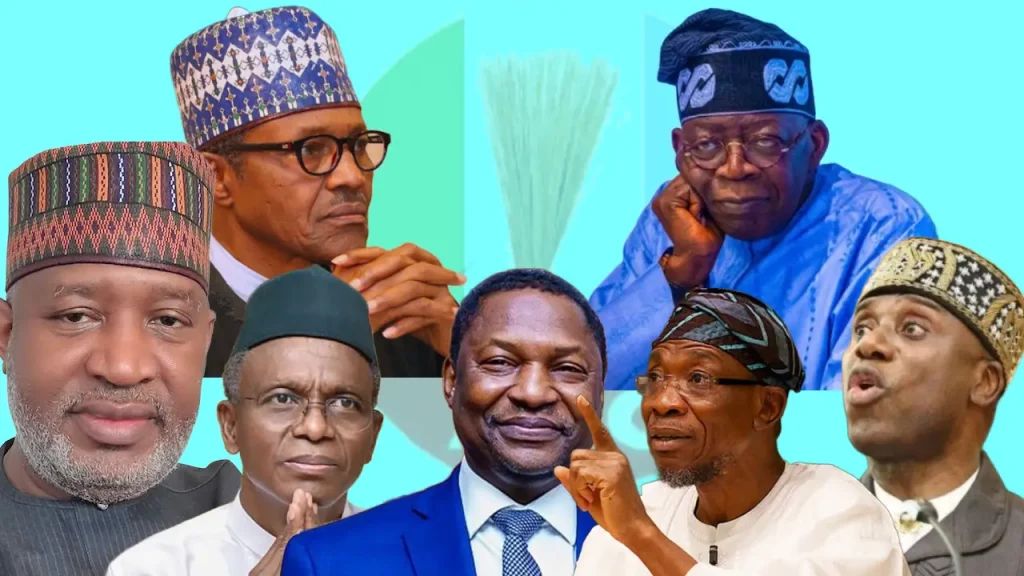
As Nigeria mourns the passing of former President Muhammadu Buhari, political watchers are turning their gaze to the ripple effects his absence will have on the 2027 general elections.
President Bola Ahmed Tinubu and the ruling All Progressives Congress (APC) are now confronted with the challenge of navigating an electoral terrain without Buhari’s formidable political influence—a man widely regarded as the rallying point of the northern electorate.
The timing of Buhari’s death coincided with the formal unveiling of a new opposition coalition under the African Democratic Congress (ADC), comprising prominent figures such as former Vice President Atiku Abubakar, former Governors Rotimi Amaechi and Nasir El-Rufai, as well as Labour Party’s 2023 presidential candidate, Peter Obi. This coalition has vowed to unseat Tinubu in the next general election.
Buhari, who contested the presidency five times between 2003 and 2019 and won twice (2015 and 2019), consistently garnered a loyal voter base—famously delivering over 12 million votes from his northern stronghold in nearly every contest.
His enduring appeal, particularly in the core north, was instrumental in the APC’s emergence and subsequent electoral victories. Analysts now believe his departure leaves a critical vacuum that could destabilize the party’s traditional vote bank.
Speaking on Channels Television during Buhari’s burial broadcast, APC chieftain and Pro-Chancellor of the Federal University of Transportation, Daura, Wahab Owokoniran, acknowledged the gravity of the loss.
“There’s no doubt this is going to be a big loss,” he said. “But Tinubu is a master strategist who has built political bridges across the country for 39 years. As president, he will consolidate those bridges.”
Owokoniran expressed confidence in Tinubu’s ability to steer the party through the turbulence. “We will lose some, but we will also gain some. Nature does not accommodate a vacuum. After Yar’Adua, Buhari emerged. Someone else will rise again,” he said.
However, opposition voices argue that Buhari’s absence fundamentally alters the dynamics, especially in the north.
Salihu Lukman, a member of the newly formed ADC coalition and former APC National Vice Chairman, described Buhari as one of the most influential political figures in Nigeria’s recent history.
READ ALSO: How Malami advised Buhari against signing Constitution amendment on Judges retirement pensions
“His popularity helped consummate the APC merger. Many northern politicians rode on his endorsement to victory, making them lazy and detached from citizens,” Lukman said during an appearance on Channels TV’s Politics Today.
“Now that Buhari is gone, no such figure exists. Politicians must relate to the electorate with humility if they hope to win.”
Lukman added that the ADC coalition is determined not to replicate the mistakes of the APC, noting that any new alliance must prioritize internal cohesion and accountability from formation through to governance.
Public Affairs Analyst and Communication scholar at Peaceland University, Enugu, Dr. Nduka Odo, offered a critical perspective.
He argued that Buhari’s departure could spell disaster for the APC if not carefully managed, especially given the stature of the figures now aligning with the ADC.
“With Atiku, Amaechi, and El-Rufai in the ADC, the cracks within APC are widening,” Odo stated. “The CPC bloc of Buhari and the newPDP bloc have essentially left the party, leaving Tinubu and the remnants of ACN to hold the fort.”
Odo also referenced historic tensions within the APC, citing the fallout from then-Vice President Yemi Osinbajo’s decision to contest the APC ticket in 2022, allegedly against Buhari’s tacit wishes.
“It appeared Buhari wanted to renege on any gentleman’s agreement with Tinubu, and that rift was never fully healed,” he said.
He further emphasized that while Buharists may remain loyal to his memory, two critical factors threaten APC’s northern dominance:
The economic hardship wrought by Buhari’s administration worsened under Tinubu’s leadership.
The emergence of northern contenders within ADC competing to be the region’s new political darling.
“We saw videos of people in the north celebrating Buhari’s death. That tells you the disillusionment. A hungry electorate does not remember legacy; they remember pain,” Odo remarked.
“Unless APC can present Buhari as an eternal figurehead and symbol of their vision, they may struggle to retain his base.”
Odo also raised concerns over perceived internal strife in Aso Rock. “There’s talk of Vice President Shettima being sidelined, and speculations that Tinubu may drop him in 2027. The recent scuffle at the APC North-East convention reflects these deepening divides,” he said.
The scholar condemned the timing of a video released by presidential aide Bayo Onanuga highlighting Tinubu’s role in Buhari’s political rise. “It was in poor taste to drop that on the same day Buhari was being buried. It signals deeper tensions and poor optics within the presidency,” he added.
As the race to 2027 unofficially begins, it is clear that the passing of Muhammadu Buhari has not just marked the end of an era—it has reshuffled the nation’s political deck.
For Tinubu and the APC, the challenge is not only to fill the vacuum but to redefine their message, consolidate their ranks, and neutralize the growing threat of a unified opposition.


-

 Featured1 week ago
Inside INEC’s race to prepare for Nigeria’s 2027 elections
-
 Featured1 week ago
2027: APC unveils nationwide campaign timetable, Tinubu to rally in 12 states
-
 Business4 days ago
Naira faces exchange rate gap as Dollar hits N1,380 on parallel market
-

 Business1 week ago
Court dismisses ₦170m Trade Fair contract claim, says Zenith Bank was not a party
-

 Latest1 week ago
Breaking: NNPCL raises petrol price to ₦1,405 per litre amid discount controversy
-
 Featured1 week ago
From kitchen to Supreme Court: Nigerian’s fight over alleged support for terrorists
-

 Business6 days ago
NCC launches Internet Governance Working Group to tackle AI risks, boost online safety
-
 Football1 week ago
Maresca reveals Guardiola’s reaction to Man City’s 4-2 defeat to PSG