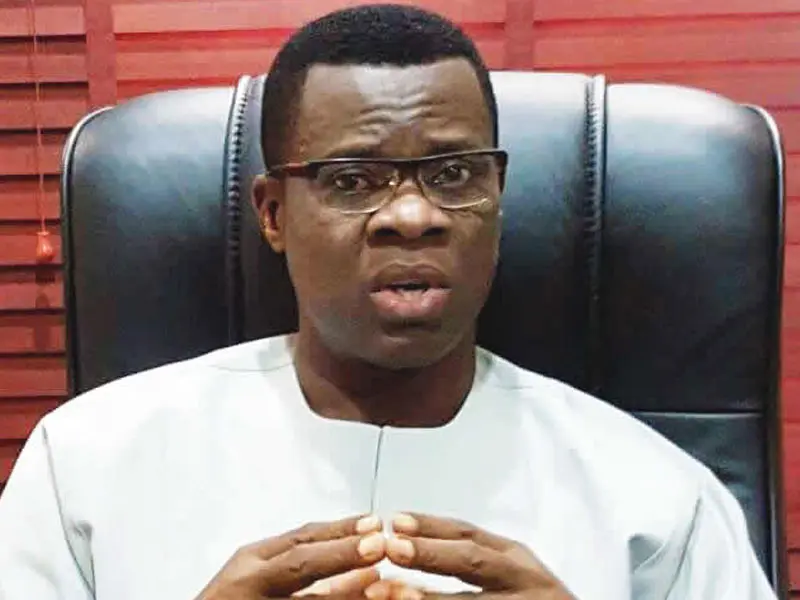
Former Resident Electoral Commissioner of the Independent National Electoral Commission (INEC), Mike Igini, has revealed that as far back as 2018, a joint technical committee of INEC and the Nigerian Communications Commission (NCC) confirmed that 93 per cent of Nigeria’s polling units had telecommunications coverage.
Igini made the disclosure while speaking on Politics Today on Channels Television, insisting that the electoral commission had long completed much of the technical groundwork needed for electronic transmission of results.
According to Igini, polling units were mapped to specific network providers, and INEC invested significant resources preparing infrastructure for real-time electronic transmission.
“Polling units were mapped to network providers, and the commission incurred substantial costs. The commission was ready,” he stated.
His comments directly challenge claims by the Nigerian Senate that inadequate network coverage makes electronic transmission impractical, particularly in rural areas.
Igini argued that the data generated by the INEC-NCC technical committee contradicts assertions that connectivity remains a major barrier.
While acknowledging the importance of reliable connectivity, Igini maintained that the core obstacle to electronic transmission has always been legal rather than technological.
He pointed to Section 52 of the 2010 Electoral Act, which prohibited electronic processes in elections. According to him, INEC formally requested the National Assembly to amend the provision in 2012 to allow electronic transmission, but the request was rejected — effectively stalling reform efforts at the time.
READ ALSO: Presiding officers exposed to risk’ – Igini warns on impact of controversial Electoral Act Bill
“The issue was never about technology alone. The law tied the hands of the commission,” Igini explained.
Political analysts note that this clarification reframes the long-running debate about electronic transmission, suggesting that institutional and legislative constraints have played a larger role than infrastructure gaps.
Looking ahead to the 2027 general elections, Igini warned that inconsistencies between proposed amendments by the Senate and the House of Representatives regarding electronic transmission could create confusion if not harmonised.
“If the legal provisions are not clear and consistent, it could open the door to post-election disputes,” he cautioned.
Electoral law experts say conflicting interpretations of transmission rules could complicate litigation and undermine public confidence in the electoral process.
Igini also stressed the need to provide explicit legal backing for the INEC Result Viewing Portal (IREV), the digital platform introduced to enhance transparency by allowing public access to uploaded polling unit results.
He argued that results uploaded to IREV should form part of the statutory electoral record. In cases where discrepancies arise between manually collated results and electronically uploaded copies, he suggested that the electronic version should prevail to protect electoral credibility.
“Without clear statutory recognition, disputes over electronically uploaded results will continue to generate controversy,” he noted.
Igini concluded that the judiciary will play a decisive role in determining whether electoral reforms strengthen democracy or deepen instability, depending on how courts interpret and uphold electoral laws.
Legal analysts agree that the credibility of electronic transmission ultimately depends not only on infrastructure and legislation but also on consistent judicial interpretation.
Igini’s intervention shifts the narrative around Nigeria’s electoral reforms, suggesting that technological capacity may no longer be the primary constraint. Instead, clarity in legislation, institutional alignment, and judicial consistency may determine whether electronic transmission becomes a stabilising force or a source of renewed contention in 2027.



 Maritime1 week ago
 Football7 days ago
 Latest7 days ago
 Latest1 week ago
 Health7 days ago
 Energy6 days ago
 Energy6 days ago
 Comments and Issues6 days ago