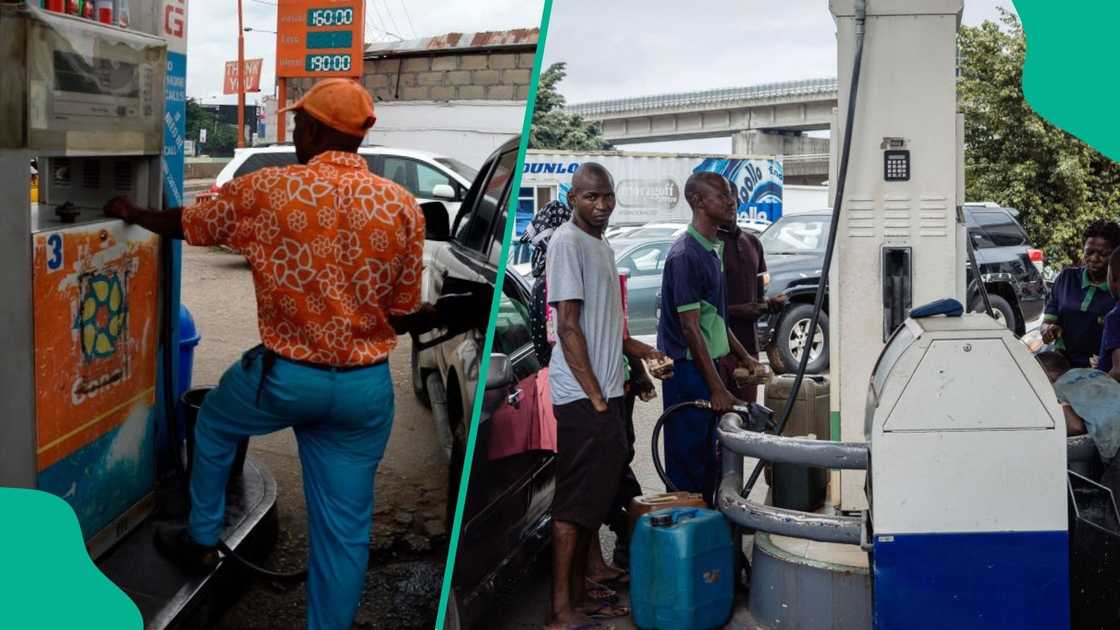
Motorists and commuters across Lagos are grappling with rising transportation costs following another sharp increase in petrol prices, with Premium Motor Spirit (PMS) now selling between N1,250 and N1,350 per litre at filling stations across the metropolis.
A survey conducted on Sunday revealed growing anxiety among road users as the sustained price hikes continue to push up daily commuting expenses. The latest surge follows an upward review by Dangote Petroleum Refinery, which raised its gantry price to N1,175 per litre from N995 earlier in the week.
The N180 increase—about 18.1 percent within three days—marks the refinery’s third price adjustment in one week and has triggered swift changes across the downstream petroleum market.
Industry sources attribute the spike partly to escalating geopolitical tensions in the Middle East, especially the standoff between Israel and Iran, as well as attacks linked to Yemen’s Houthi movement in the Red Sea shipping corridor.
These developments have forced many oil tankers to reroute, driving global freight costs up by about 40 percent, according to market data.
At the same time, international crude oil prices have climbed, with Brent crude approaching 99 dollars per barrel.
Analysts say the weak naira—trading at roughly N1,650 to the dollar—has further amplified domestic fuel costs, even as Nigeria continues to rely heavily on imported refined products despite local refining efforts.
A spokesperson for the refinery, Anthony Echiejina, said the price adjustment reflects rising feedstock and logistics costs tied to global energy market developments.
READ ALSO: NNPCL cuts petrol price by N95 after Dangote Refinery reduces Gantry rate
Retail prices have climbed across numerous stations in Lagos, with significant variations depending on location and supply arrangements.
MRS Oil Nigeria Plc and Matrix Energy Group outlets sell petrol at about N1,250 per litre. Ardova Plc (formerly AP) stations retail the product at roughly N1,300 per litre. Several independent outlets dispense fuel close to N1,200–N1,350 per litre across the city.
Stations in areas such as Gbagada, Alimosho, Iyana Ipaja, and along the Oshodi–Abeokuta Expressway reported prices hovering around N1,250 per litre, with some locations charging as high as N1,350.
Market insiders say pricing differences are increasingly influenced by supply chains, particularly whether products are sourced via coastal marine deliveries or direct gantry loading.
The price surge has already translated into higher transport fares across Lagos, with commuters reporting increases exceeding 30 percent on several routes.
Commercial driver Mr. Sodiq Olarenwaju said operators have little choice but to adjust fares.
“We are the ones passengers blame for increasing fares, but they don’t realise how much we now spend on petrol. If we buy fuel at over N1,000 per litre, we have no option but to adjust fares,” he said.
Motorists also described the difficulty of securing fuel amid fluctuating supplies. Mrs. Funke Oladipo said she spent hours searching for petrol.
“I have been driving around since morning with my jerry can looking for fuel. Some stations that opened earlier have already shut their gates,” she said.
Dr. Adewale Suleiman, a private car owner, noted that fuel price hikes typically trigger broader economic effects.
“When fuel goes up, transport fares rise and the prices of goods follow immediately,” he said.
Chief Executive Officer of the Centre for the Promotion of Private Enterprise, Muda Yusuf, warned that geopolitical instability in key oil-producing regions often leads to volatility in global markets.
He explained that disruptions in the Strait of Hormuz—through which about 20 percent of global crude shipments pass daily—can quickly raise oil prices, shipping costs, and insurance premiums worldwide.
According to Yusuf, higher fuel costs could severely impact industries reliant on energy and transportation, particularly manufacturers that depend on diesel-powered generators due to unreliable electricity supply.
“As manufacturers absorb higher energy and logistics costs, firms may adjust pricing structures or production levels,” he said, warning of potential inflationary pressures.
He added that Nigeria may not fully benefit from higher oil prices because crude production remains below capacity, fluctuating between 1.4 million and 1.6 million barrels per day.
The CPPE recommended boosting crude output, strengthening fiscal buffers, expanding domestic refining capacity, sustaining foreign exchange reforms, and providing targeted support for vulnerable households.



 Business3 days ago
 Crime1 week ago

 Comments and Issues6 days ago
 Energy6 days ago
 Business6 days ago
 Business1 week ago
 Health1 week ago