
Latest
2027 presidency: SERAP Challenges Tinubu, Atiku, Obi, 16 others to declare assets

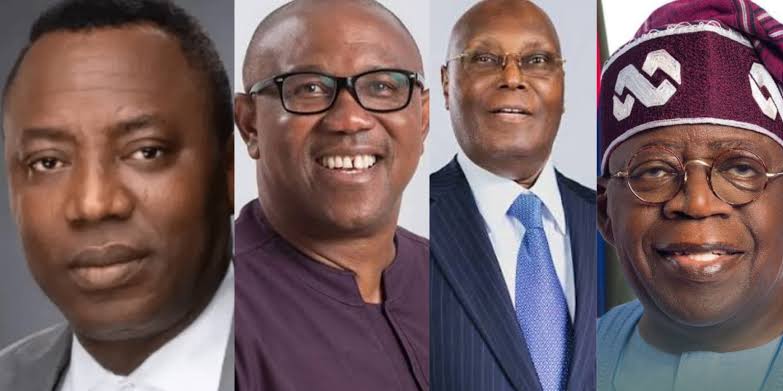
The Socio-Economic Rights and Accountability Project (SERAP) has challenged the 19 presidential candidates cleared by the Independent National Electoral Commission (INEC) for the 2027 general election to publicly disclose their assets and liabilities and commit themselves to rejecting vote-buying.
The organisation also called on the candidates to disclose the assets and liabilities of their spouses and, where applicable, unmarried children below the age of 18, as well as explain the legitimate sources of their significant assets.
SERAP made the demands in an open letter dated August 8, 2026, signed by its Deputy Director, Kolawole Oluwadare.
The organisation said candidates seeking to control Nigeria’s public finances, natural resources, appointments and security institutions should be willing to subject their financial affairs to reasonable public scrutiny before asking citizens to entrust them with political power.
Tinubu, Atiku, Obi, others among candidates
Among the presidential candidates listed by SERAP are President Bola Tinubu of the All Progressives Congress (APC), Atiku Abubakar of the African Democratic Congress (ADC), Peter Obi of the New Democratic Congress (NDC), Sandy Onor of the Peoples Democratic Party (PDP), Omoyele Sowore of the African Action Congress (AAC), Donald Duke of the Peoples Redemption Party (PRP), and Seyi Makinde of the Accord Party Movement (APM).
Others are Okwori Ada Elizabeth Frederick of the National Democratic Party (NDP), Chukwu Anita Zugwai of the Young Progressive Party (YPP), Rufai Adekunle Omoaje of the Action Alliance (AA), Adenuga Sunday of the Boot Party, Memeh Samuel of the Democratic Leadership Alliance (DLA), Nwanyanwu Daniel Danerechukwu of the Zenith Labour Party (ZLP), Okereke Sunday Chibuzor of the Labour Party (LP), Okereke Iken Esther of the National Rescue Movement (NRM), Abbas-Bin Aliyu of the Action Democratic Party (ADP), Dikwa Suleiman Mohammed of the New Nigeria Peoples Party (NNPP), and Adebayo Adewole Ebenezer of the Social Democratic Party (SDP).
Why SERAP wants pre-election asset declarations
READ ALSO; SERAP demands probe of alleged N6.79bn Police Fund diversion, missing firearms
SERAP said the candidates should voluntarily adopt higher standards of transparency, accountability and integrity, even where existing laws do not expressly require them to publicly release their asset declarations before an election.
The organisation argued that voluntary disclosure would allow voters to assess potential conflicts of interest and understand the legitimate sources of candidates’ significant wealth.
It said such disclosures would also establish a baseline against which changes in a candidate’s assets could be monitored if the person eventually wins the presidency.
“Nigeria’s democracy belongs to its citizens. Votes must not be bought. Public office must not be treated as private property,” SERAP said.
The organisation said Nigerians should be able to make their electoral choices based on policies, competence, integrity, character and vision, rather than the financial strength of individual candidates.
Constitution already requires asset declaration
SERAP acknowledged that the 1999 Constitution, as amended, does not expressly require presidential candidates to publicly publish their asset declarations before an election.
However, it argued that the Constitution contains broader principles of transparency, accountability and integrity applicable to public office holders.
The organisation cited Paragraph 11 of Part I of the Fifth Schedule, which requires public officers to declare their properties, assets and liabilities, including those belonging to unmarried children below 18.
It also referenced Section 140(1), which requires a person elected President to make the prescribed declaration before assuming the functions of office.
READ ALSO; SERAP threatens legal action against NASS over alleged N6.3bn constituency fund diversion
SERAP further relied on Article 25 of the International Covenant on Civil and Political Rights, arguing that citizens cannot meaningfully exercise their right to participate in public affairs and vote in genuine elections without access to relevant information about candidates seeking to govern them.
Group warns against vote-buying
Beyond asset disclosure, SERAP called on all the presidential candidates to publicly reject vote-buying and electoral bribery.
The organisation expressed concern over the continued use of money, gifts and other material inducements to influence voters during elections.
“An election in which citizens’ votes are purchased, coerced or otherwise financially induced cannot genuinely reflect the free political will of the Nigerian people,” it said.
SERAP cited Section 14(2)(a) of the Constitution, which provides that sovereignty belongs to the people of Nigeria, as well as Section 125 of the Electoral Act 2026, which criminalises bribery and related conduct intended to procure the return of a candidate or the vote of an elector.
According to the organisation, vote-buying becomes particularly harmful during periods of economic hardship because it exploits the financial vulnerability of citizens and risks reducing a constitutional political right to a financial transaction.
Campaign teams also targeted
SERAP urged the candidates to ensure that their campaign organisations, agents, supporters and political associates do not engage in vote-buying on their behalf.
It specifically called on the candidates to instruct their campaign teams and associates not to distribute money, food, gifts, transportation benefits or other material inducements in exchange for votes.
The organisation also urged the candidates to report credible cases of vote-buying involving members of their campaign structures to the appropriate authorities.
In addition, SERAP asked the candidates to sign a public integrity pledge committing themselves, their political parties and campaign organisations to peaceful, transparent, accountable and corruption-free elections


-
 Latest6 days ago
Israel marks 3 years since October 7 Hamas attack amid Gaza strikes, election debate
-

 Energy6 days ago
Fuel Battle: Dangote, marketers and government clash over petrol imports
-

 Energy1 week ago
Petrol, diesel prices rise 86% in 2026 as costs hit fresh highs
-

 Football7 days ago
Nigeria’s World Cup exit under spotlight as FIFA’s DR Congo files emerge
-
 Energy1 week ago
Has Iran lost control of the Strait of Hormuz? Oil flows rebound as war disruptions persist
-
 Latest7 days ago
US Court set to rule on release of FBI, DEA records on Tinubu
-

 Latest17 hours ago
Full List: Meet the 2026 Nobel Prize winners across six categories
-
 Business7 days ago
Nigerian investors at a crossroads as fixed-income yields slide