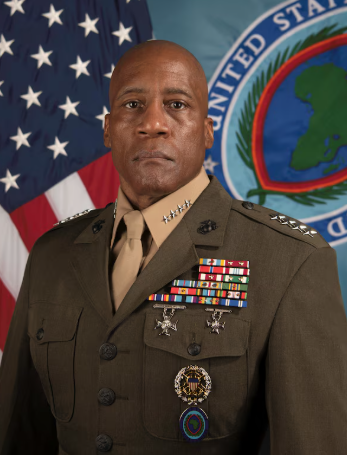
The Commander of the United States Africa Command (AFRICOM), General Michael Langley, has issued a stark warning that terrorist organizations operating in the Sahel region are making concerted efforts to expand their presence to the West African coastline.
This expansion, he cautioned, poses grave security threats not only to the immediate region but also globally.
Speaking during the African Chiefs of Defence Conference held in Nairobi, Kenya, from May 28 to 29, 2025, Gen. Langley described recent terrorist attacks in Nigeria, the Sahel, and the Lake Chad Basin as “deeply concerning.”
He highlighted that access to coastal areas would significantly enhance extremist groups’ ability to finance their operations through illicit activities such as smuggling, human trafficking, and arms trading.
Langley cited data from the 2025 Global Terrorism Index, which unequivocally identifies the Sahel as the global epicenter of terrorism.
In 2024, the region accounted for a staggering 19% of terrorist attacks worldwide and over 51% of all terrorism-related deaths, a noticeable increase from 48% in 2023. Five of the ten most-affected countries globally are located in the Sahel, with Burkina Faso particularly hard hit by ISIS and al-Qaeda-linked insurgents.
Coastal West Africa in the Crosshairs Langley specifically urged frontline coastal states—including Ghana, Côte d’Ivoire, and Benin—to fortify their northern borders against potential terrorist infiltration.
He reiterated AFRICOM’s unwavering commitment to supporting these countries’ security efforts.
“Our coastal partners are actively defending their northern frontiers. AFRICOM stands with them as they work to contain terrorist expansion,” he affirmed.
He acknowledged that the drawdown of U.S. troops in some African regions had limited direct monitoring capabilities but stressed that the U.S. remains deeply engaged through robust counterterrorism partnerships, comprehensive training programs, and critical intelligence sharing. “We go only where we are invited and where our presence aligns with U.S. national security interests,” Langley said, emphasizing a partnership-based approach.
U.S. Partnership With Nigeria Recalling his November 2024 visit to Nigeria, Langley praised the country’s military as one of the most capable in the region. He affirmed the U.S.’s steadfast commitment to supporting Nigeria’s ongoing fight against Boko Haram and ISIS West Africa.
“We continue to assist Nigeria through training, strategic coordination, and intelligence sharing. Our withdrawal hasn’t ended our engagement—it has refocused it,” he clarified.
ALSO READ :
Engaging With Sahel States and Beyond Langley noted ongoing U.S. efforts to engage Burkina Faso despite diplomatic strains, stating he invited the country’s defense chief to the Nairobi conference to sustain dialogue and maintain lines of communication.
On East Africa, he revealed that AFRICOM had intensified operations in Somalia, conducting over 25 airstrikes in 2025 alone—a significant doubling of the number carried out in the previous year—at the explicit request of the Somali government, targeting Al-Shabaab militants.
African Militaries Taking the Lead While acknowledging the growing threats, General Langley expressed strong confidence in African nations’ ability to manage their security challenges independently.
“African militaries are not waiting to be rescued—they are stepping up, confronting threats, and seizing opportunities to stabilize and develop their countries,” he stated, highlighting the increasing self-reliance and proactive measures by African forces.
He emphasized that AFRICOM’s overarching strategy is centered on “partnership, not dependence,” aiming to empower African nations to take the lead in their own security. Langley summarized AFRICOM’s core mission in three powerful words: “Peace through strength.”













 Business1 week ago
 Latest6 days ago
 Business1 week ago
 Football5 days ago
 Health1 week ago
 Business5 days ago
 Football1 week ago
 Latest1 week ago