
Business
AI: Experts at BJAN conference warn of disruptions, urge ethical adoption, human-centric skills

Published
4 months agoon
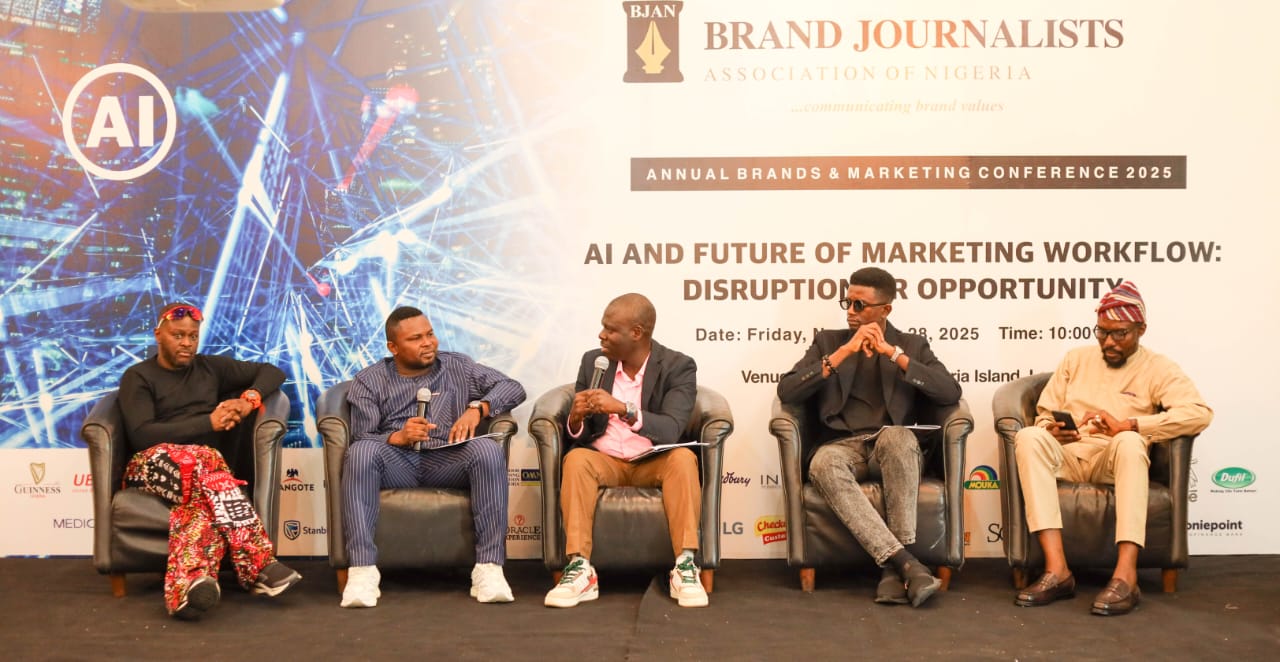
The 13th Annual Conference of the Brand Journalists Association of Nigeria (BJAN) has wrapped up in Lagos with a clear message from regulators, marketing executives, and technology experts: Artificial Intelligence is transforming the marketing and communications industry, but only professionals who understand and ethically deploy the technology will thrive.
The conference, themed “AI and the Future of Marketing Workflow: Disruption or Opportunity?”, brought together industry veterans, policymakers, and innovators who examined the sweeping changes AI is introducing to marketing practice in Nigeria and globally.
In his welcome address, BJAN Chairman Daniel Obi said the marketing and communication landscape is experiencing a “profound shift” driven by rapid advancements in AI.
He explained that AI is now central to content generation, personalised advertising, and campaign optimisation—disrupting old systems while creating new potential.
According to him, the conference theme “captures not only the excitement but also the responsibility” that comes with embracing this technology. He urged professionals to apply AI “ethically, strategically and intelligently.”
Chairman of the occasion and Group CEO of SO&U Limited, Udeme Ufot, echoed this duality, emphasizing that AI brings both disruption and opportunity.
While acknowledging that the technology challenges traditional workflows, he observed that AI creates “greater efficiency, deeper insights, faster processes and more personalised communication than ever before.”
He stressed that the key question is no longer whether AI will transform the industry, but how prepared professionals are to respond.
Ufot urged practitioners to see AI as “an enabler, not a threat,” calling for continuous skill development anchored on strong ethical standards.
Representing the Advertising Regulatory Council of Nigeria (ARCON), Dr. Susan Ngozi Agbo, who spoke on behalf of Director-General Dr. Lekan Fadolapo, highlighted the Council’s concerns over unregulated use of AI in marketing.
She noted that AI is already reshaping the marketing workflow but warned that unethical deployment could jeopardise national norms and unity.
According to her, the ethical standards in Nigeria’s advertising ecosystem are “what ensure that we all continue to be one Nigerian.”
“If AI use is unchecked,” she warned, “there will be anarchy in the system.”
Dr Agbo urged practitioners to self-censor their output to ensure it aligns with local values.
She also announced that ARCON has developed a Nigerian stock image bank to address concerns about the use of foreign AI-generated faces. Practitioners who fail to use local images must now justify their choice.
Head of Corporate Communications at Sahara Group, Bethel Obioma, reminded attendees that despite the rise of AI, the essence of communication remains rooted in human creativity.
He noted that professionals now have “an opportunity to have multiple expressions,” but insisted that the real differentiator is the “human edge,” which he said “will always trump anything else.”
Obioma argued that marketers excel by blending diverse knowledge areas into unique insights—something AI cannot replicate on its own.
Cherry Eromosele, Executive Vice President/Group Head, Marketing & Corporate Communications at Interswitch, represented by Tomi Ogunlesi, offered a strategic lens to the discussion.
She observed that journalism, advertising, media, and brand management are converging faster than ever, powered by new technologies.
Eromosele introduced the concept of the “New Marketing Trinity”, describing: Data as the fuel, Creativity as the spark, and AI as the multiplier.
She also noted that media consumption has fundamentally shifted, warning that traditional mass communication is giving way to precision-driven, personalised messaging. “Everybody’s screen has now become their network,” she said.
Providing a reality check during the panel session, Segun Umoru, Senior AI and ML Engineer at Optimus AI Labs, stated frankly that AI will displace some jobs.
“AI will take over some jobs; that’s the truth,” he said, noting that in other markets, agentic AI solutions are already replacing junior-level personnel.
Umoru projected that by 2026, Nigeria will see significant workforce changes as startups adopt lean AI-driven models for marketing, content creation, design, and web development.
Business Unit Director at +Aculty Limited, Emma Adeniran, pointed to Nigeria’s rapid AI adoption.
He explained that AI has “democratized” many aspects of marketing, raising standards and forcing professionals to “move a lot higher” to remain competitive.
The conference drew industry leaders, regulators, academics, marketing professionals, and students, all united by the shared challenge of navigating AI’s accelerating influence on marketing.
Speakers agreed that while AI promises immense value, it cannot replace human intuition, creativity, and ethical judgment—qualities they said must define the future of Nigeria’s marketing industry.

You may like
Trending

 Football1 week ago
Senegal forfeits AFCON final, CAF names Morocco 2025 Champions
 Football1 week ago
Arsenal to face Sporting as first Champions League quarter-final tie confirmed

 Comments and Issues7 days ago
Tunji Disu: A different kind of Cop

 Business1 week ago
Nigeria’s power sector collapses under N6.8trn debt burden

 Football1 week ago
Mbeumo overtakes Osimhen as Africa’s most valuable player

 Football1 week ago
Full list: Chelle drops Osimhen, Nwabali for Eagles’ friendlies
 Comments and Issues7 days ago
Let’s cut Tinubu some slack

 Health6 days ago
NAFDAC raises alarm over circulation of fake cancer drugs in Nigeria