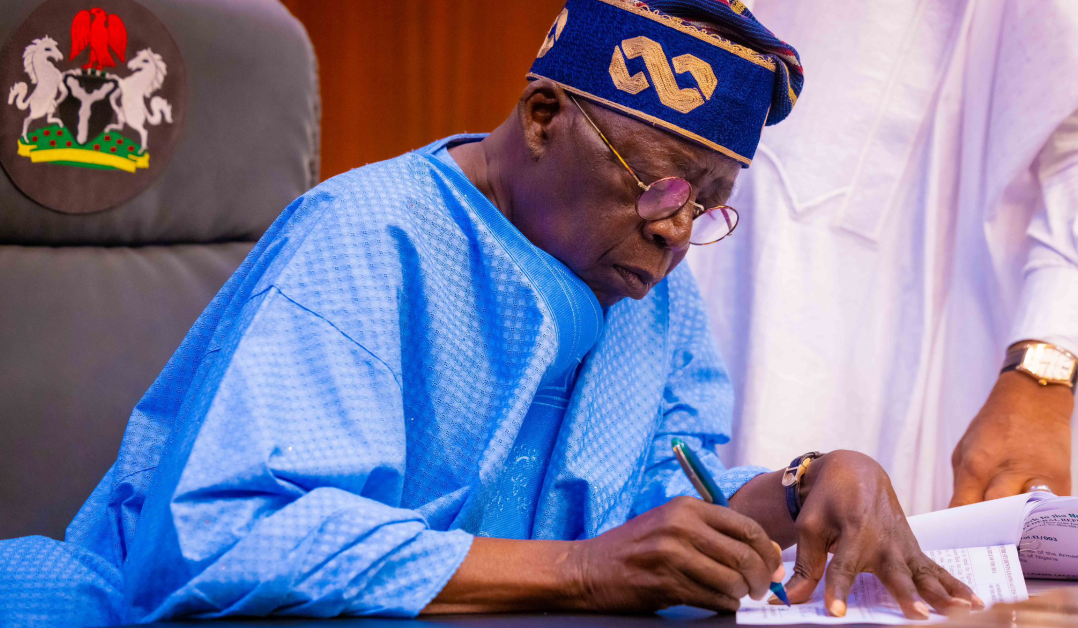
President Bola Ahmed Tinubu has officially signed into law four major tax reform bills passed by the National Assembly, marking a significant step toward overhauling Nigeria’s tax structure and strengthening revenue administration.
The presidential assent was given on Thursday during a brief but symbolic ceremony held at the Presidential Villa, Abuja.
The event was attended by Senate President Godswill Akpabio, Speaker of the House of Representatives Tajudeen Abbas, several governors, ministers, top presidential aides, and key lawmakers.
The newly signed laws include: Nigeria Tax Bill; Nigeria Tax Administration Bill; Nigeria Revenue Service (Establishment) Bill and Joint Revenue Board (Establishment) Bill
These bills were passed after months of deliberation and consultation with private sector leaders, tax professionals, civil society organizations, and international development partners.
The four tax laws are central to the Tinubu administration’s broader economic reform agenda, which focuses on improving non-oil revenue, curbing fiscal leakages, and simplifying tax compliance for businesses and individuals.
According to officials familiar with the legislation, the Nigeria Revenue Service (Establishment) Bill will replace the Federal Inland Revenue Service (FIRS) with a new, more autonomous agency, aimed at improving professionalism, transparency, and efficiency in tax collection.
The Nigeria Tax Administration Bill provides for uniform tax processes across federal and state levels, while the Joint Revenue Board Bill seeks to harmonize tax efforts between federal and subnational governments to reduce duplication and conflict.
Speaking after the signing ceremony, a senior official in the Presidency said the tax reforms are designed to increase Nigeria’s tax-to-GDP ratio, currently among the lowest in Africa.
“These reforms will boost investor confidence, make tax compliance easier, and ensure that government revenue reflects the size and potential of Nigeria’s economy,” the official noted.
READ ALSO: NACCIMA urges Tinubu to prioritize tax reforms for economic growth
Senate President Godswill Akpabio described the signing as a “historic achievement,” praising the Tinubu administration for taking bold steps to strengthen the country’s fiscal foundation.
Minister of Finance and Coordinating Minister of the Economy, Wale Edun, also lauded the development, noting that the reforms were crafted with technical support from international institutions and input from the private sector.
“We believe these laws will empower tax authorities to carry out their duties effectively while ensuring that taxpayers are treated fairly,” Edun said.
Tax professionals and economists have welcomed the development, describing it as a long-overdue modernization of Nigeria’s outdated tax framework.
Dr. Ngozi Ajayi, a taxation consultant and partner at a leading Lagos-based firm, said:
“The unification of tax processes and establishment of a central coordinating board will go a long way in eliminating duplication and boosting tax efficiency.”
However, she also urged the government to focus on implementation, noting that poor enforcement has hindered similar reforms in the past.
With these bills now signed into law, the next phase will involve setting up administrative structures, recruiting skilled personnel, and training tax officers at federal and state levels.
Analysts say if fully implemented, the reforms could significantly reduce Nigeria’s fiscal deficit and enhance funding for infrastructure, healthcare, and education.
The move signals President Tinubu’s intent to aggressively pursue domestic revenue mobilization as Nigeria seeks to reduce its reliance on oil earnings and improve fiscal sustainability.


 Latest1 week ago
 Football6 days ago
 Business6 days ago
 Latest6 days ago
 Health7 days ago
 Latest1 week ago
 Latest6 days ago
 Latest1 week ago