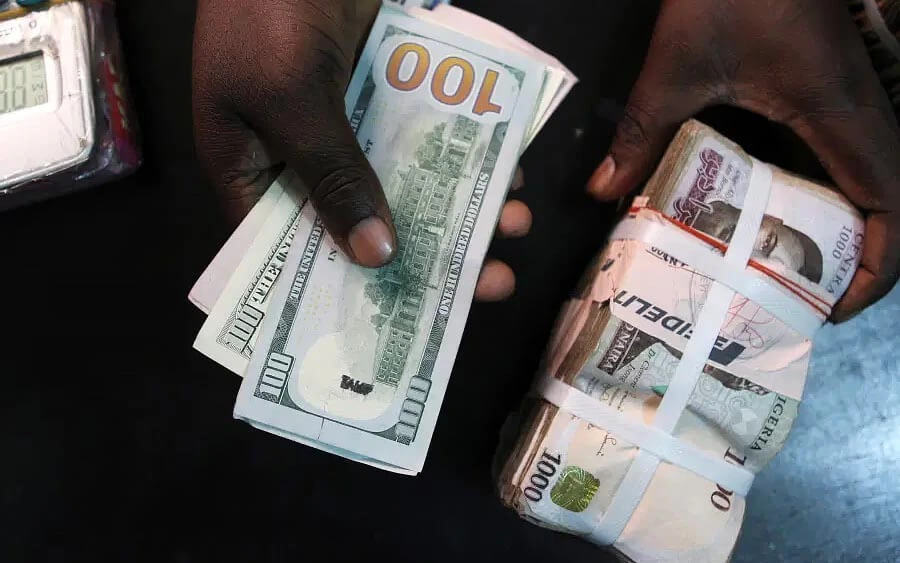
Vice-President Kashim Shettima recently asserted that the naira “would have appreciated to N1,000 per dollar in weeks” if the Central Bank of Nigeria (CBN) had not intervened — a bold claim that underscores a notable shift in Nigeria’s foreign exchange trajectory.
As of February 20, 2026, the naira traded around N1,340/$ on the parallel market, a marked recovery from previous lows beyond N1,600. Analysts say the currency is no longer in free-fall, and early signs of macroeconomic adjustment are emerging.
First was the June 2023 unification and partial float of the foreign exchange market, which collapsed multiple exchange rates into a single market-driven system.
The move eliminated arbitrage opportunities and gradually restored investor confidence, albeit at the cost of a sharp depreciation and inflation spike.
Second was the removal of the petrol subsidy in May 2023, a long-standing fiscal drain. Within two months, the government reportedly saved over N1 trillion, freeing up revenue but triggering higher transport and food costs.
“These were painful but necessary adjustments,” said financial analyst Tunde Akinyemi. “Without FX unification and subsidy removal, the naira’s current stability would not be possible.”
Vice-President Shettima described the CBN’s recent interventions as “generous,” but analysts argue the bank’s strength lies more in predictability than spectacle.
The apex bank has maintained a tight monetary stance, cleared most FX backlogs, and granted licensed Bureau De Change operators limited access to foreign currency — capped at $150,000 weekly since February 10, 2026 — to ease liquidity pressures.
READ ALSO: Naira slips to N1,359/$ after CBN’s 304th MPC cuts interest rate to 26.5%
“Monetary discipline has anchored expectations,” said economist Dr. Aisha Bello. “The CBN is signalling that it will act methodically rather than through abrupt controls.”
Nigeria’s 2026 budget, estimated at about N58 trillion with a deficit of N23.85 trillion (4.28% of GDP), reflects continued heavy borrowing. Debt servicing consumes a substantial share of government revenue, even as Federation earnings rose from N16.8 trillion in 2023 to N31.9 trillion in 2024.
“Fiscal dominance is Nigeria’s biggest structural risk,” said development economist Chinedu Okafor. “If government borrowing overwhelms monetary tightening, inflation could reaccelerate and weaken the naira again.”
Headline inflation eased slightly to 15.10% in January 2026, according to the National Bureau of Statistics, but food prices remain elevated, squeezing household incomes.
The operational expansion of the Dangote Refinery has emerged as a critical structural factor supporting the currency.
With capacity exceeding 650,000 barrels per day and ambitions to scale to 1.4 million bpd, the refinery is significantly reducing Nigeria’s dependence on imported fuel. It produces aviation fuel, naphtha, polypropylene, bitumen, LPG and other petroleum by-products, supplying between 60 and 65 million litres of petrol daily to the domestic market while exporting surplus volumes.
By cutting fuel imports, the refinery reduces FX demand and strengthens the current account balance.
“Dangote’s impact is tangible,” said energy consultant Funmi Adeyemi. “Every litre refined locally saves scarce dollars.”
While macro indicators show improvement, poverty levels remain high. The World Bank estimates that 139 million Nigerians were living in poverty as of late 2025, underscoring the gap between currency stabilisation and lived economic realities.
“Macro stability has not yet translated into kitchen-table relief,” Dr. Bello noted. “Without mass job creation and rural investment, gains will remain concentrated in urban centres.”
The naira’s rebound reflects a combination of structural reform, disciplined central banking and private-sector dynamism. Yet analysts warn that sustaining the momentum requires tighter fiscal coordination and inclusive spending.
“The recovery is real,” Akinyemi concluded. “But unless fiscal prudence and productivity reforms follow through, appreciation could remain a market statistic rather than a transformation Nigerians actually feel.”



 Football1 week ago
 Business7 days ago
 Latest1 week ago
 Health1 week ago
 Latest7 days ago
 Latest6 days ago
 Latest1 week ago
 Crime7 days ago