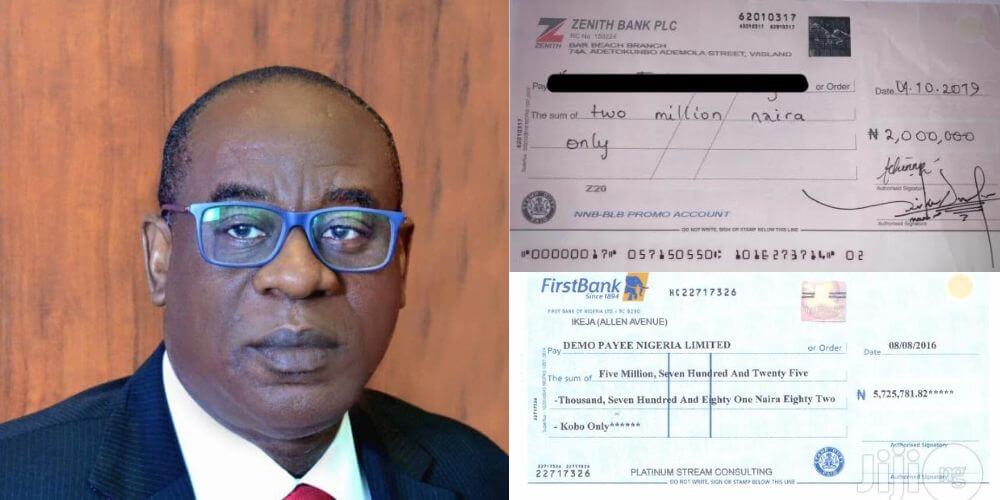
The Central Bank of Nigeria (CBN) has announced that deposit money banks and accredited cheque printers that repeatedly violate cheque production and processing standards will face penalties of up to N20 million.
The apex bank disclosed the revised sanctions in a circular dated February 10, 2026, and addressed to all deposit money banks (DMBs), cheque printers, and personalisers.
The circular was signed by Hamisu Abdullahi, Director of the Banking Services Department.
Titled “Revised Sanctions on Defaulters of the Nigeria Cheque Standard and Nigeria Cheque Printers’ Accreditation Scheme 2.0,” the directive forms part of the CBN’s broader effort to strengthen the efficiency, safety, and integrity of the Nigeria Clearing System.
In the circular, the CBN recalled that it had earlier issued sanctions in 2019 against defaulters of the Nigerian Cheque Standards (NCS) and the Nigeria Cheque Printers Accreditation Scheme (NICPAS). However, it said a review had become necessary to reflect evolving realities within the banking sector.
“In furtherance of the Bank’s commitment to increase the efficiency and safety of the Nigeria Clearing System, it has become imperative to review the aforementioned sanction grid to reflect the current realities in the banking industry,” the circular stated.
Under the revised framework, commercial banks that engage unaccredited cheque printers risk immediate withdrawal of the affected cheques from circulation alongside a N10 million fine.
A repeat offence will attract a N20 million penalty and additional withdrawal measures.
The CBN also stipulated that failure or refusal to submit personalised cheque samples for mandatory testing and analysis will attract a N5 million fine.
READ ALSO: CBN grants BDCs access to official forex market amid rising Naira pressure
For breaches relating to encoding, security, and quality standards, the apex bank imposed stricter penalties, including a minimum fine of N10,000 per instrument for noncompliance.
Accredited cheque printers and personalisers that introduce unapproved security features will face a N10 million fine per feature. The regulator noted that such penalties will be shared equally between the commercial bank and the printer involved.
Additionally, failure to produce or personalise cheques in line with approved standards will require reprinting at the offender’s cost and a N10 million fine. Repeat violations will attract a N20 million penalty.
The CBN further warned against subcontracting more than 50 percent of a cheque printing job outside approved business continuity or disaster recovery arrangements.
Such infractions could result in a N20 million fine and possible withdrawal of accreditation for repeat offenders.
On regulatory compliance, the CBN stated that cheque printers that fail to respond to official queries within seven days after receiving a warning will incur a daily fine of N1 million.
It added that continuous default exceeding 21 days after the initial warning could result in suspension of accreditation for a minimum period of three months.
Commercial banks that fail to validate Magnetic Ink Character Recognition (MICR) data at the point of truncation will also face a minimum penalty of N10,000 per instrument.
The introduction of unapproved watermarked paper will attract immediate withdrawal of the affected cheques from circulation and a N20 million fine. Repeat violations could lead to withdrawal of accreditation.
The CBN directed all stakeholders to comply strictly with the revised sanctions framework, stressing that the measures take immediate effect.
The move follows another recent regulatory proposal by the apex bank on November 5, 2025, seeking to impose a five-year ban on serial issuers of dud cheques, further underscoring its resolve to enhance discipline and credibility within Nigeria’s payment and clearing system.



 Entertainment5 days ago
 Business1 week ago
 Latest1 week ago
 Aviation7 days ago

 Crime6 days ago
 Featured7 days ago
 Crime5 days ago