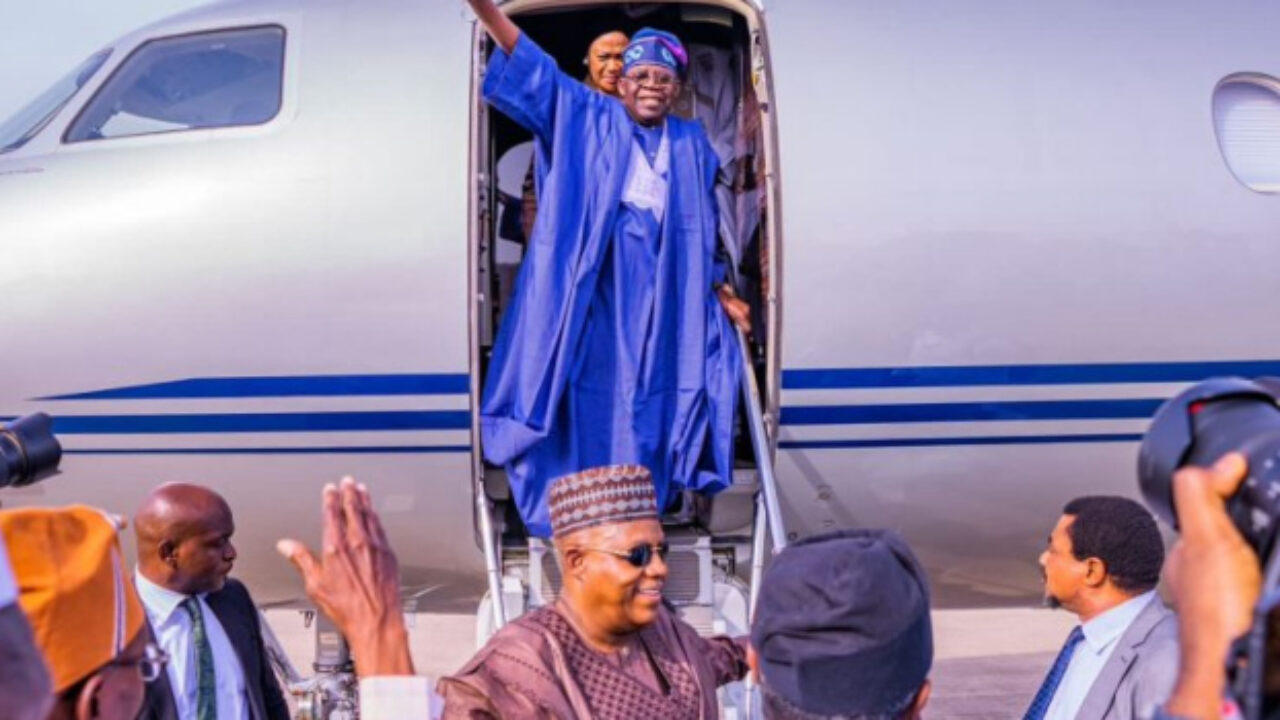
President Bola Tinubu’s extensive foreign travels—spending 245 days abroad in 33 months—have sparked criticism from analysts and citizens who question the tangible benefits for Nigeria, despite the Presidency’s claims of enhanced international standing.
The Senior Special Assistant on Foreign Affairs, Ademola Oshodi, defended Tinubu’s frequent trips on Channels Television’s Morning Brief, arguing that Nigeria’s reform path has earned “accolades and praise” from institutions like the World Bank and IMF.
According to Oshodi, these visits have strengthened international partnerships and showcased Nigeria’s economic policies as a model for reforms.
A breakdown of the numbers shows that Tinubu and Vice President Kashim Shettima undertook a combined 69 foreign trips spanning 35 countries, covering approximately 240,000 nautical miles and 380 flight hours. Tinubu alone visited 28 countries on 47 trips, most frequently Paris (11), London (9), the UAE (4), and Brazil (3).
Despite these claims, critics argue that the extended absences raise questions about governance and domestic engagement.
Economic analyst Dr. Emeka Okafor said, “There is little evidence that these trips have resulted in concrete gains for ordinary Nigerians. Spending 245 days abroad over less than three years risks detachment from pressing domestic issues—fuel, inflation, security, and infrastructure. Recognition from global institutions doesn’t automatically translate to improved livelihoods at home.”
READ ALSO: Tinubu receives US military delegation at Aso Rock
Concerns have also been raised about the administration’s $9 million lobbying contract with U.S.-based DCI Group. Oshodi admitted that Nigeria must do more to shape its international narrative, warning that misconceptions about insecurity could pose a national security risk.
“We don’t want the misconception of, oh, there’s a massive killing of Christians focused only on Christians…We don’t want a situation where people feel banditry is political rather than economic,” he said.
Security expert Dr. Fatima Bello noted, “While foreign relations are important, projecting Nigeria’s image abroad cannot replace effective domestic security and economic policies. The government risks public criticism if citizens perceive that international trips are prioritized over solutions to internal crises.”
Oshodi urged patience, citing examples of countries like the UK, China, and Ghana, where “painful” reforms eventually stabilized economies.
Yet analysts say Nigeria’s citizens are questioning whether the benefits of international recognition are being felt domestically, especially as insecurity, inflation, and unemployment remain pressing issues.
As debates intensify, many Nigerians are asking whether Tinubu’s global itinerary is boosting the nation or creating the perception of a president more focused on foreign acclaim than domestic governance.



 Entertainment5 days ago
 Latest1 week ago
 Business1 week ago
 Aviation7 days ago
 Crime6 days ago
 Crime5 days ago
 Featured7 days ago