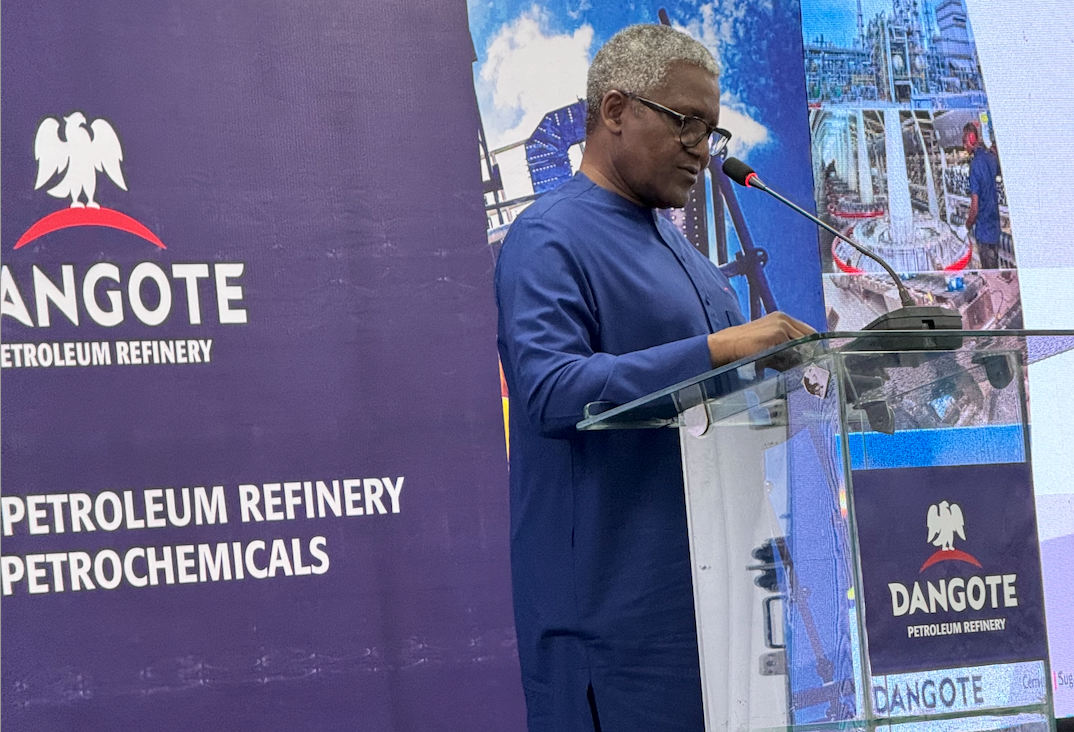
Aliko Dangote’s privately owned refinery has become the focal point of Nigeria’s energy conservation in recent weeks, with the business magnate pushing back forcefully against critics while outlining why he believes his operation—and not state-run refineries—represents the country’s best route to reliable fuel supply.
Speaking to journalists in a series of recent interviews, Dangote — whose refinery began commercial operations after years of anticipation — defended the plant’s technical capacity, took aim at persistent proposals to revive the Ajaokuta Steel project, and warned that ill-informed attacks on his company risk deterring other investors.
“When we built this refinery, the Nigerian engineers we hired performed better than the Indians,” Dangote told reporters, noting that 18 of those engineers have since taken expatriate roles in Qatar. He framed the achievement as proof of local technical competence and a counter to claims that his operations lack capacity.
Dangote was blunt about Ajaokuta Steel Company, long a symbol of stalled industrial ambition in Nigeria. “Ajaokuta Steel Company will not work,” he said.
“We can keep deceiving ourselves and keep being passionate about it, but it’s not possible.” He argued that policymakers and industrial advocates should stop treating Ajaokuta as a realistic engine of national industrial revival and instead focus on viable alternatives.
Responding to accusations that his firm is or will become a monopoly, Dangote pushed back. “We don’t want to be a monopoly, we want other players in the business,” he said, but warned potential entrants they must come prepared to compete on the right playing field.
READ ALSO: Dangote Refinery’s Direct Fuel Supply A Bold Step Toward Energy Independence
“Other players cannot come to a soccer field and want to play cricket, you will wound somebody,” he said, using the metaphor to stress that mismatched expectations and standards will create losses and instability.
He argued that market economics—not market dominance—explain why some state refineries have struggled. “If we don’t make money, nobody will come into this business,” he observed, adding that Nigeria National Petroleum Corporation (NNPC) refineries face structural disadvantages in producing high-value fuels.
“When we produce, we have 54 percent gasoline. NNPC, if they try, will achieve only 18 percent. They will produce low-value fuel oil … The more they operate, the more money they lose,” Dangote said.
Dangote also rebutted public claims that his refinery lacks capacity. “If we don’t have the capacity, why are we exporting?” he asked, pointing to ongoing exports as evidence that the refinery is producing beyond domestic needs. He accused some industry voices of attempting to undermine his business the way Nigeria’s textile sector was once undermined.
The businessman highlighted the fiscal benefits of his operations: “For every N1 we turn around, the government collects 50 kobo from various taxes,” he said, arguing that the government has collected more in taxes from the refinery than shareholders have received in dividends.
“If we didn’t set up the business, the government wouldn’t have collected taxes of N600 to N700 billion from us,” he added, framing the refinery as a public good as well as a private enterprise.
On the question of retail fuel assets, Dangote said the company had deliberately steered clear of acquiring downstream retail brands during the refinery build. “We didn’t want to go into retail… We could have bought Mobil, AP, and Oando,” he said, suggesting that avoiding retail was a strategic choice to avert monopoly accusations and to let independent marketers become customers.
“Restrict ourselves to production, they will become our customers, and we will have a nice party together. But if they are looking for fights, I have been fighting all my life.”
An energy analyst based in Lagos commented that Dangote’s technical claims and export activity do indicate meaningful refining capacity that was previously absent in Nigeria, but cautioned that scale alone does not guarantee stable domestic supply.
“Logistics, distribution, pricing policy and regulatory clarity will determine whether refinery output feeds local markets sustainably,” the analyst said.



 Entertainment7 days ago
 Crime1 week ago
 Crime7 days ago
 Football6 days ago
 Politics6 days ago
 Business6 days ago
 News6 days ago
 Latest6 days ago