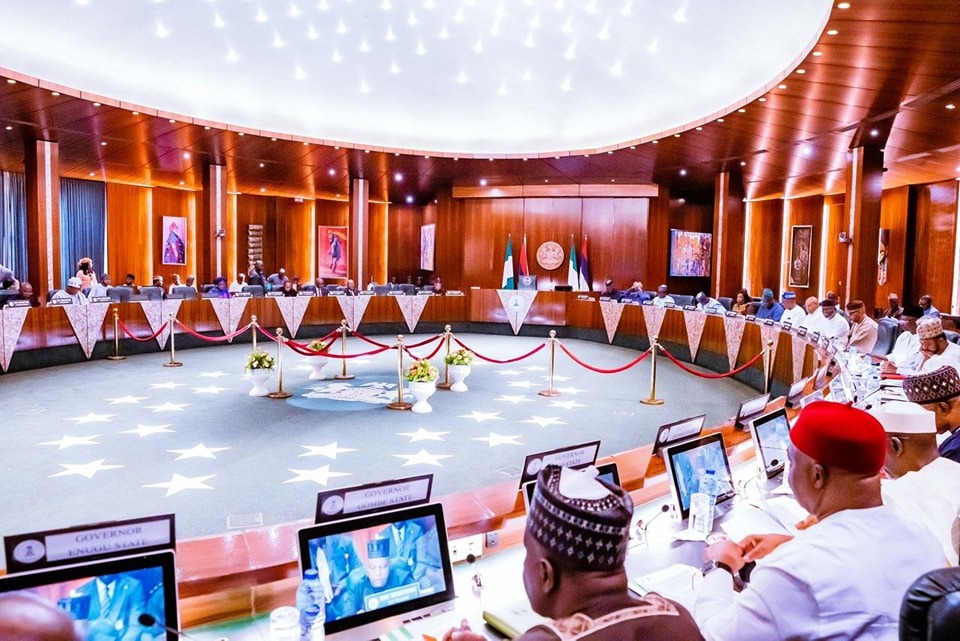
The Federal Executive Council (FEC), presided over by President Bola Ahmed Tinubu, has approved the demolition of the aging Carter Bridge in Lagos and the construction of a new structure following technical assessments that declared the existing bridge beyond rehabilitation.
The Minister of Works, David Umahi, disclosed this on Wednesday, March 4, while briefing journalists after the council meeting. He said the approval forms part of a broader package of major infrastructure projects aimed at improving transportation networks across the country.
According to the minister, the council approved about ₦5.6 billion for the design and costing of a new Carter Bridge project. He explained that detailed technical reviews and stakeholder consultations showed that the bridge’s current condition makes rehabilitation impossible.
“The stakeholders’ engagement and technical reviews showed that the Carter Bridge can no longer be rehabilitated. It has to be demolished and a completely new bridge constructed,” Umahi said.
He added that the government had engaged Advanced Engineering Consultants to undertake the comprehensive design and cost evaluation for the project ahead of the procurement stage for construction.
READ ALSO: Tinubu hails Obasanjo as ‘towering influence’ on Nigeria, Africa at 89
The minister also revealed that FEC approved six major infrastructure projects during the meeting, including the completion of the long-delayed Suleja–Minna Road project.
Umahi explained that the contract was initially awarded to Salini Construction Company but was later terminated due to poor performance, noting that only about 10 kilometres of the project had been completed before the termination.
Following a fresh review, the federal government decided to complete the remaining 71 kilometres of the dual carriageway. Umahi said one carriageway of the project has now been awarded to China Geo-Engineering Corporation (CGC) at a cost of N91 billion, while the second carriageway has already received clearance from the Bureau of Public Procurement (BPP).
He further disclosed that President Tinubu directed that the road be constructed using reinforced concrete rather than asphalt to ensure greater durability and longevity.
In another decision, Umahi said the council approved the review and rescoping of the Kano–Kongolam Road project, which was originally awarded in 2022 under the federal government’s tax credit scheme.
The 132-kilometre highway project, which cuts across Kano, Jigawa and Katsina states, was initially designed as an asphalt road but has now been redesigned as part of efforts to improve its long-term durability and performance.
The minister said the series of approvals reflect the Tinubu administration’s commitment to modernizing Nigeria’s transport infrastructure and addressing critical road and bridge challenges across the country.



 Football1 week ago
 Football1 week ago
 Business1 week ago
 Football1 week ago
 Football1 week ago
 Comments and Issues6 days ago
 Business1 week ago
 Comments and Issues6 days ago