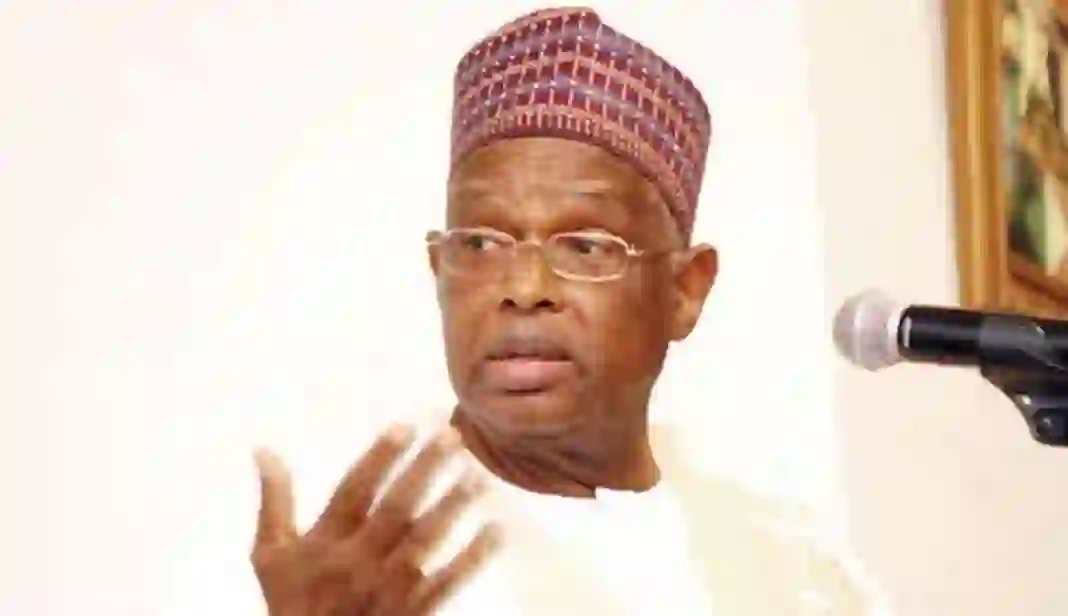
Nigeria has lost one of its most distinguished elder statesmen, Professor Jibril Muhammad Aminu, a revered academic, diplomat, and public servant, who died in Abuja on Thursday after a prolonged illness.
He was 85 years old.
A towering figure in Nigeria’s intellectual and political landscape for over five decades, Professor Aminu’s death marks the end of an era defined by commitment to national service, excellence in academia, and high-level diplomacy.
Professor Jibril Aminu held some of the most influential portfolios in Nigeria’s post-independence history. He served as Minister of Education, and later, Minister of Petroleum and Mineral Resources during the late 1980s and early 1990s, playing a critical role in shaping key sectors of national development.
In 1999, following Nigeria’s return to democratic governance, he was appointed Ambassador to the United States, a position he held until 2003. His diplomatic tenure was widely praised for re-establishing Nigeria’s global image in the post-military era and rebuilding relations with Washington during a critical period of democratic transition.
READ ALSO: South-west patriots finalize regional blueprint for historic National constitutional reform summit
Professor Aminu subsequently served two terms as Senator for Adamawa Central Senatorial District from 2003 to 2011, where he emerged as a respected voice on education policy, foreign affairs, and national unity.
Before his foray into politics, Professor Aminu was already a globally recognised medical scholar and academic leader. He obtained his medical degree from the University of Ibadan, followed by further studies in the UK and the United States, including prestigious academic appointments.
He served as Executive Secretary of the National Universities Commission (NUC) in the early 1980s, where he was credited with initiating policies that modernised Nigeria’s university system. He was also Vice Chancellor of the University of Maiduguri, where he laid the groundwork for the institution’s academic reputation in the North-East.
His scholarship in internal medicine and medical education earned him acclaim in medical and academic circles across Africa and beyond. He was a Fellow of the Nigerian Academy of Science, the West African College of Physicians, and a member of numerous international scientific bodies.
Since news of his death broke on Thursday morning, tributes have poured in from across the country. Political leaders, academics, diplomats, and ordinary Nigerians have described Professor Aminu as a man of exceptional intellect, integrity, and patriotism.
President Bola Tinubu, in a condolence message, described him as “a quintessential Nigerian patriot whose life exemplified service above self.”
Former Vice President Atiku Abubakar, a fellow Adamawa native, called him “a true intellectual colossus and principled statesman who brought grace and substance to every position he held.”
Throughout his long and storied career, Professor Aminu was widely regarded as a man of principle, untainted by scandal, and deeply committed to the values of knowledge, service, and national cohesion.
Sources close to the family disclosed that Professor Aminu had battled a long-term illness before passing away peacefully at his home in Abuja.
Arrangements for his burial are expected to be announced by the family in line with Islamic rites.
He is survived by his wife, children, grandchildren, and a nation in mourning.



 Business1 week ago
 Latest6 days ago
 Business1 week ago
 Football1 week ago
 Business1 week ago
 Business1 week ago
 Football5 days ago
 Business4 days ago