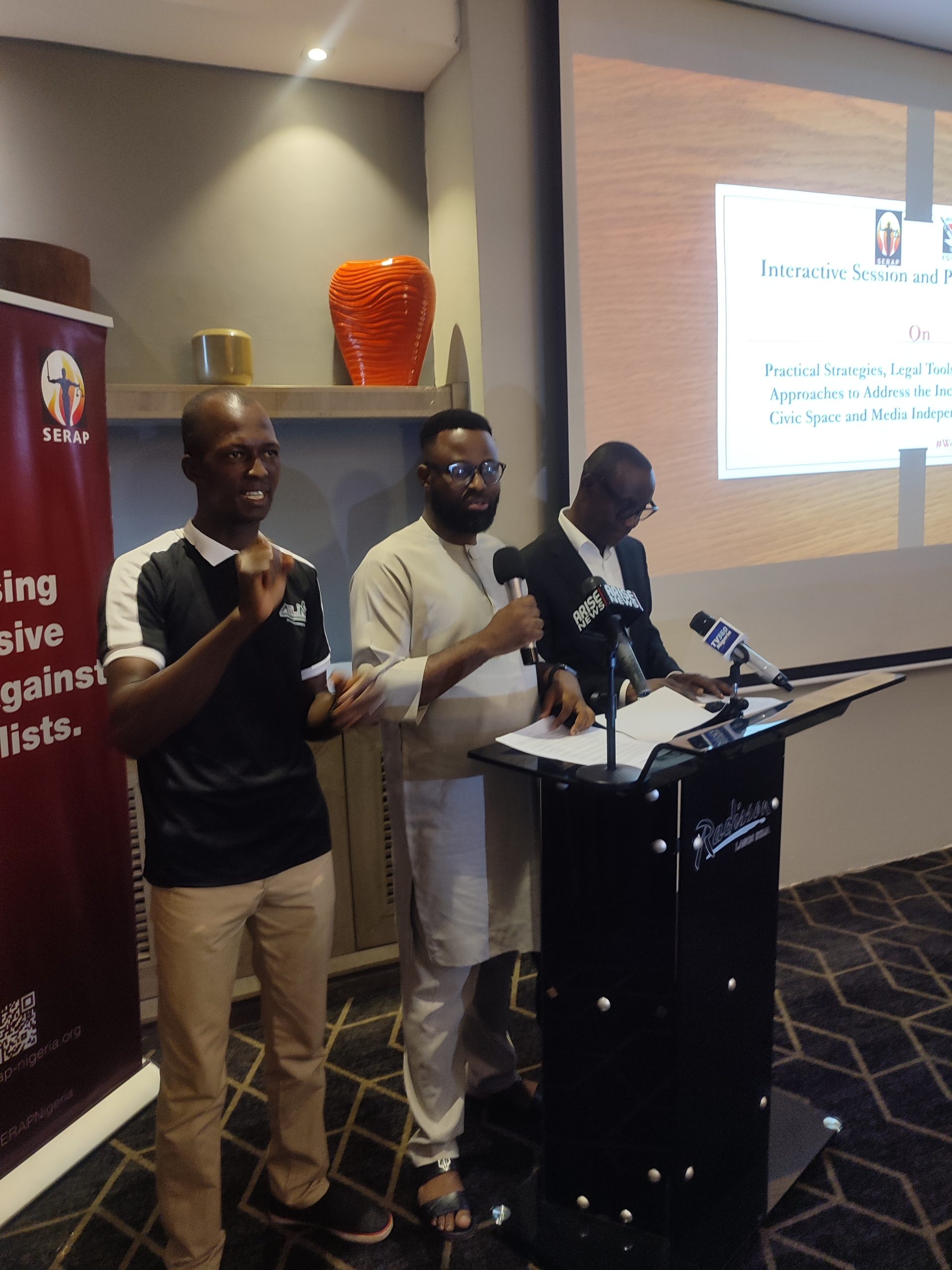
As the world marks 2025 World Human Rights Day, the Socio-Economic Rights and Accountability Project (SERAP) and the Nigerian Guild of Editors (NGE) have sounded the alarm over what they describe as the intensifying misuse of repressive laws—particularly the Cybercrime (Amendment) Act 2024 and strategic lawsuits against public participation (SLAPP)—to muzzle journalists, activists, and civil society organizations (CSOs) across Nigeria.
In a joint statement released in Lagos, the groups warned that the weaponisation of legislation and judicial processes now poses a grave threat to Nigeria’s democracy, civic freedoms, and the rule of law.
SERAP and the NGE said security agencies, acting for state and non-state actors, have increasingly deployed Section 24 of the Cybercrime Act, which addresses “cyberstalking”, as a tool to suppress constitutionally protected press freedom and free expression.
They described the pattern of repression as involving extrajudicial actions, unlawful arrests, prolonged detentions, malicious prosecutions, and the abuse of legislative and law-enforcement powers.
“These actions violate the 1999 Constitution and Nigeria’s obligations under international human rights law,” the statement read.
Speaking during the event, Richard Akinnola, veteran journalist, former Vanguard editor, and Executive Director of the Centre for Free Speech, said the evidence of crackdown is overwhelming and well-documented.
He noted: 56 journalists were assaulted or arrested in August 2024 alone while covering nationwide protests. Nigeria dropped 10 places to 122nd in the 2025 World Press Freedom Index (Reporters Without Borders).
The CJID Press Attack Tracker recorded 110 verified attacks in 2024—already surpassing the entire 2023 total by the third quarter.
At least three journalists have been detained since August 2025 under the Cybercrime Act, despite the recent amendment.
Akinnola also highlighted recent incidents, including the arrest and detention of: Tega Gobernadora (Fejiro Oliver), publisher of Secret Reporters, detained since September 18, 2025 on cyberbullying charges; Azuka Francisca Ogujiuba, publisher of Media Room Hub, arrested twice in August over a land-related court injunction report.
Sodeeq Atanda of the Foundation for Investigative Journalism (FIJ), detained for 11 hours in Ekiti State after honouring a police invitation linked to a sexual-harassment investigation.
He also condemned the Federal Government’s September 2025 charges against activist and Sahara Reporters publisher, Omoyele Sowore, alongside social media platforms, for posts allegedly critical of President Bola Tinubu—charges brought under both the Cybercrime Act and the Criminal Code.
Additionally, the DSS lawsuit against Professor Pat Utomi in May 2025, accusing him of establishing a shadow government, was cited as a disturbing example of SLAPP being deployed to intimidate political critics.
“These cases reflect a systematic pattern: the use of laws and courts as tools to crush peaceful dissent,” Akinnola said.
In his remarks, Gbenga Adefaye, Provost of the Nigerian Institute of Journalism (NIJ) and former NGE president, expressed concern over what he called the normalisation of harassment and legal abuse against journalists, activists, artistes, opposition politicians, and ordinary citizens.
He pointed to a pending lawsuit at the ECOWAS Court of Justice, challenging the constitutionality of Section 24 of the Cybercrime Act, which he said is inconsistent with Section 39 of the Nigerian Constitution and the African Charter on Human and Peoples’ Rights.
“Impunity for attacks on journalists and rights defenders creates a dangerous environment and weakens democratic accountability,” Adefaye warned.
Both organisations called on Nigerian authorities at federal and state levels to act immediately by: Releasing all journalists, activists, and citizens detained solely for peaceful expression; Withdrawing SLAPP lawsuits targeting journalists, activists, CSOs—including the DSS suit against SERAP; Conducting a comprehensive review of the Cybercrime Act and related restrictive laws.
Directing security agencies to uphold human rights and stop using the law as an instrument of intimidation.
SERAP and NGE urged global partners, foreign governments, and international human rights bodies to hold Nigerian authorities accountable and insist on the unconditional release of individuals detained for exercising their fundamental rights.
They stressed that suppressing critical voices undermines Nigeria’s democratic development and erodes public trust in state institutions.



 Football1 week ago
 Football1 week ago
 Comments and Issues7 days ago
 Business1 week ago
 Football1 week ago
 Football1 week ago
 Comments and Issues7 days ago
 Health6 days ago