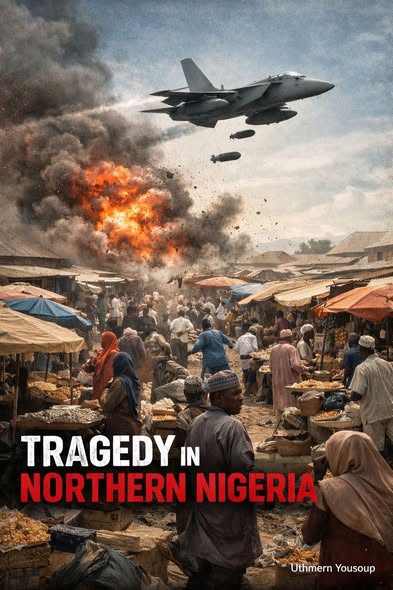
The Human Rights Writers Association of Nigeria (HURIWA) has strongly condemned a reported airstrike by the Nigerian Air Force at Jilli Market along the Borno–Yobe axis, alleging that over 200 civilians, mostly traders, were killed in the incident.
In a statement issued on April 13, 2026, and signed by its National Coordinator, Emmanuel Nnadozie Onwubiko, the group described the strike as “a catastrophic failure of state responsibility” and part of what it called a troubling pattern of fatal military air operations that have claimed civilian lives over the past decade.
HURIWA said the Jilli incident was not isolated, citing previous cases where military air operations allegedly resulted in civilian casualties.
Among the incidents referenced were: The March 16, 2014 strike in Kayamla, Borno State; The January 17, 2017 bombing of an IDP camp in Rann, Borno State; Air operations in Adamawa State in December 2017; A February 28, 2018 strike in Daglun, Borno State.
Incidents in Zamfara (2019 and 2022), Sakotoku in Borno (2020), Niger State (2021), Nasarawa State (2023), and Tudun Biri in Kaduna State (December 3, 2023).
The group argued that the recurrence of such incidents points to “systemic failures in intelligence gathering, target verification, operational discipline and accountability.”
READ ALSO: HURIWA blasts Dangote Refinery monopoly, accuses FG of fuel price crisis amid rising hardship
“These recurring incidents can no longer be dismissed as mere accidents,” HURIWA stated. “When such deadly errors become frequent and predictable, they amount to institutional negligence and a grave violation of the right to life.”
HURIWA called on the Federal Government to take urgent action, outlining seven specific demands:
The group urged the establishment of a transparent, civilian-led investigative panel, including the National Human Rights Commission (NHRC), civil society organisations and independent observers. It insisted that findings be made public and that those found culpable be prosecuted.
HURIWA demanded immediate payment of N200 billion in compensation to victims’ families—calculated at N1 billion per victim—as well as comprehensive medical care and rehabilitation for survivors. It also encouraged affected families to seek legal redress.
The association called for a comprehensive overhaul of rules of engagement, including mandatory multi-layer intelligence verification before authorising strikes in civilian-populated areas.
Professional Training and Technological Upgrade:
It urged investment in advanced targeting systems, precision-guided technology and continuous professional training focused on civilian protection and compliance with international humanitarian law.
HURIWA stressed the need for stronger enforcement of discipline and command responsibility within the armed forces.
The group advocated for the establishment of a binding national framework on the Protection of Civilians to guide all security operations nationwide.
HURIWA warned that failure to decisively address recurring civilian casualties in military operations could erode public trust and undermine national security efforts.
“The value of Nigerian lives must never be reduced to statistics or collateral damage,” the statement said, adding that the Jilli incident should serve as a turning point in strengthening safeguards for civilian protection.



 Latest1 week ago
 Latest6 days ago
 Crime1 week ago
 Business1 week ago
 Latest6 days ago
 Crime1 week ago
 Football6 days ago
 Business1 week ago