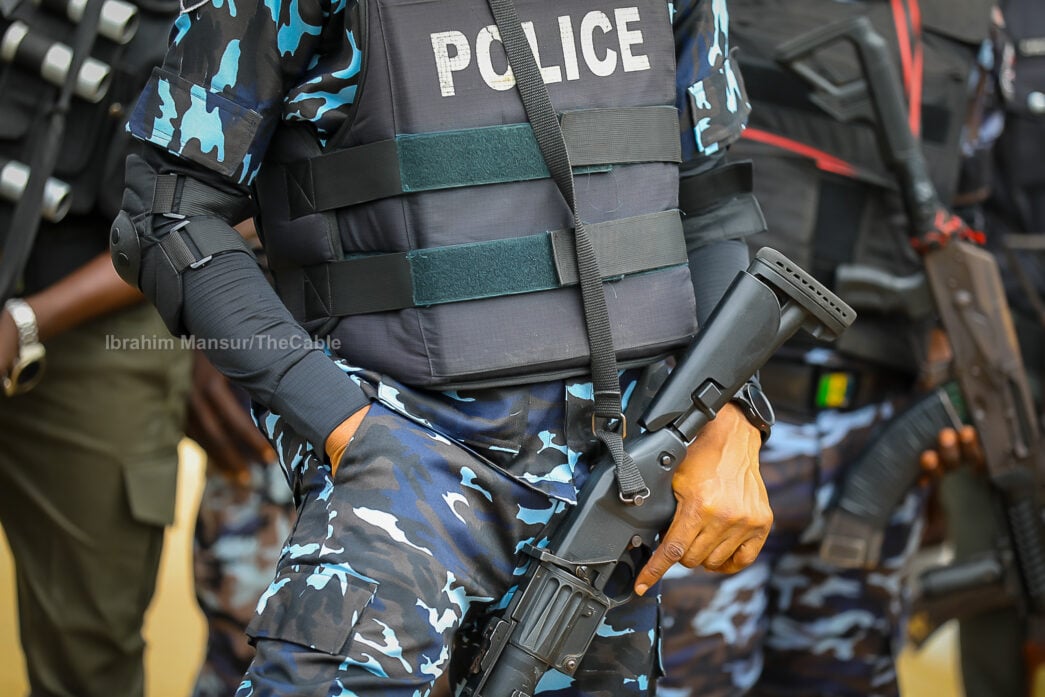
The fatal shooting of Inspector Ibrahim Sani by a fellow police officer in Rivers State has once again brought to the fore troubling questions about firearms discipline, stress management, and internal safety protocols within Nigeria’s security agencies.
On Sunday, January 18, 2026, what began as a routine security assignment at Next Cash and Carry Supermart, Trans-Amadi, Port Harcourt, ended in tragedy when Inspector Victor Okus allegedly opened fire on his colleagues during duty.
According to a statement issued on Monday by the Rivers State Police Public Relations Officer, CSP Grace Iringe-Koko, Inspector Sani, who was attached to 14 Police Mobile Force (PMF), Yola, died from gunshot wounds, while another officer, Inspector Daniel Dauda, sustained serious injuries and is currently receiving treatment.
The Unit Commander of 14 PMF, DSP Turaki Hassan, explained that the incident occurred at about 1:20 p.m., while the officers were on joint guard duty with military personnel at the shopping complex.
Inspector Okus, attached to 17 PMF but deployed on special duty at Intels, Onne, allegedly shot the officers in the head and neck regions under circumstances that are still being investigated.
Both victims were rushed to Nopsam Hospital, where Inspector Sani was pronounced dead. His remains have since been deposited at the Military Hospital Mortuary in Port Harcourt for autopsy.
The Rivers State Commissioner of Police, Olugbenga Adepoju, immediately ordered a comprehensive and transparent investigation, directing that the suspect be subjected to an Orderly Room Trial before being formally charged to court.
While shocking, the Rivers incident is not isolated. In recent years, there have been multiple cases across Nigeria where security personnel have either accidentally or deliberately shot colleagues, civilians, or loved ones.
In Lagos, a police sergeant in 2024 was arrested after fatally shooting a motorist during a dispute at a checkpoint.
In Cross River, an officer accidentally discharged his weapon during a patrol briefing, killing a colleague on the spot.
Similar cases have been reported in Abuja, Ogun, and Anambra states, often linked to mishandling of firearms, emotional distress, or fatigue.
READ ALSO: Tensions in Enugu after Police shooting of popular Ogene musician
Security analysts note that these incidents point to systemic weaknesses, rather than isolated lapses.
Security and criminology experts say the increasing number of internal shootings reflects deep-rooted challenges within the policing system.
Dr. Akinwale Ojo, a security governance analyst, explains that prolonged deployments, exposure to violence, and inadequate psychological support can impair judgment.
“Many officers operate under extreme stress with little or no access to mental health evaluation. When firearms are involved, even a momentary lapse can be fatal,” he said.
Another expert, retired Deputy Commissioner of Police Usman Garba, emphasized the need for continuous firearms retraining and stricter internal supervision.
“Handling a service rifle is not routine. It requires constant drills, discipline, and emotional stability. When these are lacking, colleagues and civilians alike are at risk,” he noted.
Commissioner Adepoju, while assuring the public that justice will be served, issued a stern warning to officers on the responsibility that comes with bearing arms.
“Handling of firearms while on duty is a serious responsibility and not a routine task. Officers must prioritize their safety and the safety of others to prevent avoidable tragedies,” he said.
The Police Command also extended condolences to the family, friends, and colleagues of Inspector Sani, describing his death as painful and deeply regrettable.
Civil society groups are calling for more than prosecution. They are urging the police authorities to strengthen psychological screening, enforce mandatory rest periods, and improve weapons control procedures, especially for officers on special or inter-unit deployments.
As investigations continue, the death of Inspector Ibrahim Sani stands as a grim reminder that the greatest threat can sometimes come from within, and that safeguarding lives must begin with ensuring that those entrusted with weapons are fully equipped—mentally, professionally, and institutionally—to handle them.
For many Nigerians, the hope is that this tragedy will not become just another statistic, but a turning point in addressing the silent dangers within the nation’s security architecture.



 Latest1 week ago
 Football7 days ago
 Business6 days ago
 Latest7 days ago
 Health1 week ago
 Latest6 days ago
 Latest6 days ago
 Latest1 week ago