Adeosun Ayomide Oluwaseun was once known among his peers as a lively, determined young man with big dreams and restless energy.
At just 20, he is already a student, a musician and a quiet symbol of resilience. But behind his calm confidence lies a life-altering accident that changed the course of his childhood—and his future.
An ND2 Mass Communication student of the Ogun State Institute of Technology (OGITECH), Igbesa, Ayomide once dreamed of becoming a soldier. That ambition came to an abrupt end on a seemingly ordinary Sunday in November 2016.
On Sunday, November 20, 2016, life followed its usual rhythm. Ayomide, then just 10 years old, attended church with his family at Cherubim and Seraphim (C&S), Orisun Iye Alaseyori, Papalanto, in Ewekoro Local Government Area of Ogun State.
After returning home, he noticed a fault in the entrance door of their apartment. Acting out of simple responsibility, the young boy picked up a nail and hammer to fix it.
“As I was hitting the nail, it flew and hit my right eye,” he recalled. “At first, it didn’t look serious. There was no blood, no pain.”
Neither he nor his parents suspected the damage was severe. It wasn’t until a week later, while preparing for school, that reality dawned on him.
“I closed my left eye and discovered that I couldn’t see with the right one anymore.”
Ayomide was taken from one hospital to another in search of hope. Doctors eventually delivered devastating news: the eye was irreparably damaged and posed a risk to his brain. Surgery was urgently required.
“We were told we had just three days to operate,” he said. “They suggested an artificial eye so I wouldn’t be disfigured, but it cost N100,000. We didn’t have the money.”
The eye was removed, marking the beginning of a new reality—one shaped by visual impairment, emotional pain and shattered childhood dreams.
Years later, when Ayomide gained admission into OGITECH to study Mass Communication, he discovered that the biggest challenge was not tuition fees or coursework—but independence.
“Moving around campus was very difficult,” he said. “Submitting files, doing documentation, standing in long queues—it all takes so much effort.”
READ ALSO: Breaking: FG responds to claims of abandoning Nigerian students in Morocco
Without the parental guidance he relied on at home, he learned to navigate the campus largely by instinct. Tasks that appear simple to others often leave him physically and emotionally exhausted.
“I prefer to do things myself. If I send someone, I keep doubting if it was done correctly. By the time I get home, I sleep for hours because of the stress.”
Still, giving up was never an option.
“Sometimes I feel bad knowing that if my condition was different, I could do more,” he admitted. “But I know what I want to achieve, so I keep pushing.”
Music as Healing and Identity
If education gave Ayomide direction, music gave him healing.
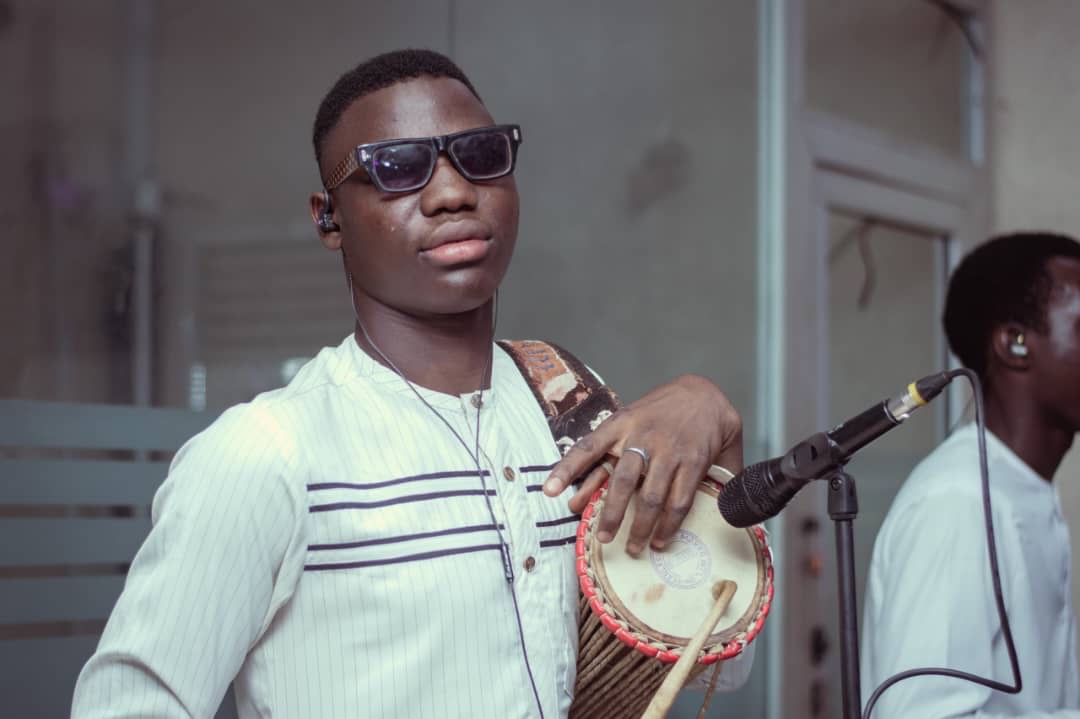
After losing his right eye, he embraced one of his natural talents—playing the talking drum. What began as a coping mechanism soon became a source of joy, purpose and identity.
“Once I am playing my talking drum, I’m always happy,” he said with a smile. “It’s my joy, my first wife. Anytime I lift my drum, I’m filled with joy.”
However, even music reinforced the importance of education in his life.
“When I started going out to play, I noticed how people treated me,” he said. “I realised that without education, I can’t get to the top. I need to be able to speak, write and express myself.”
That realisation pushed him to pursue higher education seriously, combining academics with his musical passion.
Living With Stigma
Ayomide was not born blind. Losing his right eye forced him to rely heavily on his left eye, which doctors say is not as sharp. To cope with social stigma, he often wears dark shades—despite medical advice.
“I wear dark glasses not for fashion,” he explained. “It makes it harder for me to see, sometimes I stumble or fall, but I use it to avoid people staring.”
He reserves his medically recommended glasses mostly for examinations, choosing discomfort over constant scrutiny during daily activities.
“It’s not easy to walk freely when people are murmuring or staring,” he said quietly.
A Call for Inclusion and Support
As an indigene of Ogun State, Ayomide is calling on the government to improve learning environments for people living with disabilities. According to him, many academic buildings lack basic facilities that would make movement and learning easier.
“Most schools are not designed for people like us,” he said. “It shouldn’t be this hard to learn.”
He also hopes for financial support to complete his education.
“I would really appreciate help with my school fees,” he said.
Yet, the pain of abandoned dreams still lingers.
“I always wanted to be a soldier,” he said. “But when I lost my eye, I was told I can’t be accepted because I’m disabled. That was when I gave up.”
Still, through education and music, Ayomide Adeosun continues to rewrite his story—one step, one lecture hall, and one drumbeat at a time.



 Football1 week ago
 Business7 days ago
 Latest1 week ago
 Latest7 days ago
 Health1 week ago
 Latest7 days ago
 Crime7 days ago
 Latest6 days ago