The Nigerian currency continued its downward slide against the United States dollar on Thursday across both the parallel and official foreign exchange markets, deepening concerns about persistent pressure on the country’s foreign exchange system.
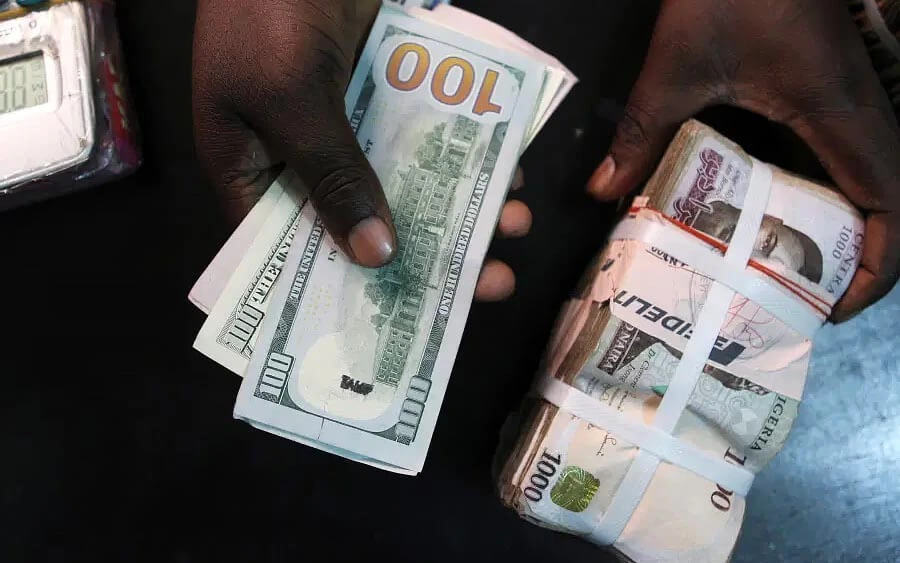
At the parallel market, popularly known as the black market, the naira weakened to N1,405 per dollar, compared to N1,390 recorded the previous day, representing a N15 day-to-day depreciation.
A Bureau De Change operator in Wuse Zone 4, Wuse Zone 4, Abubakar Hassan, confirmed the development, noting that demand for the U.S. currency has remained strong despite regulatory efforts to stabilise the market.
“We are seeing sustained demand for dollars from importers and travellers. Supply is still tight, and that is pushing the price higher in the parallel market,” he said.
Official Market Also Weakens
The pressure was also evident in the official foreign exchange window managed by the Central Bank of Nigeria.
Data from the official market showed that the naira closed at N1,387.45 per dollar, slightly weaker than the N1,387.09 recorded the previous day.
READ ALSO: Naira edges up to N1,368.5/$ amid February fluctuations
This marks the tenth consecutive depreciation of the naira at the official market, highlighting sustained volatility in the country’s currency market.
Earlier in the week, the naira had already suffered a sharp N37.85 drop against the dollar after its ninth straight decline at the official window.
The continued weakening of the naira has occurred despite a modest increase in Nigeria’s external reserves.
Figures released by the Central Bank of Nigeria show that the country’s reserves rose to $49.88 billion as of March 3, 2026, compared to $49.60 billion recorded in February.
The increase in reserves would typically provide support for the local currency by boosting the central bank’s capacity to intervene in the market.
However, analysts say structural pressures—particularly high demand for foreign exchange and limited supply—continue to weigh heavily on the naira.
Financial analysts say the persistent depreciation reflects deeper structural challenges in the Nigerian economy.
Economic analyst, Bismarck Rewane, said the pressure on the naira is largely driven by demand-supply imbalances in the foreign exchange market.
“When demand for dollars from importers, manufacturers, and travellers significantly outweighs supply, the naira will naturally weaken. Until Nigeria earns substantially more foreign exchange from exports, the pressure will remain,” he said.
Similarly, investment banker Johnson Chukwu noted that Nigeria’s heavy reliance on imports continues to expose the currency to volatility.
“The naira’s depreciation reflects Nigeria’s structural dependence on imported goods and services. Until local production improves and non-oil exports expand, the foreign exchange market will remain vulnerable to shocks,” he explained.
While the recent increase in external reserves provides some buffer, economists warn that sustained currency stability will require stronger export earnings, increased foreign direct investment, and improved confidence in the country’s economic reforms.



 Entertainment4 days ago
 Latest6 days ago
 Business7 days ago
 Health1 week ago
 Latest1 week ago
 Aviation6 days ago

 Latest1 week ago