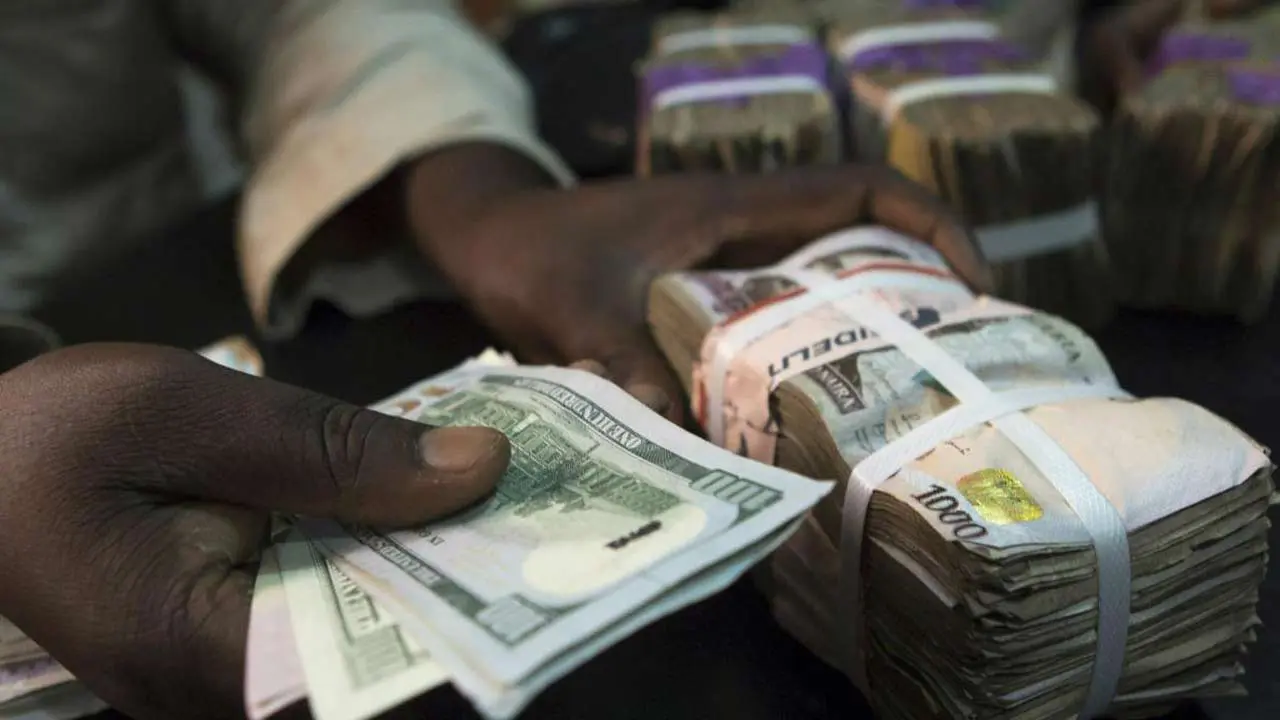
Nigeria’s naira suffered a significant blow in the official foreign exchange market on Friday, April 4, 2025, closing at N1,600/$1, according to data from the Central Bank of Nigeria (CBN).
This marks a 1.9% depreciation from N1,569/$1 recorded the previous day and represents the weakest performance of the naira since December 4, 2024, when it closed at N1,608/$1.
The fall in Nigeria’s exchange rate comes as Trump-era global tariffs triggered a wave of investor panic across financial markets, weakening currencies in several emerging economies and dampening commodity prices — including crude oil, Nigeria’s main foreign exchange earner.
The naira has depreciated by 3.9% in just the first four days of April, falling from N1,537/$1 at the end of March to Friday’s closing figure. Intra-day trading data revealed highs of N1,625/$1 and lows of N1,519/$1, indicating a wide trading range and heightened market volatility.
Notably, the N1,625/$1 intra-day high is one of the highest recorded levels so far this year, suggesting that demand pressures are prompting traders to price the naira at significantly weaker levels.
However, the lower band of N1,519/$1 shows that some traders are still banking on short-term central bank interventions or improved FX inflows.
The Nigeria Foreign Exchange Market (NFEM) average rate also closed weaker at N1,567/$1, the softest average rate recorded since December 2024.
In a recent statement, the CBN disclosed that its Net Foreign Exchange Reserves (NFER) rose to $23.11 billion at the end of 2024 — the highest level in more than three years. This figure reflects net reserves after liabilities have been accounted for.
READ ALSO: Naira hits ₦1,552.53/$ amid Trump’s tariff war
The apex bank noted a remarkable improvement in reserve levels from $3.99 billion in 2023, $8.19 billion in 2022, and $14.59 billion in 2021, highlighting what it described as “substantial progress” in reserve management.
However, analysts have expressed caution, stating that the reserve level remains vulnerable, especially given Nigeria’s heavy reliance on short-term portfolio inflows and external borrowing to bolster its reserves.
To mitigate these concerns, CBN sources said that the bank is preparing a new round of foreign currency forwards to support FX stability. Unlike previous agreements under former CBN governor Godwin Emefiele, the new contracts are reportedly more favorable to Nigeria, addressing some of the criticisms of earlier deals.
The recent depreciation in the naira is largely attributed to fallout from U.S. President Donald Trump’s new “Liberation Day” trade policy, which introduced sweeping tariffs on all U.S. trading partners, including Nigeria.
The policy has disrupted global financial markets, leading to mass selloffs by investors seeking safer assets amid fears of retaliatory tariffs and a possible global recession. China responded to Trump’s move with a 34% tariff on all U.S. imports, escalating the trade war.
Nigeria, meanwhile, was hit with a 14% U.S. tariff, which Trump described as “concessionary,” noting that Nigeria’s trade surplus warranted a 28% tariff under his policy.
Although the immediate effect of these tariffs on Nigeria’s exports to the U.S. may be limited, experts warn that the greater threat lies in the crude oil market.
Oil prices dipped below $70 per barrel for the first time in 2025 amid fears of slowed global demand. This is particularly troubling for Nigeria, whose 2025 budget is based on a $75 per barrel benchmark and a daily output of 1.8 million barrels.
With crude accounting for over 90% of Nigeria’s foreign exchange earnings, any sustained downturn in oil prices could significantly erode FX inflows, placing further pressure on the naira and the country’s fiscal stability.
While the CBN’s improved net reserves offer some buffer, analysts warn that unless oil prices rebound and foreign investment stabilizes, exchange rate volatility is likely to persist.



 Football3 days ago
 Crime1 week ago
 Crime1 week ago
 Business1 week ago

 Business1 week ago
 Business1 week ago
 Latest1 week ago