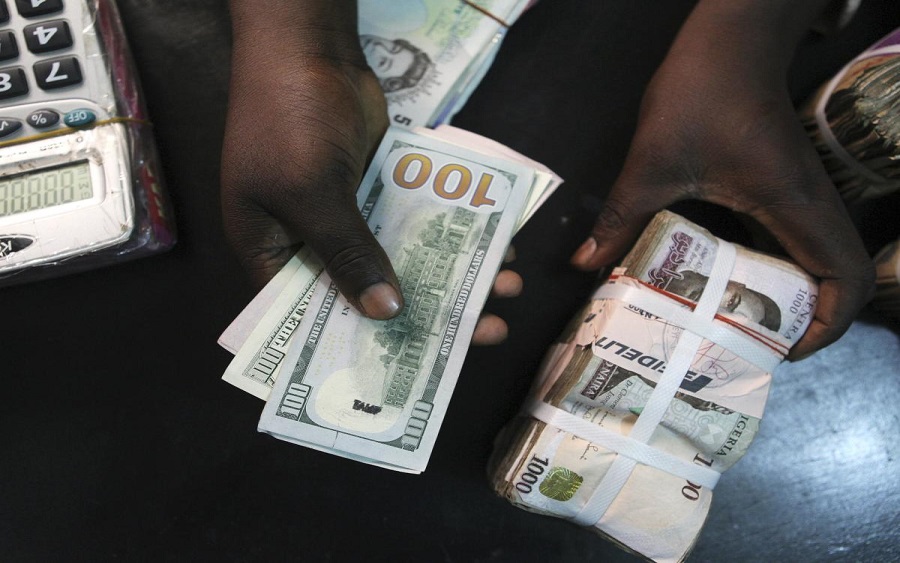
Naira on Thursday fell to a record low of N1,410 per dollar following strong demand on the parallel market, also known as the black market.
This represents 3.29% or N45.00 weaker than N1,365 recorded at the close of trading on Wednesday.
The observed depreciation is unparalleled and stands as the lowest point in the historical performance of the Naira, reflecting the severity of the current economic challenges.
Market analysts attribute the recent decline to a consistent surge in demand for dollars that has been evident since the commencement of January. The primary contributors to this heightened demand include:
A substantial portion of the demand is attributed to businesses actively seeking to restock goods or acquire raw materials, necessitating a higher demand for foreign exchange.
Individuals pursuing overseas studies have also played a significant role in driving the demand for dollars. This trend is likely connected to the need for tuition payments and related educational expenses.
The departure of diaspora Nigerians, particularly noticeable after the holiday season, has contributed to the increased demand for foreign currency. The departure of individuals from the US and other foreign countries has had a notable impact on the parallel market.
With schools abroad reopening, international students are actively restocking their foreign currency reserves to meet impending school fees and other financial obligations. Additionally, students are securing funds for holiday allowances.
The unprecedented depreciation marks the lowest point in the naira’s history against the US dollar, raising concerns about potential economic ramifications.
The domestic currency depreciated 0.41% to close at N882.24 to a dollar at the close of business, based on data from NAFEM where forex is officially traded.
This represents an N3.63 loss or a 0.41% decrease in the local currency compared to the N882.24 it closed at on the previous day.
READ ALSO: Naira gains at official market, drops to N1360/$1 at parallel market
The intraday high recorded was N1313/$1, while the intraday low was N700/$1, representing a wide spread of N613/$1.
According to data obtained from the official NAFEM window, forex turnover at the close of the trading was $56.60 million, representing a 3.18% decrease compared to the previous day.
Similarly, the naira depreciated at the parallel forex market where forex is sold unofficially, the exchange rate quoted at N1365/$1, representing a 0.37% decrease over what it closed the previous day, while peer-to-peer traders quoted around N1399.12/$1.
The Governor of the Central Bank, Mr. Yemi Cardoso stated that the naira is undervalued promising that in 2024, the bank will work towards real price discovery in the foreign exchange market.
Mr Cardoso stated this while delivering the keynote address at the Nigeria Economic Group outlook for 2024 via video conference.
According to Cardoso, the apex bank will execute inflation-taming policies through monetary policy instruments and collaboration with the fiscal side of the economy, which is the Ministry of Finance.
He also promised to shrine discipline in the forex market and promptly address any infractions and abuses.
He stated: “We believe that the naira is currently undervalued, And coupled with coordinated measures on the fiscal side, we will expedite genuine price discovery in the near term. This coordinated approach will contribute to a more balanced and stable exchange rate”
The naira traded at N878.61 on the official market according to Nairametrics daily FX monitor yesterday but recorded N1360/$1 on the unofficial market.
On increasing the FX reserves, Mr Cardoso stated that the bank’s partnership with the Ministry of Finance and NNPCL ensures all foreign exchange inflow is returned to the bank as it will result in the accretion of the country’s foreign reserve.
The Governor also noted that the anticipated resumption of operations in the three refineries across the country will contribute to a reduction in the pump prices of PMS which is a major contributor to the CPI basket.
He also noted that the inflation outlook is geared towards increasing economic growth and a more predictive cost environment.
He stated, “Inflationary pressures are expected to decline in 2024 due to the CBN’s inflation-targeting policy, which aims to rein in inflation to 21.4%,”
“The outlook for decreasing inflation in 2024 will have a profound impact on businesses, providing a more predictable cost environment and potentially leading to lower policy rates, stimulating investment, fueling growth, and creating job opportunities,”












 Latest1 week ago
 Football6 days ago
 Business6 days ago
 Latest6 days ago
 Health7 days ago
 Latest6 days ago
 Latest1 week ago
 Latest6 days ago