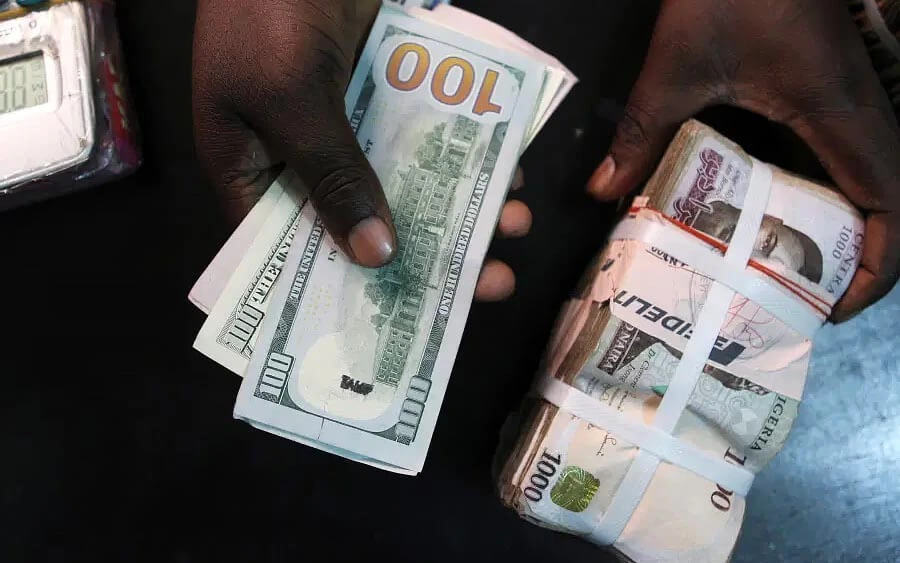
The Naira appreciated to N1,365 per U.S. dollar on Thursday, extending gains against the greenback as global currency markets reacted to a broad-based decline in the value of the U.S. currency.
Data published on the Central Bank of Nigeria (CBN) website showed that the local currency strengthened from N1,369/$ recorded on Wednesday, reflecting improved sentiment across global financial markets and renewed appetite for risk assets.
The naira traded within a range of N1,351.5/$ to N1,365/$ during the day, with an average rate of N1,359.9/$, indicating relative stability in domestic foreign exchange activity.
The appreciation comes amid a weakening U.S. dollar, which is on track for its largest weekly decline since January. The U.S. dollar index has fallen by about 1.3% this week as investors unwind safe-haven positions following a ceasefire agreement in the Gulf region and expectations of improved global oil supply flows.
Market sentiment has been influenced by optimism that the ceasefire will hold, alongside expectations that diplomatic engagements between the United States and Iran in Islamabad could further stabilize geopolitical tensions.
Major global currencies also recorded gains against the dollar. The euro traded at $1.1690, while the British pound rose by 1.8% to $1.3424, breaking above its 200-day moving average. The Australian and New Zealand dollars both posted weekly gains of nearly 3%, reflecting a broader shift toward risk-sensitive assets.
READ ALSO: Naira slips to N1,389/$ as external reserves drop $850m in three weeks
The Japanese yen, however, remained under pressure, trading slightly above recent lows at 159.2 per dollar, while China’s yuan strengthened to 6.83 per dollar in offshore trading — its strongest level since 2023.
Analysts attribute the dollar’s recent decline to easing geopolitical tensions following a period of heightened conflict in the Middle East.
Earlier in March, the dollar had strengthened significantly as tensions between the United States, Israel, and Iran triggered a flight to safety among investors, pushing up oil prices and increasing inflation concerns.
With the ceasefire now in place, investors have begun reversing those positions, leading to a broad-based retreat from the dollar.
However, uncertainty remains. Reports indicate that shipping activity through the Strait of Hormuz is still below normal levels, with only a fraction of the usual traffic passing through compared to about 140 vessels daily before the conflict. This continues to pose risks to global oil supply stability and market confidence.
Despite the naira’s short-term gains, Nigeria’s external reserves have continued to decline. CBN data shows reserves fell to $48.89 billion, down from $49.18 billion at the beginning of April, continuing a downward trend that began in mid-March.
The apex bank, however, has maintained an optimistic outlook. It previously projected that external reserves would rise to $51.04 billion in 2026, up from $45.01 billion in 2025, supported by higher crude oil earnings, sovereign bond issuances, and increased diaspora remittances.
While the naira’s appreciation reflects favourable global conditions and a weaker dollar, analysts caution that sustained stability will depend on Nigeria’s reserve position, oil market performance, and broader macroeconomic reforms in the months ahead.



 Latest7 days ago
 Football6 days ago
 Business5 days ago
 Football1 week ago
 Football1 week ago
 Football1 week ago
 Health6 days ago
 Latest6 days ago