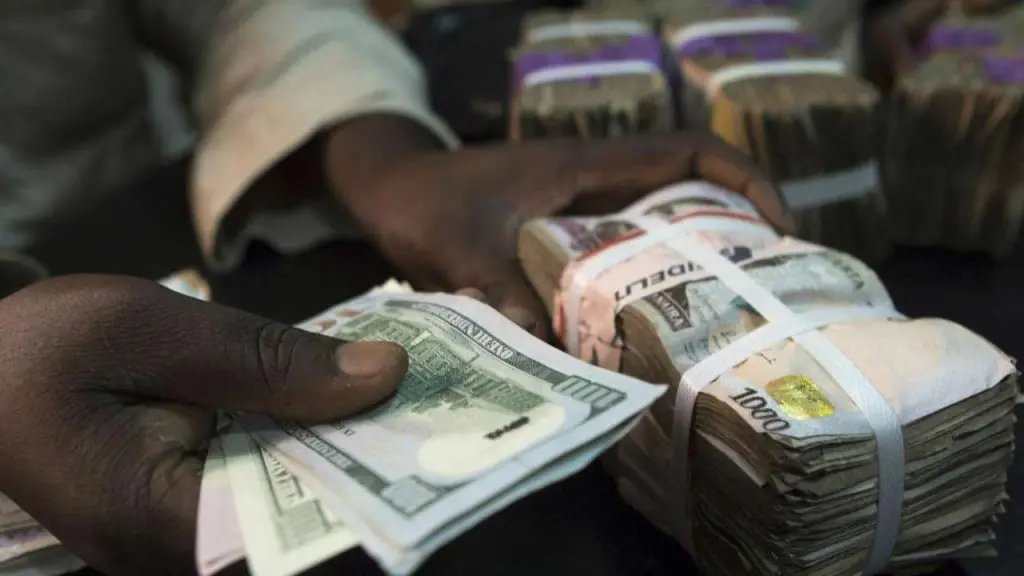
Despite the naira’s recent appreciation in the foreign exchange (forex) market, Bureau De Change (BDC) operators have raised concerns about a lingering loss of confidence in the local currency.
While the naira’s gains are a positive development, it remains burdened by devaluation at the official market and depreciation in the open market, according to licensed currency traders.
The President of the Association of Bureau De Change Operators of Nigeria (ABCON), Aminu Gwadebe, shared these insights during an exclusive interview over the weekend.
He attributed the naira’s recent strength to the intervention of the Central Bank of Nigeria (CBN) at the Electronic Foreign Exchange Matching System (EFEMS) window, which has significantly boosted forex supply while demand remains weak.
Gwadebe further noted that the naira has become one of the most unpredictable currencies in the world, facing numerous challenges, including trade wars, exchange rate instability, and speculative attacks.
He emphasized that global economic slowdowns in major economies such as the United States, Europe, and China have exacerbated forex market volatility, resulting in reduced trade volumes.
READ ALSO: Naira falls further against Dollar at official market, records gains in parallel market
Additionally, he highlighted the impact of regulatory changes, technological advancements, and market volatility on the forex market. The recapitalization policy for BDCs, he stated, has increased compliance costs for forex brokers, further affecting market liquidity.
“These challenges have led to increased market volatility, reduced liquidity, higher trading costs, and greater regulatory scrutiny,” Gwadebe explained.
To sustain the naira’s gains, Gwadebe urged the CBN to adopt a forward communication strategy, emphasizing positive developments while minimizing negative news.
“The naira appreciated significantly at the open market from a low of N1,580 per dollar to a higher level of N1,545 per dollar during the week. The CBN’s intervention at the EFEMS window has significantly boosted supply, coupled with weaker demand,” he stated.
However, he warned that the naira still suffers from a confidence deficit, with forex players reluctant to release their holdings due to uncertainty.
“The CBN, as the key market catalyst, must ensure that its interventions extend beyond the wholesale banking sector to include the retail BDC window. This will help boost supply at the critical end of the forex market,” he added.
BDC operators have attributed the naira’s volatility to rising forex demand, spurred by contractual payments and federal government releases.
READ ALSO: Naira faces unprecedented volatility as BDC operators raise alarm
Gwadebe acknowledged that the forex market is under speculative pressure, reinforcing the need for regulators to maintain consistency in policy implementation to stabilize the market.
“These occasional shocks in the forex market are often artificial, discretionary, and a bubble that will eventually burst,” he remarked.
He also urged the CBN to revisit its previous policy of directing a fraction of International Money Transfer Operators’ (IMTOs) proceeds received by banks and fintech firms to the BDC window.
This, he said, would enhance liquidity at the retail forex level and reduce pressure on the naira.
The CBN has continued to introduce measures to address forex market volatility, which currency speculators frequently exploit to weaken the naira. The regulatory body has taken steps to stabilize the currency and prevent market distortions caused by speculative trading.



 Latest7 days ago
 Business1 week ago
 Football6 days ago
 Business5 days ago
 Football1 week ago
 Football1 week ago
 Football1 week ago
 Health6 days ago