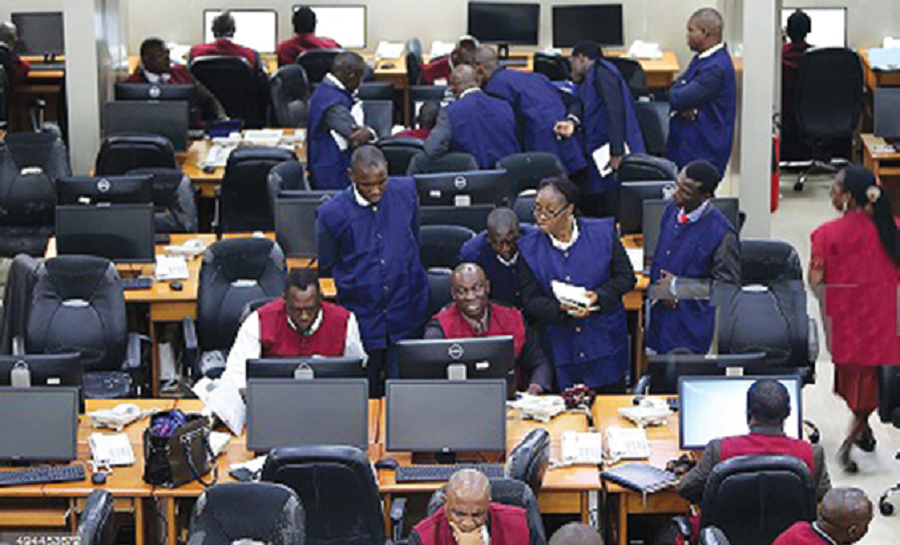
The Nigerian stock market has begun December 2025 on a positive note, recovering from its steep November decline—the first monthly drop since March—triggered by heavy profit-taking and widespread concerns over proposed tax reforms, including a 10 per cent Capital Gains Tax (CGT) on equity investments.
The NGX All-Share Index (ASI) rose 1.20 per cent on Monday to close at 144,928.36 points, lifting market capitalisation by 1.41 per cent to N92.38 trillion and pushing the year-to-date (YTD) return to 40.81 per cent. The rally continued on Tuesday, with a 0.27 percent gain bringing the index to 145,323.87, expanding YTD gains to 41.19 per cent.
The early-December rebound was driven by renewed interest in heavyweight stocks, including Dangote Cement, International Breweries, and NCR Nigeria.
Sector performance was broadly positive, with banking (+0.65 per cent), industrial goods (+0.47 per cent), and consumer goods (+0.38 per cent) posting gains. Guinness Nigeria (+10 per cent) and the Nigerian Exchange Group (+9.96 per cent) topped the gainers’ chart.
Despite the upward movement in index levels, trading volume fell sharply by 33 per cent to 403.8 million shares, even as the number of deals increased—indicating that the rally was powered by high-value, targeted trades rather than widespread market participation.
Financial markets expert Dr. Kunle Adesina said the uptick reflects bargain-hunting after November’s “overdone” correction but warned that structural risks remain.
“The fundamentals haven’t fully stabilised. Policy uncertainty—especially surrounding the CGT—continues to cast a shadow over long-term investor sentiment,” he said.
Another analyst, Charlotte Umeh, emphasised the role of seasonal spending and portfolio rebalancing heading into year-end.
“December typically brings improved liquidity. But inflationary pressures, forex volatility, and global headwinds could easily cap market momentum,” she noted.
The November downturn—an ASI decline of -6.88 per cent—exposed the market’s vulnerability to policy shifts. The shock was worsened by the so-called “Black Tuesday” on November 11, when stocks plunged as investors reacted to the impending implementation of the CGT.
Although Finance Minister Wale Edun’s assurances moderated the panic, investors remain wary. Large institutional selloffs in BUA Cement (-4.76 per cent week-on-week) and Nigerian Breweries (-2.55 per cent) reflect ongoing caution.
Analysts warn that currency depreciation risks and double-digit inflation continue to erode real investment returns. Foreign reserves—though boosted in late 2025—remain pressured by rising forex demand.
Capital markets strategist Anthony Obiora explained: “Foreign inflows have improved significantly, but sustainability is the concern. Unless forex pressures ease, we may see reduced participation from offshore investors in 2026.”
Despite the risks, analysts expect the NGX to sustain moderate gains through December, driven by year-end spending, reforms, and investor repositioning.
Foreign portfolio investment rose 172 per cent year-on-year to N2.3 trillion as of October, offering additional liquidity.
However, experts warn that persistent inflation, forex instability, and shifting global conditions could limit future upside.
They advise investors to diversify—particularly toward banking for stability and consumer goods for growth—while adopting a long-term view.
As Nigeria enters the final month of 2025, the stock market’s recovery remains fragile but encouraging—supported by targeted bargain-hunting, stronger liquidity, and improving investor confidence, yet shadowed by policy tensions and macroeconomic risks.



 Football1 week ago
 Football1 week ago
 Comments and Issues7 days ago
 Business1 week ago
 Football1 week ago
 Football1 week ago
 Comments and Issues7 days ago
 Health6 days ago