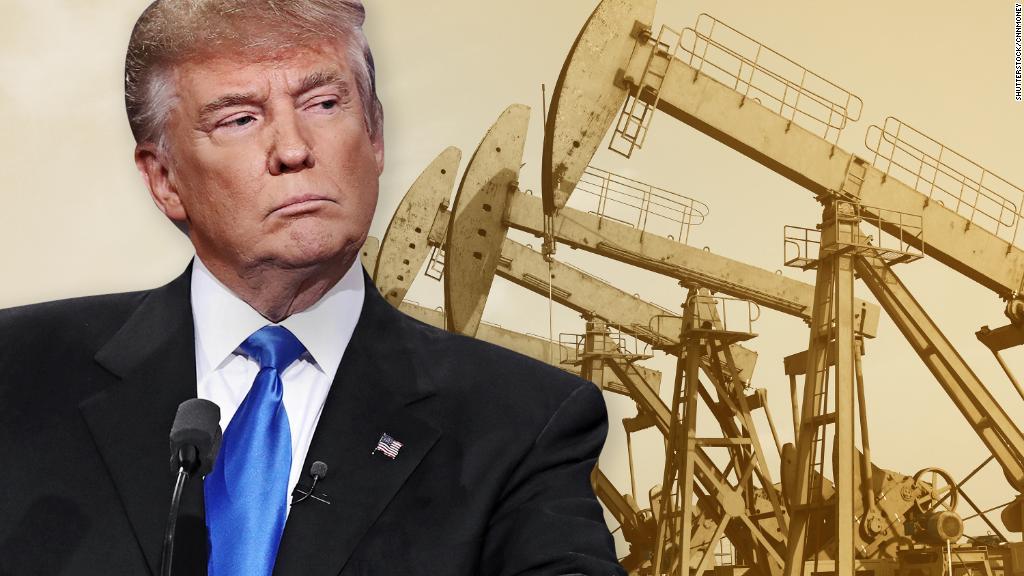
Oil prices saw a slight dip on Monday as market participants anticipated changes in U.S. foreign policy under President Donald Trump who was sworn in as the 47th President of the United States on Monday, particularly regarding the sanctions imposed on Russia’s oil industry.
The expected shift in policy has sparked investor optimism, with hopes that Trump’s administration could strike a deal with Russia to ease tensions and potentially end the ongoing conflict with Ukraine.
Brent crude futures fell by 28 cents, or 0.35 per cent, to $80.51 per barrel at 07:39 GMT, following a 0.62 per cent decline in the previous session. Similarly, U.S. West Texas Intermediate (WTI) dropped 21 cents to $77.18 per barrel.
The fluctuation in global oil prices has had a direct impact on fuel prices in Nigeria, where the cost at the pump has soared to around N1,000 per liter.
At the weekend, Dangote Refinery raised its depot price from N899 to N955 per liter, citing the surge in global oil prices as the reason for the increase.
This volatility in global oil prices highlights the complex and interconnected nature of energy markets, with geopolitical factors, weather disruptions, and policy changes all playing a role in shaping the cost of oil worldwide.
As President Trump takes office, all eyes will be on his administration’s actions and their potential to reshape the global energy landscape.
Investors are particularly focused on the potential reversal of Biden’s suspension of new licenses for LNG export facilities.
READ ALSO: Anti-drone jammers cars escort Trump’s motorcade to inauguration venue
“There is a fair amount of uncertainty across markets coming into this week given the inauguration of President Trump and the raft of executive orders he reportedly is planning to sign,” ING analysts commented in a report.
“This combined with it being a U.S. holiday today, means that some market participants may have decided to take some risk off the table.”
The recent sanctions on Russia’s oil industry, particularly the blocking of over 100 tankers engaged in business with Russia, caused disruptions in global oil supply chains.
These sanctions led to increased demand for alternative suppliers, especially in China and India, as well as a shift towards unsanctioned tankers to transport oil from Russia and Iran.
Energy analysts suggest that the sanctions have driven up oil prices in the short term due to reduced supply, but the market is now looking to Trump’s foreign policy to see if any sanctions will be lifted as part of efforts to end the Russia-Ukraine war.
In addition to the potential easing of sanctions on Russia, the global oil market has also been impacted by geopolitical factors, including the ceasefire between Hamas and Israel, which has helped ease tensions in the Middle East and stabilize oil prices.



 Business3 days ago
 Crime1 week ago

 Comments and Issues6 days ago
 Energy6 days ago
 Business6 days ago
 Business1 week ago
 Health1 week ago