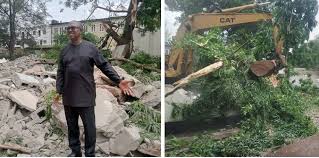
The demolition of the Obi family property in Lagos came as one too many, to paraphrase a common expression in Nigeria. Distressingly, it followed the same pattern of official attack on the property and businesses of non-indigenes, especially the Igbo, in Lagos: dredge up any legal excuse or none at all and demolish homes, shops, offices, markets et al, belonging members of a targeted group and built on hitherto unencumbered lands with valid title documents, including C of Os and others. These demolitions are often done with such viciousness and impunity you would think that destruction of people’s means of livelihood has become nothing more than a game of snookers.
I am a victim of such mean, remorseless destruction of a lifetime-savings property in Lagos myself and, therefore, can speak authoritatively about the unspeakable pain that comes with it. For those who survive the shock (and many do die from the shock, to be sure, or live in irreversible depression thereafter), the pain may sooner or later go away and life goes on. But the phenomenon of demolitions in Lagos has become such an invidious constant that it has since ceased to be a consequence of illegal land use by individuals or groups; it has, unfortunately, become more like a campaign of witch-hunt and vendetta against a targeted non-indigene group or political opponents, the objective obviously being to inflict maximum psychological and economic pain on, and possibly bankrupt, them.
For me, the sudden destruction of Peter Obi’s brother’s-owned business’s property in Ikeja GRA, Lagos, acquired since 2011 with all the papers – receipts, C of O, others – intact, isn’t only about the extreme churlishness in its intent and execution, or the frightening attack on a basic fundamental of citizenship -property rights – that it symbolises; or the lack of legality and justice in its execution and the processes leading it. Even more importantly, it also speaks to the unraveling of a civilization we had hitherto widely admired as the nation’s champion of legal and social justice, human rights and the rule of law. The late Rotimi Williams, Gani Fawehinmi, Alao Aka-Bashorun, Kanmi Ishola-Osobu, among others – all champions of social justice and rule of law – would be rolling in their graves to know that a learned judge presiding over a court of competent jurisdiction in Yorubaland gave a judgment in favour of “An Unknown Litigant” and ordered the destruction of a validly-acquired property in a part of Yorubaland on the basis of such an imponderable judgment.
I insist that what we are witnessing today under Bola Tinubu – the obdurate lawlessness that characterizes his conduct of public affairs – is devaluing the Yoruba essence. Tinubu’s presidency is a total diminution, even a complete reversal, of the nationality’s hitherto cherished worldview: the supremacy of justice and fair play, human and property rights, liberal democracy and individual liberties in socio-political engineering.
As a cub reporter with The Guardian in Lagos from the late 80’s until I became a title editor many years later, I always felt proud to be associated with an organization and a society reputed for their fierce resistance of injustice and tyranny, whether that resistance manifested in the bruising crusade against the annulment of the June 12, 1993 presidential election won by the late MKO Abiola, or in the media pummeling of the Olusegun Obasanjo Administration for the whip-him-into-line withholding of Lagos council funds by then President Obasanjo in 2004, obviously to punish then Governor Bola Tinubu for creating “unauthorized” additional 37 local councils (now local council development areas) in Lagos State. The controversy surrounding the creation of those new councils by Lagos was to lead to the calls for fiscal and true federalism, which Tinubu’s tendency vociferously championed in the early 2000’s.
The current dispute over the Obi family property in Lagos may well be a perfect deja vu experience for all keen followers of social and legal justice trends in the Lagos area. But, while it is true that in 1982, the Lagos State Government attempted to evict the late Emeka Odumegwu Ojukwu from his late father’s property at 29 Queens Drive, Ikoyi, a step deemed an act of ‘self-help’ by the court, it is also true that after Ojukwu sued it, Lagos followed the due process all the way to the Supreme Court, until February 14, 1986, when judgment was entered in Ojukwu’s favour.
Not any more. Today, everything seems lost in the miasma of Tinubu’s politics of self-aggrandizement that no longer pays heed to the niceties of rule of law, human and property rights, personal or group liberty, freedom of movement and association and democratic principles, among other civic rights that define a free society. Yorubaland, well, Lagos, no longer stands tall as the land of legal luminaries that once bestrode the nation’s portals of justice like a colossus (permit the cliche) and pointed the noble way for law and society to go. The legal officers who handled Ndibe Obi’s property case for the Lagos judiciary were nothing more than a bunch of sneaky lawyers and judges whose interest was anything but justice. Nor did they give a jot about the deleterious effects of their action on the primacy of the South West in the realm of law and justice.
As many commentators have said, the problem of the Tinubu presidency lies in its tendency to play more politics than governance – and raw, crude politics at that! That tenor of Tinubu’s politics – raw and crude – is, in my view, another negation of the South West’s claim of political sophistication. Instead of using good governance to win support for his second term bid, Tinubu is busier deploying all manner of subterfuges to sabotage the opposition, apparently so that only he would be on the presidential ballot in 2027 and probably be returned unopposed. That is a crime (undermining the integrity of the Democratic Party) for which Richard Nixon was impeached as President of the United States on October 30, 1973. After two years in the saddle, practically the only visible “achievement” of President Bola Ahmed Tinubu (PBAT) is the well advertised disarray in the Nigerian opposition. Now if that is sophisticated politics, I do not know what crude politics and misuse of power are.
Really, despite protestations to the contrary, I find no sagacity in Tinubu’s politics, which seems to thrive more on absolute, not to add arrogant, fiendishness, sometimes even naivety. The relentless drive to alienate Peter Obi and his support base, for instance, doe not make any sense at all, if you ask me. Wouldn’t he rather do things, as president, that could win Obi’s supporters to his side? Should he rather invest billions to try and run Obi down thereby antagonizing the Labour Party flag-bearer’s six million plus voters, or invest those billions in wooing them through good governance? Similarly, should he rather invest billions in hiring e-urchins to throw potshots at Atiku than invest those billions in development projects to woo Atiku’s other six million plus voters to his side?
Not only that the elaborate schemes to bend the National Assembly, the judiciary, the electoral commission, security agencies and even the media, to his will, what has been aptly described as state capture, do not conduce to building a democratic republic, they are also a sad indication that Tinubu’s democratic credentials are nothing, probably have never been anything, to write home about. Instead, what we have before us is a creeping descent into totalitarianism, a system which the president appears to place a lot of premium on, and in which he would be both the State and the law, where criticisms of the president, whether constructive or otherwise, would be taken as a personal affront and punishable.
It, certainly, is not enough that the Lagos State government has denied involvement in the Obi family property demolition saga, an attempt at self-exculpation that Columnist Steve Osuji has pooh-poohed as a lame excuse.
Said Mr. Osuji: “Ikeja GRA is probably the primest (!) piece of property on the mainland part of Lagos. Ikeja is also the administrative seat of the Lagos Government. It, therefore, stands to reason that every inch of land in Ikeja, especially the GRA, is assumed to be well noted and annotated in the Lagos land registry,” wrote Osuji, a one time Imo State government’s spokesman and veteran journalist, who writes a popular online column EXPRESSO.
“EXPRESSO can assert that no one can move a bulldozers into Oduduwa Street, in Ikeja GRA without the knowledge of the governor of Lagos State. In fact, Aso Rock is probably complicit in the barbarism of last Tuesday.”
It, therefore, follows that Lagos (read Tinubu) must clear their own mess. They must begin by unconditionally restoring Ndibe Obi’s rights to his property and, by so doing, demonstrate to Nigerians that property rights are still part of the 1999 Constitution of the Federal Republic of Nigeria (as amended) and that nobody must be denied rights to their property who have valid title documents.