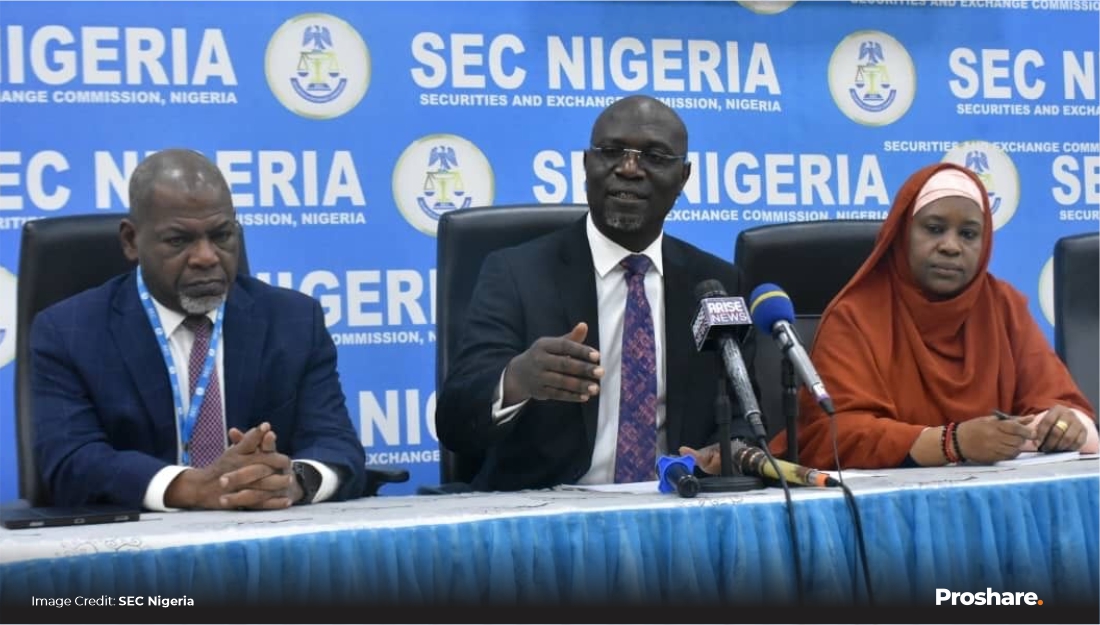
A sweeping directive by the Securities and Exchange Commission (SEC) to impose tenure limits on directors of key capital market institutions has triggered widespread anxiety and uncertainty across Nigeria’s financial markets.
In a circular issued last Friday, the SEC introduced strict tenure restrictions for directors of Capital Market Operators (CMOs) classified as “significant public interest entities.” Under the new rules, directors may serve a maximum of 10 consecutive years in the same company and 12 years across the same group structure.
The directive, which took immediate effect, also introduced a mandatory 3-year cooling-off period for Chief Executive Officers (CEOs) and Executive Directors who have reached the maximum tenure, before they can be reappointed as Chairman. Even then, such Chairmanship would be capped at four years.
The circular has rattled the capital market ecosystem, with several operators and board members scrambling to determine whether they fall under the “significant public interest entity” category—a classification the SEC said will be determined solely by the Commission.
“This has created panic across the board,” said a senior executive at a leading Lagos-based investment firm. “People want to know who exactly is targeted, and when the enforcement will begin. It could affect long-serving executives who have built entire institutions.”
Another source close to the market noted, “This could mark the end for several high-profile figures across stockbroking, fund management, and investment banking. And the lack of a public list of affected entities only adds to the confusion.”
Although the SEC has not published names, sources familiar with the directive suggest that the rule is not aimed at listed commercial banks or ordinary private companies.
Rather, the target appears to be Financial Market Infrastructure (FMI) firms and major institutional CMOs—including entities like FMDQ Group, Central Securities Clearing System (CSCS), NGX Group, and NG Clearing.
“Entities that play systemic roles, especially those handling public assets or influencing market infrastructure, are most likely under this rule,” said Dr. Olufemi Banjoko, a corporate governance expert and partner at Lagos-based law firm AlphaTrust Legal.
“The SEC is clearly pushing for tighter governance and deeper board accountability in critical market-facing institutions.”
READ ALSO: SEC’s new tenure limits for capital market directors spark uncertainty across financial sector
A particularly controversial aspect of the circular is the outright prohibition of converting Independent Non-Executive Directors (INEDs) into Executive Directors (EDs), including promotions to CEO positions. The SEC argued that such practices “erode neutrality and compromise the oversight function” expected of INEDs.
“Once you’ve served as an INED, the assumption is that you are an external check on management. Transmuting that role into an executive one blurs accountability and diminishes board independence,” said Ngozi Umeh, Director of Governance Studies at the Nigerian School of Business Ethics.
While the directive draws strength from the National Code of Corporate Governance (NCCG), some experts argue that its enforcement may hit legal roadblocks, particularly for unlisted or privately held firms.
In an effort to ease mounting concerns, the Association of Securities Dealing Houses of Nigeria (ASHON) issued a statement clarifying that its members are not affected by the circular.
“We have sought clarification from SEC and have received assurances that our members are not within the category referred to,” the statement read. “Accordingly, members are advised to remain calm and continue to carry on their businesses as professionally as we have always done.”
However, some industry insiders remain cautious. “Until SEC defines what it means by ‘significant public interest,’ nobody is fully at ease,” said a top official at a Lagos-based fund administration firm.



 Football1 week ago
 Business7 days ago
 Business7 days ago
 Latest5 days ago
 Football1 week ago
 Business1 week ago
 Business1 week ago
 Business1 week ago