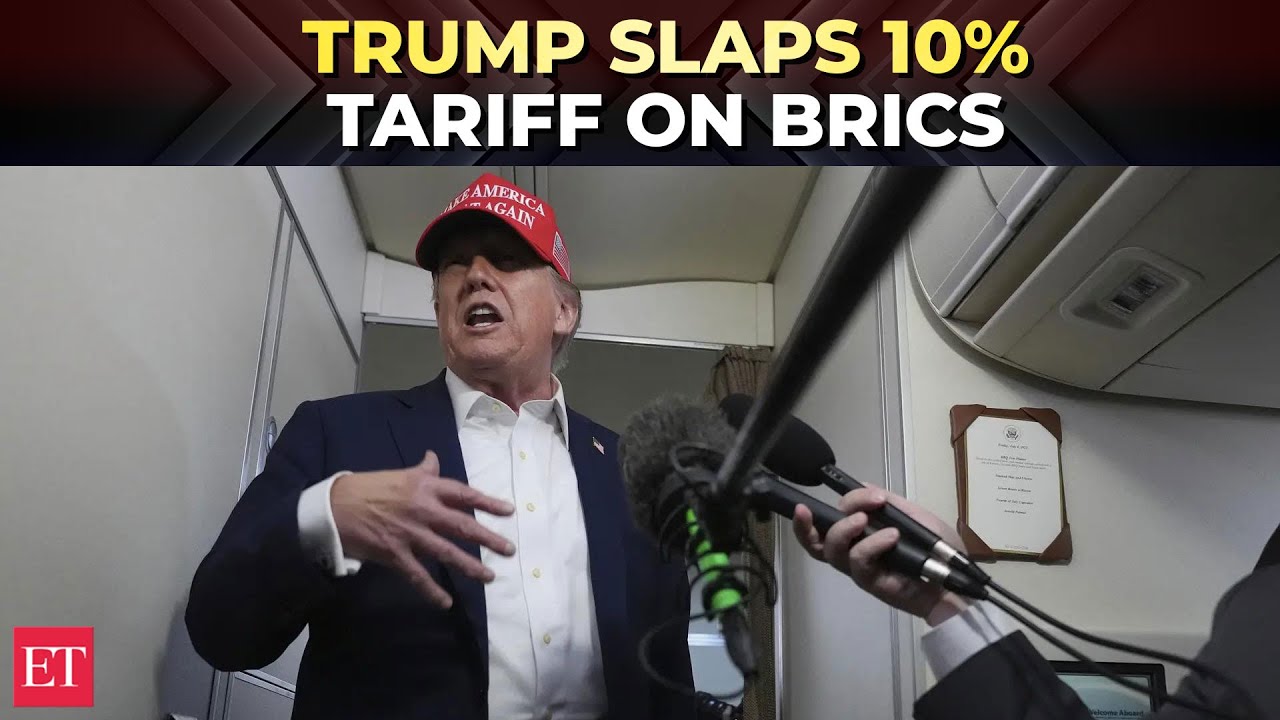
U.S. President Donald Trump has announced the imposition of an additional 10% tariff on goods from Nigeria and other countries he accuses of aligning with what he termed the “anti-American policies of BRICS.”
The declaration, made via a post on his Truth Social platform on Sunday, has sent ripples through global trade circles and heightened tensions with key developing economies.
Trump’s announcement, which coincided with the ongoing BRICS Summit in Rio de Janeiro, Brazil, came without reference to any specific actions or policies by the bloc. However, it appears to be a direct response to the BRICS group’s growing political and economic influence, and its vocal opposition to what it calls “unjustified unilateral protectionist measures.”
“Any Country aligning itself with the anti-American policies of BRICS will be charged an ADDITIONAL 10% Tariff. There will be no exceptions to this policy,” Trump wrote in his Sunday evening post.
Nigeria, which was formally admitted as a BRICS partner country on January 17, 2025, is among those affected by the new tariff directive.
The West African nation became the ninth partner under a newly created category introduced during the 16th BRICS Summit in Kazan, Russia, in October 2024. Other nations in this category include Belarus, Bolivia, Cuba, Kazakhstan, Malaysia, Thailand, Uganda, and Uzbekistan.
READ ALSO: Trump talks of peace after U.S. B-2’s strike on Iran Nuclear sites
In a joint statement issued from the summit in Rio, BRICS leaders indirectly criticized the Trump administration’s tariff policies, expressing “serious concerns about the rise of unilateral tariff and non-tariff measures which distort trade and are inconsistent with WTO rules.” They warned that such actions risk worsening global inequality and stifling economic recovery.
Despite the tariff threat, Nigerian President Bola Ahmed Tinubu reiterated his country’s commitment to the BRICS partnership and the broader vision of the Global South.
Speaking during a high-level session at the Rio summit, Tinubu stated that Nigeria “associates with what I have heard today and all that has happened in BRICS,” adding that the next phase for the bloc should focus on “financial restructuring and reevaluation of the global structure.”
In a statement issued by presidential spokesperson Bayo Onanuga, Tinubu emphasized the disproportionate burden Africa faces on issues like climate change and healthcare.
“Africa has contributed the least to global emissions but suffers the most,” he said. “We need a new path of justice anchored in fairness, sustainable technology transfer, and accessible financing.”
Tinubu outlined Nigeria’s ambitious commitments under Vision 2050, including renewable energy adoption, climate action, urban resilience, and South-South collaboration. He also highlighted domestic efforts such as the African Carbon Market Initiative and the Great Green Wall as examples of proactive climate strategy.
READ ALSO: Trump’s visa crackdown puts 16 struggling U.S. Colleges at risk of collapse—Forbes
President Tinubu also advocated for strengthening the global health architecture, particularly in tackling non-communicable diseases. He called on BRICS to serve not only as an economic bloc but also as a beacon for equitable health and environmental solutions.
“As we approach COP-30, BRICS must become a beacon for emerging solutions rooted in solidarity, self-reliance, sustainability, and shared prosperity,” he said.
He reaffirmed Nigeria’s commitment to “strategic collaboration that translates into sustainable and inclusive development for all,” especially for youth, who comprise 70% of Nigeria’s population.
The Trump administration earlier announced that the new tariffs would take effect on August 1 for countries that fail to reach a trade agreement with the United States. A 90-day pause issued in April is set to expire on Wednesday, sparking concerns among global investors and trade partners about a renewed wave of tariff wars.
The latest developments underscore the growing rift between the United States and the BRICS coalition, which now includes Brazil, Russia, India, China, South Africa, Saudi Arabia, Egypt, the UAE, Ethiopia, Indonesia, and Iran.
BRICS has positioned itself as a counterbalance to Western-led institutions, aiming to elevate the Global South’s influence in international governance.



 Health7 days ago
 Latest7 days ago
 Energy7 days ago
 Trending Stories7 days ago
 Latest5 days ago
 Latest7 days ago
 Football5 days ago
 Latest6 days ago