
Latest
Trump’s renewed push for Greenland sparks NATO alarm as White House floats military option

Published
3 months agoon
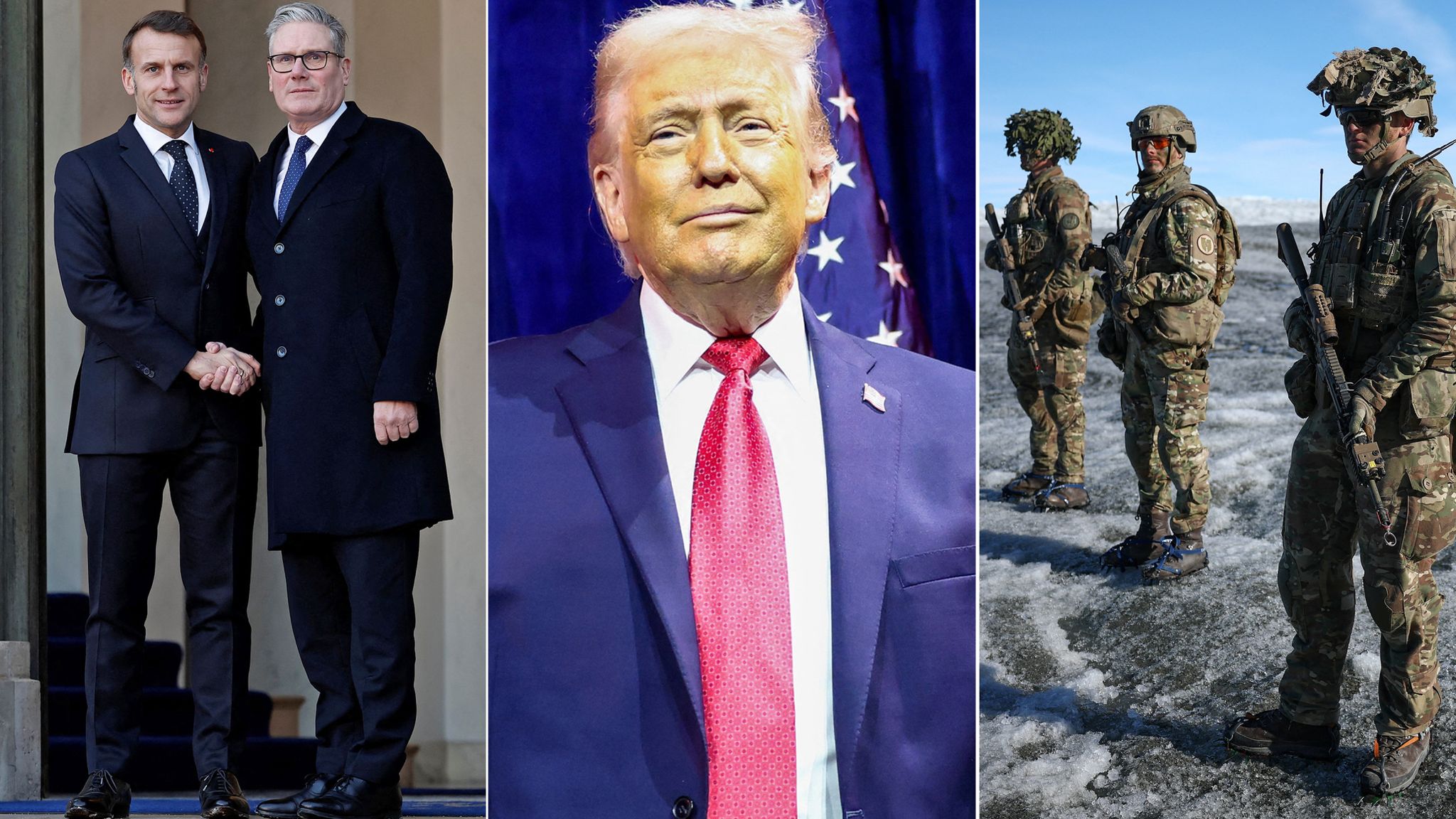
Fresh tensions have erupted between the United States and its European allies after President Donald Trump renewed his controversial push to acquire Greenland, with the White House openly stating that the use of military force remains an option — a stance that has sent shockwaves through NATO and drawn stern warnings from Denmark.
Comments by Trump and senior members of his administration suggesting that force could be used against the Danish autonomous territory have alarmed European capitals and prompted some of the strongest reactions yet, including a warning from Copenhagen that any military intervention would effectively spell the end of the NATO alliance.
The escalation comes just days after the United States reportedly used military force in an operation involving Venezuelan President Nicolás Maduro, heightening concerns in Europe about Washington’s increasingly aggressive posture.
According to a U.S. official familiar with the matter, Secretary of State Marco Rubio told lawmakers during a closed-door briefing on January 5 that the sharpened rhetoric on Greenland was part of a broader strategy to increase pressure on Denmark to sell the territory.
Despite the pressure, both Denmark and Greenland have maintained a firm stance. Following a high-level meeting at the White House on Wednesday led by Vice President JD Vance, Denmark’s Foreign Minister, Lars Løkke Rasmussen, said there remained “a fundamental disagreement” between the two sides.
Greenland, an autonomous Danish territory for more than 300 years, has long attracted U.S. strategic interest due to its vast untapped natural resources, sparse population, and crucial location in the Arctic.
The island holds deposits of diamonds, graphite, lithium, copper, nickel and gallium, as well as oil and rare earth minerals such as neodymium and dysprosium — materials critical for smartphones, advanced magnets and modern defence technologies. China and Russia are currently the world’s leading producers of many rare earth elements.
READ ALSO: Trump presses NATO backing for U.S. control of Greenland as tensions rise
Strategically, Greenland sits along the GIUK Gap — a vital North Atlantic corridor linking Greenland, Iceland and the United Kingdom — where NATO closely monitors Russian naval movements. Trump recently claimed the island was “covered” with Russian and Chinese ships, though European officials have countered that while Moscow and Beijing have increased Arctic activity, there has been no unusual surge near Greenland itself.
The United States already maintains a military presence on the island through the Pituffik Space Base, established during the Cold War and now operated by the U.S. Space Force for missile defence and space surveillance.
White House Press Secretary Karoline Leavitt reinforced Washington’s position in a January 6 statement, describing Greenland as a “national security priority” for the United States.
Security analysts have described the remarks as deeply troubling. Marion Messmer, Director of the International Security Programme at the London-based think tank Chatham House, said it was “extremely concerning” that military action had been openly threatened and not ruled out.
She noted that European leaders had no choice but to take Trump’s fixation on Greenland seriously, given the high geopolitical stakes involved.
Greenland gained expanded self-rule under the 2008 Self-Government Act, though Denmark retains responsibility for defence and foreign policy. While the territory has the legal right to declare independence, Denmark does not have the authority to sell it.
Trump first floated the idea of purchasing Greenland during his initial term, a proposal Denmark flatly rejected. Since his return to office last year, Danish officials have reiterated that the island is not for sale, while expressing willingness to cooperate with Washington on security and investment issues. Denmark also announced a $13.7 billion increase in Arctic security spending last year.
On January 4, a day after the U.S. military operation in Venezuela, Trump told reporters: “Let’s talk about Greenland in 20 days.”
Danish Prime Minister Mette Frederiksen has since issued a blunt warning in response to suggestions of military force.
“If the United States chooses to attack another NATO country militarily, everything will stop — including NATO and thus the security that has been provided since the end of World War II,” she said in a television interview.
Lars-Christian Brask, Deputy Speaker of the Danish Parliament, said Denmark was taking Trump’s comments seriously while stressing the importance of the U.S.–Danish alliance.
“One NATO country doesn’t go and require territory of another NATO country. It’s unheard of and it’s disrespectful,” he said.
Several European leaders have rallied behind Denmark, issuing a joint statement affirming the “inviolability of borders” and declaring that Greenland’s future can only be decided by Denmark and Greenland themselves. Canada also endorsed the statement.
“Greenland does not want to be owned by the United States. Greenland does not want to be governed by the United States. Greenland does not want to be part of the United States,” Nielsen said. “We choose the Greenland we know today, which is part of the kingdom of Denmark.”

You may like
Trending

 Football1 week ago
Manchester City storm into FA cup semi-finals with 4-0 rout of Liverpool

 Business1 week ago
Soaring fuel prices worsen economic hardship for Nigerians
 Latest1 week ago
Inside the daring U.S. mission to rescue stranded airman in Iran
 Latest1 week ago
2027: Fresh details emerge on Peter Obi’s political strategy amid ADC crisis

 Crime1 week ago
Fear grips Zamfara villages as bandits demand N16m or face attacks

 Latest1 week ago
Breaking: Internal pressure mounts as ADC considers leadership shift to Ralph Nwosu

 Latest6 days ago
APC plotting to frustrate Peter Obi’s 2027 ambition — Obidient Movement

 Latest1 week ago
Senator Abbo blames betrayal, internal disputes, external interference for ADC crisis