By – ABIODUN IFEOLUWA.
Thousands of residents in the
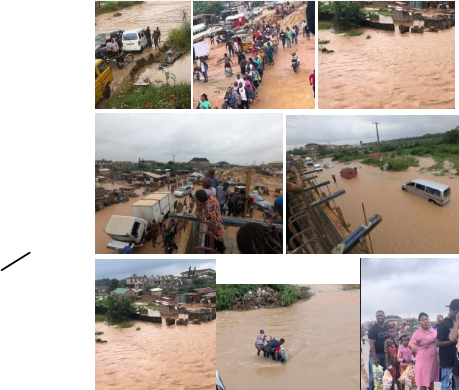
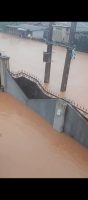
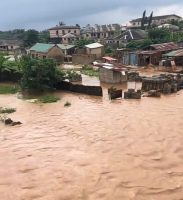
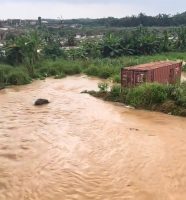
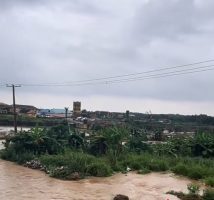
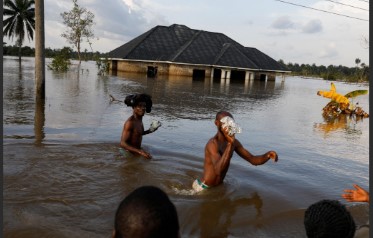
Ikorodu area of Lagos State have been left stranded after heavy rainfall caused the Afa River to overflow its banks, submerging the old Afa Bridge on the crucial Agric–Isawo Road. The flooding has drawn renewed criticism over the five-year delay in completing a new elevated bridge being constructed by HiTech Construction Company.
The downpour, which began late Sunday night and continued into Monday evening, saw water levels rise steadily until the river completely cut off access for motorists and pedestrians by Monday afternoon. The unfinished new bridge, intended to replace the ground-level crossing, left residents vulnerable and without a safe alternative route.
By Monday morning, the bridge was still accessible, but as the downpour persisted, the water level rose until the river spilled over, completely cutting off motorists and pedestrians from crossing.
National Daily Newspaper gathered that HiTech Construction Company, owned by Lebanese-Nigerian businessman Gilbert Chagoury a longtime ally of President Bola Tinubu has been handling the Agric–Isawo road construction for over five years, using interlocking concrete block pavement (ICBP).
Part of the project includes a new elevated bridge designed to replace the old ground-level crossing. However, the new bridge remains incomplete, leaving residents vulnerable whenever heavy rains hit.
Traders Count Losses :
The flooding did not only disrupt movement but also stretched several metres on both sides of the river, forcing plank sellers and petty traders near the bridge to shut down.
One plank seller, Mrs. Rukayat Sodiq, lamented:
“Whenever this river overflows, our businesses die. Customers can’t reach us, and our wood stock also gets soaked. We have been suffering this for years now. We just want the government to finish this bridge once and for all.”
A Makeshift Solution:
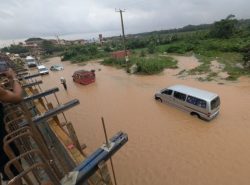
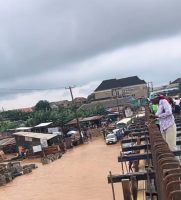
In an interim arrangement, the contractor constructed wooden staircases that allowed pedestrians to climb onto the unfinished elevated Afa bridge.
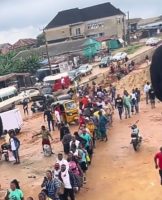
When I visited the bridge on Tuesday, scenes of hardship and resilience were on full display. From Igboolomu Junction, commuters alighted from taxis and formed queues to ascend the wooden steps.
Mr. Henry Opara, a commuter returning home, described the ordeal:
“It’s like climbing a mountain every day. Old people and children are finding it very hard. The staircase is risky, but we don’t have any other option. We can’t swim across.”
Despite the challenges, residents displayed remarkable solidarity. They encouraged one another with cautionary words such as “Don’t fall o,” and “Hold something o.”
A young man assisting an elderly woman up the stairs told me:
“We can’t leave the old ones behind. If we don’t help each other, who will? This is how we survive in Lagos.”
Vehicles at a Standstill:
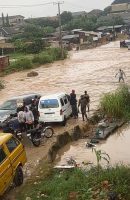
For motorists, the situation was dire. At least five vehicles had broken down in the murky floodwater, forcing drivers to wait helplessly.
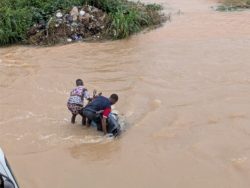
Motorcyclists struggled to drag their bikes through the current. It often required two people to haul a single motorcycle.
Drama struck when a daring motorcyclist attempted to ride across the flooded bridge, cheered on by onlookers. He eventually lost balance and fell into the water before being rescued by a bystander.
One of the spectators, who gave his name simply as Musa, said with a wry smile:
“This is how we entertain ourselves in our suffering. That man was lucky. If not for the young boy who jumped in, the river could have carried him away.”
Cost of Transport Soars:
The flooding also deepened the financial burden on residents. Before the flood, a trip from Agric Bus Stop to Igboolomu Junction cost N300, while Agric to Isawo cost N400.
Now, passengers pay the same N300 to Agric, cross the flooded bridge on foot, and then pay an additional N100 or N200 on the other side.
Miss Oyinade Adurale , a trader who sells foodstuff at Isawo, complained bitterly:
“I spend double on transport every day now. The money I make from sales is going back to transport. If this continues, I will stop selling here.”
Excavators at Work :
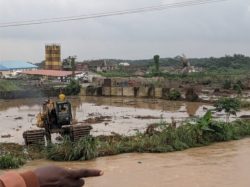
At a distance from the bridge, two excavators could be seen on the riverbank, attempting to clear and redirect the water flow. But as at the time of leaving the scene, their efforts had yet to yield visible results.
A Lingering Burden
For residents, the situation is a painful reminder of a project that has dragged on for over half a decade.
A visibly frustrated resident, Mr. Olarotimi Sijuade, summed up the collective mood:
“This road has been under construction for more than five years. Every rainy season, we suffer the same story. We are tired of promises. Let the government complete this bridge and end our suffering.”
The plight of Ikorodu residents is not just the story of one flooded bridge it is the story of failed timelines, broken promises, and the human cost of abandoned infrastructure.
Each delay in completing the Agric–Isawo road and its critical bridge is paid for daily by traders losing income, children missing school, workers stranded, and entire communities cut off.
Government cannot continue to look away while citizens risk their lives on makeshift wooden staircases and flooded roads.
Completion of this project is not a favour it is an obligation
long overdue.














 Latest1 week ago
 Latest2 days ago
 Football6 days ago
 Comments and Issues7 days ago
 Health6 days ago
 Crime1 week ago
 Business5 days ago
 Featured1 week ago