
Crime
Army captures notorious commander ‘Gentle de Yahoo’ in Imo, seizes arms

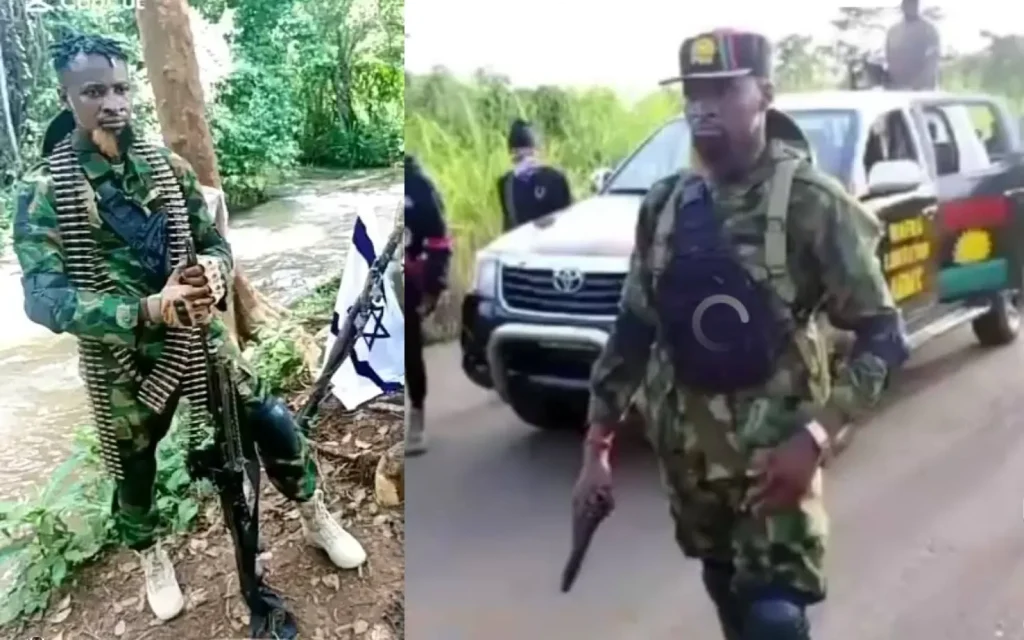
The Nigerian Army on Tuesday announced the arrest of a high-profile commander linked to the Indigenous People of Biafra (IPOB) and the Eastern Security Network (ESN), identified as Ifeanyi Eze Okorienta — popularly known as “Gentle de Yahoo.”
Troops of the 34 Artillery Brigade, acting in a joint operation with sister security agencies, apprehended the suspect at a hideout in Aku-Ihube, Okigwe Local Government Area of Imo State, the military said.
Military authorities said the operation yielded a significant haul of weapons and other incriminating items. Recovered exhibits include an English pistol, 120 rounds of 7.62mm special ammunition, 25 rounds of 7.62mm NATO ammunition, a cartridge, six mobile phones, military and police uniforms and a German flag.
Troops also discovered a workshop allegedly used to dismantle stolen vehicles for resale and destroyed 10 motorcycles found at the scene.
According to military intelligence cited in the statement, Okorienta is accused of organising “enforcement squads” that carried out violent attacks to enforce illegal sit-at-home orders across parts of Anambra and Imo states.
The Army said the commander had been linked to kidnappings, targeted killings and other criminality that terrorised communities in the Southeast for years.
Residents and security sources have blamed Gentle de Yahoo and his associates for a wave of violence in the region — including, the military noted, the killing and beheading of a military couple who travelled to Imo State for their wedding.
READ ALSO: Army Chief Oluyede Visits Katsina After Killings, Vows to Crush Bandits
The Army described the arrest as part of sustained efforts to dismantle criminal networks that have undermined peace and economic activity in the Southeast.
The arrest drew swift reactions from Igbo socio-cultural and political leaders. Ohanaeze Ndigbo, led by President General Jackson Omenazu, lauded the Federal Government and security agencies for the operation.
In a statement signed by Deputy President General Mazi Okechukwu Isiguzoro and National Spokesman Chief Chinemeze Ohia, the group praised the roles of the Office of the National Security Adviser, the Minister of State for Defence and the Chief of Defence Staff.
Ohanaeze described Gentle de Yahoo as “the self-proclaimed leader of the AUTO-PILOT MILITIA, and the nonexistent Biafran Army,” and urged remaining fighters to lay down their arms, saying “the era of impunity is over.”
The group blamed violent Biafran factions for enforcing destructive Monday sit-at-home orders that it said crippled the Southeast’s economy and drove away investment.
Also reacting, All Progressives Congress (APC) chieftain Joe Igbokwe hailed the arrest as a liberation of the Southeast. In a Facebook post he accused Gentle de Yahoo of being responsible for the deaths of “more than a thousand Igbos between 2015 and 2025,” and thanked military authorities for the capture.
The development has rekindled guarded optimism among many residents and Igbo stakeholders. A top local stakeholder, speaking on condition of anonymity, told reporters the arrest could be the first step toward restoring normalcy: “Every Monday we have been forced to stay indoors out of fear. These commanders thrive on intimidation. Hearing that one has been caught is good news.”
Social-media reaction reflected jubilation and cautious relief. Posts on X (formerly Twitter) ranged from outright celebration — “Glory be to God gentle de Yahoo has been arrested” — to requests for official confirmation before celebrating. Others described the suspect as a “political assassin” allegedly used to eliminate opponents under the guise of activism.
Security officials have not yet released full details of the intended next steps, including transfer, formal charges or planned prosecution.
The Army said the exhibits recovered would form part of evidence for ensuing investigations, and that operations to pursue other suspected commanders and criminal cells in the region would continue.
The arrest marks one of the most prominent captures of a suspected commander in recent years and will likely intensify interest in how federal and state authorities follow up with investigations and legal proceedings aimed at dismantling networks accused of fueling insecurity across the Southeast.


-

 Business5 days ago
CBN reduces MPR by 350bps to 23% in major monetary policy shift
-

 Business7 days ago
Jetour takes T1 adventure SUV experience to Abuja, targets growing Nigerian market
-

 Football4 days ago
Saka: England still carry World Cup scar
-
 Comments and Issues5 days ago
Sometimes, goodwill finds us through the people we love
-

 Football7 days ago
Nigeria vs Colombia: Falconets battle for U-20 World Cup semi-final ticket
-
 Football1 week ago
Breaking:Brighton shocks Arsenal 3-0 as Gunners’ perfect start comes crashing down
-

 Latest2 days ago
Arsenal eye €70-80m move for Real Madrid star
-
 Comments and Issues6 days ago
Peter Obi and the Pensioners’ Testimony