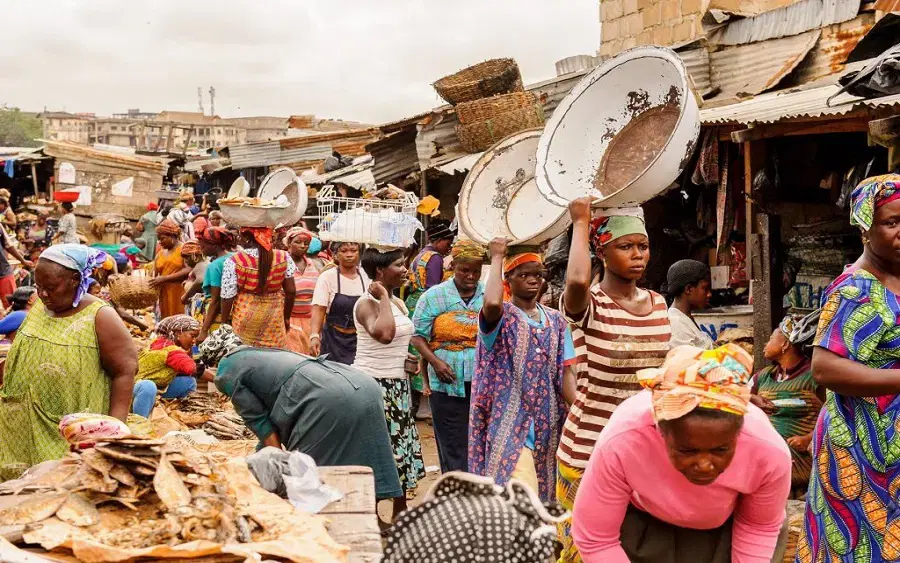
Nigeria’s worsening poverty crisis has moved beyond speculation and into what analysts describe as a statistically inevitable reality, as fresh data and projections reveal that economic reforms have failed to translate into improved living conditions for millions of citizens.
While the latest Consumer Price Index (CPI) figures released by the National Bureau of Statistics (NBS) suggest that headline inflation is moderating and macroeconomic indicators show tentative signs of recovery, the lived experience of Nigerians continues to deteriorate sharply.
According to PwC’s Nigeria Economic Outlook 2026, an additional two million Nigerians are projected to fall into poverty next year, pushing the total number of poor people to about 141 million—roughly 62 percent of the population and the highest level ever recorded in the country’s history.
The outlook presents a stark contradiction: eight consecutive months of easing inflation and modest growth on paper, yet deepening hardship on the ground.
Experts say the widening gap between official statistics and everyday realities exposes a structural crisis rooted in weak policy coordination, inconsistent reforms, and inadequate social protection.
“Macroeconomic stability does not automatically translate to human welfare,” said Dr. Ayo Teriba, an economist and CEO of Economic Associates.
“Nigeria’s challenge is that reforms have been front-loaded, while social buffers have been back-loaded or entirely absent. Poverty has become the most visible outcome of reform, not a temporary side effect.”
When the current administration assumed office in 2023, it promised a bold economic reset, swiftly implementing fuel subsidy removal, exchange-rate liberalisation, and tighter fiscal discipline.
These measures were widely applauded by international partners for their long-term logic. However, their short-term consequences have been devastating for households.
Inflation, often described as a “silent tax,” has eroded purchasing power and punished wage earners. Although the NBS reported in December 2025 that headline inflation eased to 15.15 percent—largely due to a rebasing of the CPI—from 34.8 percent a year earlier, the relief has been mostly statistical.
“Changing the base year does not change the arithmetic of survival,” said Prof. Muda Yusuf, Director of the Centre for the Promotion of Private Enterprise (CPPE). “When households spend 70 to 80 percent of their income on food, claims of easing inflation feel detached from reality.”
READ ALSO: Inflation falls to a five-year low, but Nigerians still feel economic strain
Food inflation, officially reported at 10.84 percent year-on-year, remains particularly punishing. PwC data further highlights the disconnect: while nominal household spending rose by nearly 20 percent in 2025, real household spending contracted by 2.5 percent, meaning Nigerians are spending more money to consume less.
Economic growth, hovering around 4 percent, has also failed to lift households meaningfully. Analysts argue that Nigeria requires sustained growth of between 7 and 9 percent to significantly reduce poverty. “Anything below that merely slows the descent,” said Teriba.
According to the NBS Multidimensional Poverty Index, about 133 million Nigerians—63 percent of the population—are multidimensionally poor, with poverty heavily concentrated in insecure regions.
About 86 million poor Nigerians live in the North, where insecurity is most severe. Rural poverty stands at 72 percent, compared to 42 percent in urban areas, while some conflict-affected states record poverty rates as high as 91 percent.
“Insecurity is no longer just a security issue; it is one of Nigeria’s most powerful poverty drivers,” said Dr. Zainab Usman, a political economist. Conservative estimates suggest Nigeria loses about $15 billion annually—roughly ₦20 trillion—due to insecurity-related disruptions across agriculture, trade, manufacturing, and transportation.
Yet, despite the scale of the crisis, poverty alleviation remains marginal in fiscal planning. The proposed 2026 federal budget of N58.47 trillion allocates just N206.5 billion—about 0.35 percent of total spending—to projects directly tagged as poverty reduction. This is less than one percent of the capital budget.
Nigeria’s fiscal position further complicates the outlook. The 2026 budget carries a deficit of N23.85 trillion, with debt servicing projected at N15.52 trillion—nearly half of expected revenue. Public debt has risen above N152 trillion, raising concerns that borrowing is increasingly used to fund recurrent spending rather than productive investment.



 Health1 week ago
 Latest7 days ago
 News1 week ago
 Business6 days ago
 Business1 week ago
 Business7 days ago
 Latest1 week ago
 Latest7 days ago