
News
Fubara advocates leadership, public interest as pillars of good governance

Published
1 year agoon
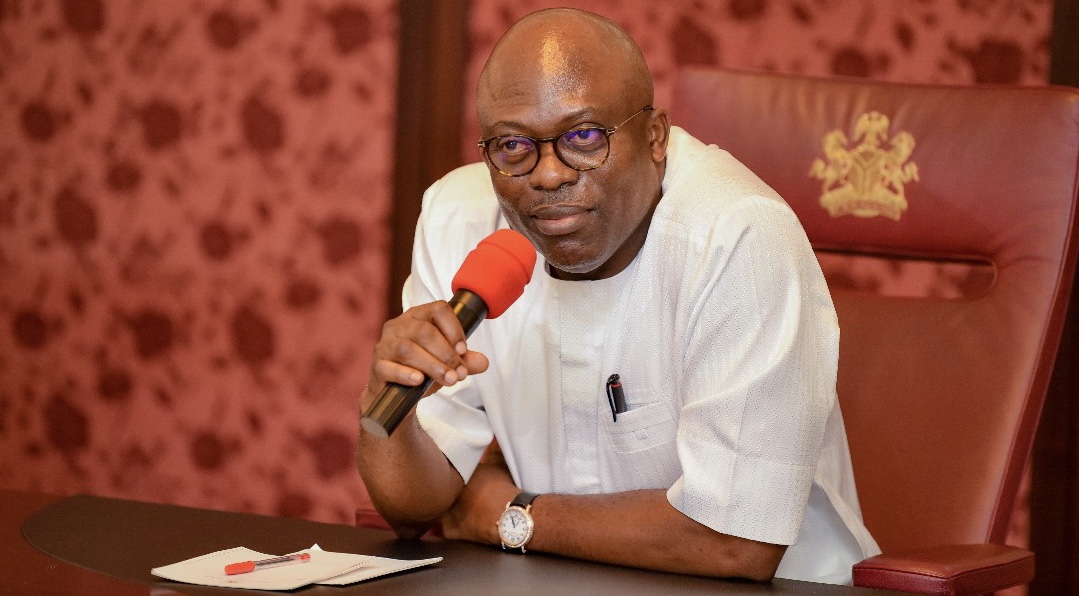
Governor Siminalayi Fubara of Rivers State has emphasized that meaningful leadership and prioritizing public interest are essential components of good governance.
He made this assertion while delivering a keynote speech at the Freedom Online 6th Yearly Lecture, held at Sheraton Lagos Hotel, Ikeja, on Thursday, February 27, 2025.
Represented by former Deputy Governor of Rivers State, His Excellency Engineer Tele Ikuru, Fubara spoke on the theme, “Nigeria’s Socio-Political Challenges: Whose Fault, Leaders or the Led?”
He stated that addressing this question requires a critical examination of governance, accountability, and citizen participation.
He stressed that both leadership and followership play integral roles in shaping the socio-political landscape and must work collectively to ensure national progress.
In his address, Governor Fubara underscored the importance of public interest in policymaking. According to him, governance must be people-centric to be effective and impactful.
“For the government to be effective and impactful, the needs of the people must be at the center of public policy. This is because development is ultimately about the people. Therefore, the present and future needs of the people must constantly shape both public policy and governmental action. This is why in Rivers State today, under my leadership, our governance philosophy is RIVERS FIRST. By this philosophy, we run a government that is inclusive, participatory, and prioritizes the needs of our people first in all that we do as government,” he stated.
READ ALSO: Tinubu holds consultation meeting with Fubara, Ogoni leaders, Wike on peace in Ogoni land
The Governor further stressed that leadership must be meaningful and beneficial to the people. He reiterated that leaders have the responsibility to drive positive change and improve the living standards of their citizens.
“Indeed, responsive leaders can move the people from where they are to where they ought to be. Any leadership that does not elevate the people to a better standard or quality of life may lose legitimacy and alienate the people. In fact, the mettle of leadership is often judged by the way it treats the vulnerable majority rather than the privileged few.
“This is why in Rivers State, we are building 20,000 housing units for low-income workers to lift them to a better quality of life. This is the largest public housing scheme in the history of Rivers State since 1967. We are also reviving our primary healthcare delivery system and deepening healthcare penetration to all communities in Rivers State.”
Fubara emphasized the need to strengthen institutions to allow them to function independently without undue political interference. He also highlighted the importance of civic education in fostering an informed and engaged electorate.
“Citizens need to be educated on their rights and responsibilities in governance. The media remains a critical partner in guaranteeing that citizens are appraised of their rights and responsibilities. Traditional institutions also have a role to play in citizens’ education and enlightenment,” he said.
He urged civil society organizations, the media, and individuals to continue demanding transparency and accountability in governance, stating that openness is crucial to building trust between the government and the people.
Governor Fubara called for ethical leadership, stressing that political parties must prioritize candidates with integrity and competence. He also underscored the need for electoral integrity to ensure credible leadership selection.
“Improving electoral integrity will ensure free, fair, and credible elections, which is crucial for better leadership selection. Political parties must prioritize candidates with integrity and competence over personal or political affiliations,” he stated.
On the issue of youth empowerment, Fubara emphasized the importance of skill acquisition and job creation in tackling unemployment and youth restiveness.
“In Rivers State, youth empowerment and social investment are key components of our 2025 budget. Addressing unemployment through economic empowerment will significantly reduce insecurity and social unrest,” he added.
In his conclusion, Governor Fubara reiterated that Nigeria’s socio-political challenges are a shared responsibility between leaders and the led. He stated that while leaders must be accountable and implement people-centered policies, citizens must also actively participate in governance and hold their leaders accountable.
READ ALSO: Fubara Did Not Lose at Supreme Court – HURIWA exposes misinformation campaign
“Leaders must implement patriotic policies and strengthen institutions, while citizens must become more politically conscious, demand accountability, and vote based on competence rather than sentiment. In Rivers State and across Nigeria, we must break the cycle of poor leadership and passive followership by fostering a culture of civic engagement and ethical governance.”
He further emphasized that Nigerians must take ownership of the country’s progress rather than relying on external intervention.
“Foreigners will not fix Nigeria for us. Until Nigerians take full ownership of the country’s problems and solutions, the cycle of poor governance and underdevelopment will persist. The choice is ours: to act decisively and change Nigeria’s trajectory or remain in a state of stagnation, blaming one another while the nation deteriorates.”
Earlier in his opening remarks, Gabriel Akinadewo, Managing Director and Editor-in-Chief of Freedom Online, posed critical questions on Nigeria’s governance and democratic journey.
“This inquiry leads us to examine the relationship between citizens and their elected representatives, and the accountability that binds them. Twenty-six years into our democratic journey that began in 1999, we must candidly assess whether Nigerians are satisfied with the state of our nation. What must our leaders do to earn public trust? Equally important, what responsibility do citizens bear in ensuring accountable governance? And how do we distinguish between political maneuvering and substantive governance?” he asked.
He called for urgent reforms in the political and judicial systems, stating that delayed justice and politically motivated cases weaken the country’s democratic fabric.
“Our political and judicial systems require urgent reform. Why must straightforward cases, particularly those of political significance, become entangled in technical complexities and languish in our courts for months? As the world advances, Nigeria cannot afford stagnation,” he added.

You may like
Trending

 Business1 week ago
Nigeria braces for cost surge amid 2026 inflation projections
 Latest6 days ago
ADC accuses INEC of misinterpreting court order, demands chairman’s removal amidst growing leadership crisis

 Business1 week ago
Naira slips to N1,387/$ in March amid persistent FX market turmoil

 Football5 days ago
Manchester City storm into FA cup semi-finals with 4-0 rout of Liverpool

 Health1 week ago
Emails expose concerns within CDC, FDA over COVID-19 vaccine data mining system
 Business5 days ago
Soaring fuel prices worsen economic hardship for Nigerians
 Football1 week ago
Gravina Resigns as Italy FA President After World Cup Failure

 Football1 week ago
Super Eagles to Face Poland, Portugal in June Friendlies