
Business
Group scolds World Bank over subsidy crisis

Published
3 years agoon
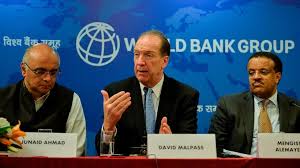
A group, the Movement for Fundamental Change, in Nigeria, has scolded the World Bank for imposing subsidy removal on the Nigerian government without requisite commitment to domestic production of petrol in the country.
Movement for Fundamental Change rises to challenge the imperialism of the World Bank to ensure the continuous underdevelopment of Nigeria.
Movement for Fundamental Change in a statement by the Chairman, Oloye Adegboyega Adeniji, and Senior Analyst, Alhamdu Ayuba, scolded the World bank for prescribing an economic therapy to Nigeria that has failed over the time. They argued that the neo-liberal policies imposed on the Nigerian government are inconsistent with the socio-economic culture and development agenda on the country.
The group recalled that former Vice-President Osinbajo had in 2016, said: “The downstream sector has been deregulated with the elimination of petroleum subsidy. This policy was removed from government, a burden of not less than N15.4 billion monthly”. They group, therefore, asked why the World Bank now come back again to the same “remove subsidy” chorus? “It seems the World Bank misunderstands the hyper-inflationary impact of increasing the price of imported fuel,” the group protested.
The Movement for Fundamental Change, was of the view that lazy World Bank “researchers” simply copy generic neo-liberal templates and recommend them inappropriately to Nigeria, without a good understanding of the country’s socio-economic challenges. The group asserted that home-made economic plan of the General Abacha era under the leadership of Prof. Sam Aluko, showed much better results than all the inappropriate World Bank recommendations since the last 40 years.
READ ALSO: Group slams NNPC over $3bn crude repayment loan
The group argued further that the World Bank correctly identified the problem as corruption in the Nigeria’s government, which the Bank identified to include smuggling subsidised imported petroleum products out the country. Adegboyega Adeniji and Alhamdu Ayuba argued that logically, the World Bank should recommend the tackling of massive corruption in the system that it identified correctly, but the Bank, in advancing its imperial policies, foisted its pre-determined neo-liberal conclusion that is clearly catastrophic.
They highlighted how fuel price has been increased over 20 times from 8kobo/litre in 1973 to N570/litre presently in 2023 with catastrophic consequences.
they insisted that the imperial policy will continue to destroy the Nigerian economy, declaring that enhancing the production capacity of refineries for domestic production of petrol is the solution to the subsidy crisis.
The statement transmitted to National Daily Newspaper reads:
Tinubu, World Bank and Subsidy removal
Fuel subsidy removal and other World Bank programs and recommendations to Nigeria have all failed consistently as we predicted. These neo-liberal postulations of the World Bank are inconsistent with our social-democratic culture and developmental agenda.
READ ALSO: Tinubu administers Oath of Office on new ministers
In December 2016, Vice-President Osinbajo said, “The downstream sector has been deregulated with the elimination of petroleum subsidy. This policy was removed from government, a burden of not less than N15.4 billion monthly”. Now, why did the World Bank come back again to the same “remove subsidy” chorus? It seems the World Bank misunderstands the hyper-inflationary impact of increasing the price of imported fuel.
Apparently, lazy World Bank “researchers” simply copy generic neo-liberal templates and recommend them inappropriately to Nigeria, without a good understanding of our socio-economic challenges. The home-made economic plan of the General Abacha era under the leadership of Prof. Sam Aluko, showed much better results than all the inappropriate World Bank recommendations since the last forty years.
The World Bank correctly identified the problem as corruption in the government, which according to the same World Bank includes smuggling subsidised imported petroleum products out of Nigeria. logically, the World Bank should recommend that we address the issue of massive corruption that it identified correctly, but the World Bank jumped to its pre-determined neo-liberal conclusion that is clearly catastrophic.
Fuel price has been increased over twenty times from 8kobo/litre in 1973 to date. By 1983, it was 20kobo/litre. By 1993, it was N3.25/litre. By 2003, it was N42/litre, all the way to N570/litre presently with catastrophic consequences. Why are lazy World Bank researchers repeating a remedy that has consistently failed over ten times? We challenge the World Bank to a debate on this. With the level of mass poverty in Nigeria, this increase in fuel price has made our situation even worse. Macro-economic instability, inflation, unemployment, poverty, disease and insecurity are all increasing. The Naira is further devalued.
The permanent solution to the fuel subsidy is simple and has been known since the Alhaji Shagari administration. We must stop the wasteful importation of expensive petroleum products by increasing domestic refining capacity. To increase domestic refining capacity is simple. We merely maintain and upgrade the existing refineries and build more public or private refineries.
signed:
Oloye Adegboyega Adeniji Alhamdu Ayuba,
Chairman, MFC Seniuor Analyst

You may like

INEC Extends The Deadline for Party Register Submission Ahead of 2027 Elections


Nigeria Declares Readiness to Host 2030 Commonwealth Games


BREAKING: The Head of Service of the Federal Capital Territory (FCT), Grace Adayilo is dead


Nigeria, Switzerland begin talks on artefact repatriation and cultural cooperation

El-Rufai rules out 2027 ambition, Says He’s back to mentor youth, Support credible leadership

NMDPRA – Nigerians spend N1.3tn on petrol in June amid soaring energy costs
Trending
 Latest1 week ago
ADC accuses INEC of misinterpreting court order, demands chairman’s removal amidst growing leadership crisis

 Football7 days ago
Manchester City storm into FA cup semi-finals with 4-0 rout of Liverpool
 Business6 days ago
Soaring fuel prices worsen economic hardship for Nigerians
 Latest7 days ago
2027: Fresh details emerge on Peter Obi’s political strategy amid ADC crisis

 Health1 week ago
Study finds higher risk of heart inflammation in teens after mRNA COVID-19 vaccination

 Latest6 days ago
Inside the daring U.S. mission to rescue stranded airman in Iran
 Latest6 days ago
Breaking: Internal pressure mounts as ADC considers leadership shift to Ralph Nwosu
 Latest1 week ago
Fani-Kayode knocks Peter Obi after explosive NADECO-Abacha post