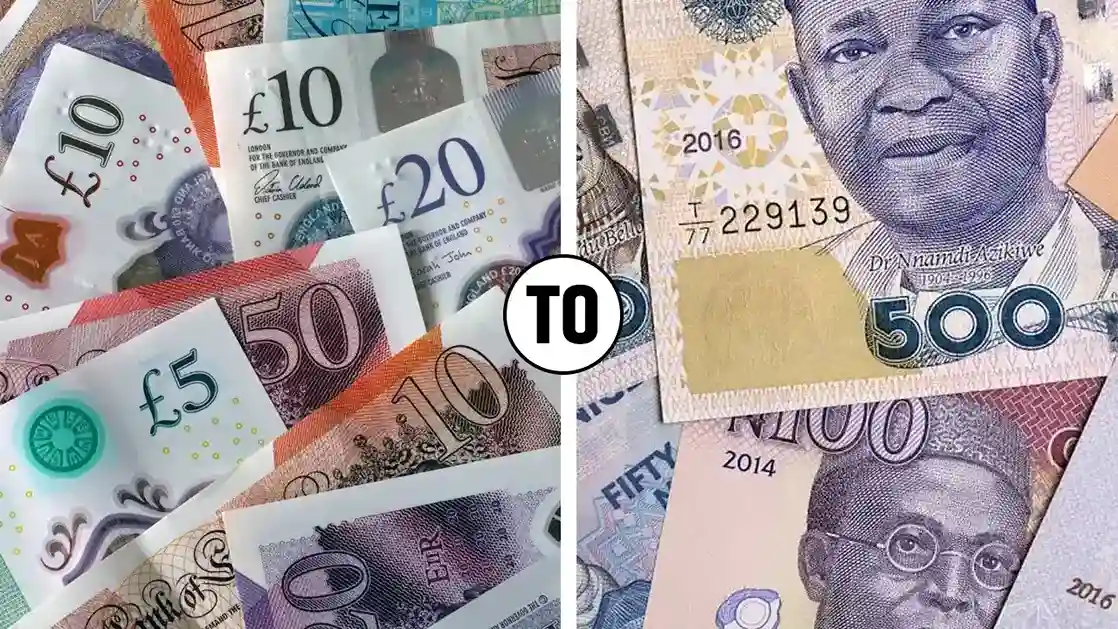
The Nigerian naira remained stable at ₦2,200 to the British pound in the parallel market on Thursday, showing resilience despite a significant decline in the value of the pound sterling on the global foreign exchange market, triggered by rising political and economic uncertainties in the United Kingdom.
While the British pound entered a correction phase due to renewed concerns over the UK’s fiscal stability, the naira showed no immediate reaction in the informal forex market.
Market analysts described the naira’s behavior as a consolidation pattern, reflecting local dynamics rather than global currency shifts.
Sterling came under pressure following emotional scenes in the UK Parliament, where Finance Minister Rachel Reeves appeared visibly shaken after Prime Minister Keir Starmer declined to reaffirm her position as Chancellor of the Exchequer.
This followed the government’s controversial decision to reverse welfare reforms, which weakened investor confidence and prompted a nearly 1% drop in the pound alongside a sharp sell-off in UK government bonds.
Despite the external turmoil, the naira’s muted response is seen as a sign of local market stickiness, possibly due to strong demand for foreign currency, constrained supply, or speculative sentiment.
The UK, home to the largest Nigerian diaspora outside Africa, continues to strengthen economic ties with Nigeria, offering reassurance amid global market volatility.
Under the Developing Countries Trading Scheme (DCTS), the UK has confirmed that 99% of Nigerian exports remain eligible for duty-free access, a move aimed at deepening bilateral trade.
This policy is expected to lower tariffs on thousands of Nigerian products, ease export processes, and unlock broader access for Nigerian businesses in the UK market.
READ ALSO: Naira gains ground in official market as U.S. Dollar sinks to lowest level
Speaking on the current economic relationship, UK High Commissioner to Nigeria, Dr. Richard Montgomery, lauded Nigeria’s ongoing economic reforms. He noted that the country’s progress in tax administration and revenue collection has improved its fiscal outlook and investor confidence.
“There’s been an increase in Nigeria’s foreign exchange reserves, which lowers investment risk. Government revenue collection has improved without raising taxes—thanks to recent reforms,” Montgomery said.
He backed the May 2025 Nigeria Development Update (NDU), which concluded that the naira had stabilized, reinforcing the World Bank’s optimism regarding Nigeria’s economic trajectory.
Montgomery emphasized that both nations are positioning for stronger cooperation, with bilateral trade already valued at £7.2 billion.
Investors are now shifting their attention to the U.S. Labor Department’s June employment report, due Thursday, as recession fears mount following weaker-than-expected private payroll data.
Meanwhile, former President Donald Trump’s announcement of a new trade agreement with Vietnam, just ahead of a July 9 tariff deadline, buoyed market optimism in Asia and supported risk sentiment globally.
Despite these global fluctuations, Nigeria’s parallel market remains relatively isolated, driven largely by local demand, monetary policy expectations, and speculation. Stakeholders continue to monitor how macroeconomic reforms and external partnerships may eventually shape exchange rate stability in the months ahead.



 Football7 days ago
 Business6 days ago
 Business6 days ago
 Latest4 days ago
 Crime1 week ago
 Business7 days ago
 Football6 days ago
 Football1 week ago