The death toll from the tragic train collision at Bekasi Timur Station near Jakarta has risen to 16 after another victim succumbed to injuries sustained in the crash, Indonesian authorities confirmed on Wednesday.
The latest victim, identified as 25-year-old Mia Citra, reportedly died at Bekasi City Hospital following emergency surgery, according to officials from Indonesia’s National Search and Rescue Agency (Basarnas).
Authorities disclosed that all 16 fatalities recorded from the accident were women, as the impact of the collision was concentrated on a female-only carriage at the rear of a commuter train.
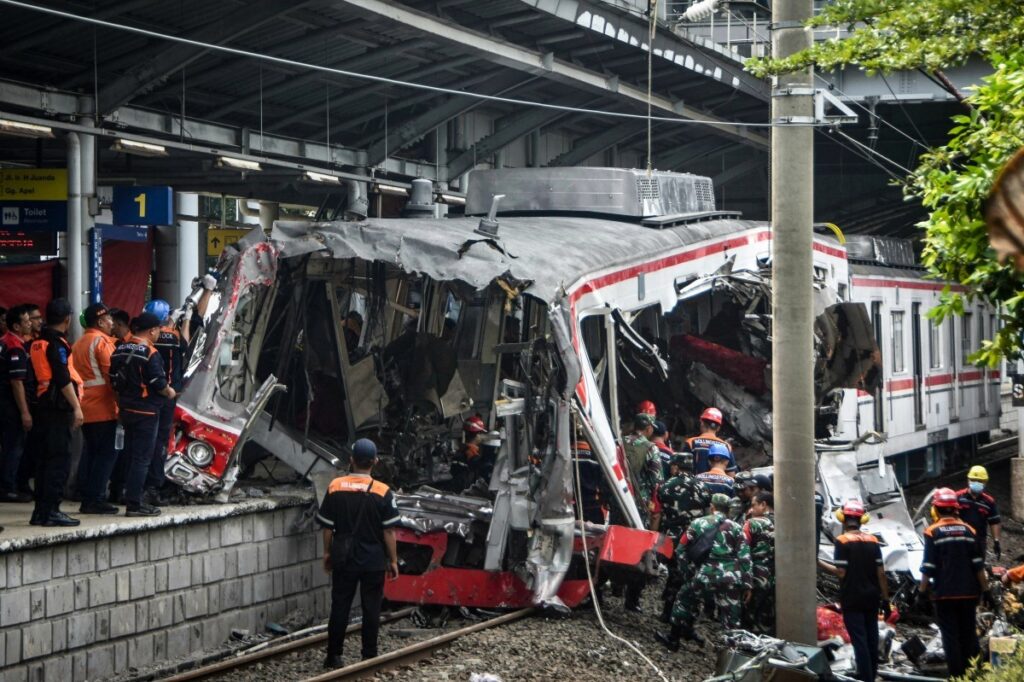
The deadly incident occurred late Monday night when the Argo Bromo Anggrek express train, traveling from Jakarta to Surabaya, slammed into the back of a stationary commuter train at Bekasi Timur Station.
Investigators said the commuter train had been forced to stop after an earlier accident involving a taxi at a nearby level crossing.
According to preliminary findings, a taxi reportedly stalled on the railway tracks and was struck by another train heading toward Jakarta, causing disruptions along the route and forcing the Cikarang-bound commuter service to halt at the station.
Moments later, the high-speed express train, traveling at an estimated speed of 110 kilometres per hour, crashed into the rear section of the stationary commuter train.
The force of the collision crushed the final carriage, which had been designated exclusively for female passengers, trapping dozens of commuters inside twisted metal debris.
Emergency responders and rescue workers spent more than 12 hours at the scene using hydraulic cutting equipment and heavy rescue tools to free trapped passengers from the wreckage.
Indonesian authorities confirmed that a total of 106 people were affected by the disaster, including 90 injured passengers. Officials said 46 victims remain hospitalized, while three are receiving intensive care treatment. Forty-four others have since been discharged after receiving medical attention.
President Prabowo Subianto visited some of the injured victims on Tuesday and ordered an immediate nationwide audit of railway level crossings and rail safety infrastructure.
The Indonesian government blamed poor safety conditions and infrastructure weaknesses for the recurring accidents at rail intersections across the country.
President Subianto also approved emergency funding estimated at Rp20 billion to support medical treatment, infrastructure repairs, and relief efforts for affected families.
West Java Governor Dedi Mulyadi announced that families of the deceased would receive compensation packages worth Rp50 million each, while additional support would be provided for children and dependents of the victims.
Meanwhile, the Ministry of Transportation has launched a formal investigation into the taxi company linked to the earlier incident that triggered the rail disruption.
The tragedy has also sparked renewed debate over the positioning and safety of women-only train carriages in Indonesia’s rail system. Safety advocates have questioned whether placing designated female compartments at the rear of trains exposes passengers to greater risk during rear-end collisions.
Rail services along the Bekasi-Cikarang route have partially resumed, although transport officials warned commuters to expect delays as engineers continue repair work on damaged tracks and signalling systems.




 Health1 week ago
 Crime1 week ago
 Business1 week ago
 Agribusiness7 days ago
 Business1 week ago
 Health1 week ago