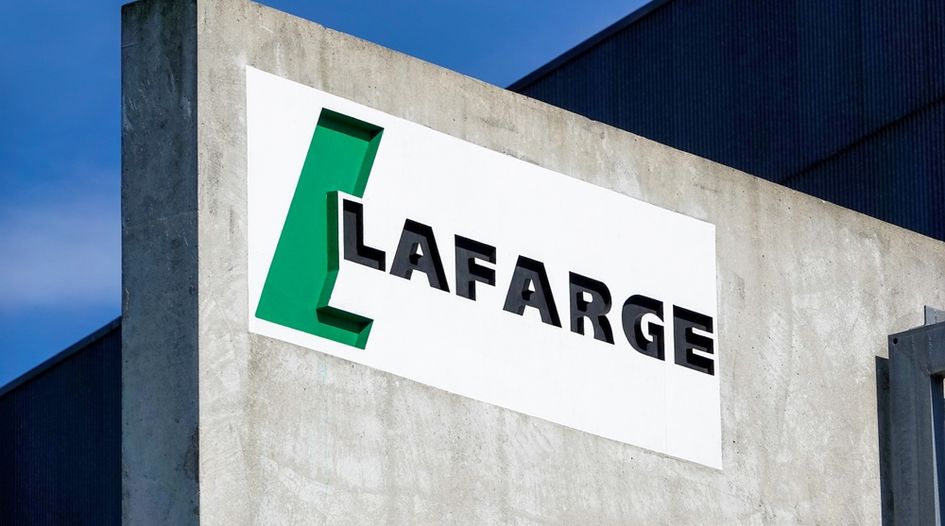
A French court in Paris has convicted cement giant Lafarge of paying €6.5 million to jihadist groups, including the Islamic State (IS) and the al-Qaeda-linked Nusra Front, in a landmark ruling that marks the first time a company has been tried in France for financing terrorism.
The court found that the payments were made to ensure continued operations at the company’s Syrian plant during the country’s civil war, but ruled that the funds ultimately supported terrorist organisations responsible for widespread violence in the region and beyond.
As part of the judgment delivered on Monday, former Lafarge Chief Executive Officer Bruno Lafont was sentenced to six years in prison for terrorism financing, while former deputy managing director Christian Herrault received a five-year sentence.
The court also imposed a fine of €1.125 million on the company, which is now owned by Swiss conglomerate Holcim.
Prosecutors told the court that Lafarge continued operations at its Syrian facility after most multinational firms had withdrawn from the country following the outbreak of civil war in 2012. While foreign staff were evacuated, local employees reportedly remained on site until 2014, when Islamic State forces seized control of the plant.
The court heard that the company used intermediaries to make payments that allowed staff and goods to move safely in and out of the facility, effectively securing operational continuity amid escalating conflict.
Presiding Judge Isabelle Prévost-Desprez said it was clear that the payments were intended to keep the factory running, but stressed that they also strengthened armed groups responsible for attacks in Syria and abroad.
READ ALSO: Why UK government classified IPOB as terror group
“These payments were essential in enabling the terrorist organisations to gain control of Syria’s natural resources, allowing them to finance terrorist acts within the region and those planned abroad, particularly in Europe,” she said.
She added that the scale and secrecy of the payments contributed to the “extreme gravity” of the offences.
Herrault defended the decision to maintain operations at the plant, arguing that it was motivated by concern for the safety and welfare of local employees trapped in a conflict zone.
Lafarge acknowledged the court’s findings, stating that the conduct in question occurred more than a decade ago and was in “flagrant violation” of its corporate code of conduct.
The company, which has significant global operations, including in Nigeria, has faced sustained legal scrutiny since investigations began in 2017 into its activities in Syria.
In Nigeria, Lafarge operates as one of the country’s major cement producers with an installed capacity of about 10.5 million metric tonnes per annum across multiple plants. The company has recently announced expansion plans for its Ashaka plant in Gombe State and its Sagamu plant in Ogun State.
The ruling comes amid heightened global and domestic scrutiny of terror financing networks. In Nigeria, authorities recently published a list of individuals and groups allegedly linked to terrorism financing as part of intensified efforts to disrupt funding channels supporting armed groups and separatist movements.
The case against Lafarge underscores growing international legal pressure on corporations operating in conflict zones, particularly regarding the risks of indirect financing of armed groups in pursuit of business continuity.



 Latest7 days ago
 Latest1 week ago
 Football7 days ago
 Business5 days ago
 Comments and Issues4 days ago
 Business6 days ago
 Crime5 days ago