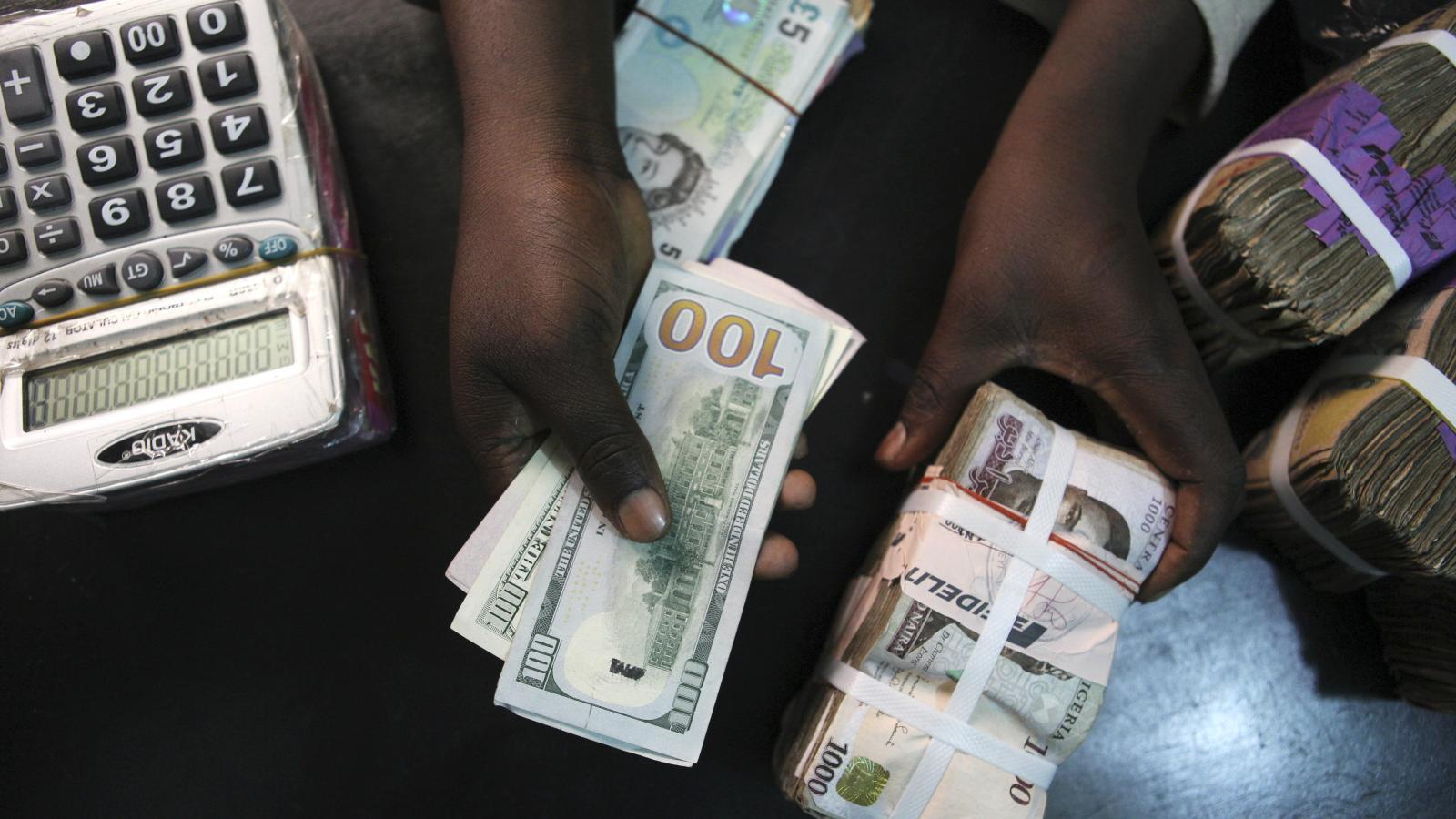
The Nigerian naira weakened against the US dollar in both the official and parallel foreign exchange markets on Tuesday, despite beginning the week on a strong note amid positive macroeconomic fundamentals.
Data from the Central Bank of Nigeria (CBN) showed that the naira dropped slightly at the official window, closing at N1,533/$ on Tuesday, compared to N1,531.95/$ recorded on Monday — a N1.15 depreciation within 24 hours.
In the parallel market, the local currency also lost ground, falling to N1,565/$, down from N1,560/$ the previous day.
The decline erased a key support level for the naira, even as market optimism remained high due to a surge in capital inflows and rising external reserves.
Despite the naira’s mild depreciation, analysts remain optimistic about the currency’s near-term prospects.
On Monday, the naira had appreciated against the greenback, buoyed by increased demand for Nigerian assets, which also boosted the country’s external reserves to $39.54 billion as of August 1.
The positive sentiment was largely driven by foreign portfolio investments (FPIs), particularly into the CBN’s open market operations (OMO) — offering high yields to foreign investors amid global rate cuts.
According to the National Bureau of Statistics (NBS), Nigeria attracted $5.642 billion in capital inflows in Q1 2025.
Of that, portfolio investment accounted for a massive $5.204 billion, dwarfing foreign direct investment (FDI) at $126.29 million, and other investments at $311.17 million.
The United Kingdom led the pack with $3.681 billion, representing 65.26% of total inflows. South Africa followed with $501.29 million, while Mauritius contributed $394.51 million.
Economists say this renewed interest in Nigerian financial instruments signals stronger investor confidence, which could support naira recovery if sustained over the coming months.
READ ALSO: Naira faces renewed pressure amid Dollar strength, market volatility
Internationally, the US dollar remained subdued on Wednesday amid lingering market caution over President Donald Trump’s expected nomination to the Federal Reserve Board, following the exit of Governor Adriana Kugler.
The US Dollar Index (DXY), which measures the strength of the greenback against six major currencies, was down 0.1% at 98.527, marking a near four-month low after the release of a weak US jobs report.
The muted trade also followed poor performance in the US services sector in July and rising producer input costs — all of which fuelled speculation that the Federal Reserve may cut interest rates by September.
Current market expectations indicate a 90% probability of a September rate cut, with approximately 60 basis points of easing priced in before year-end.
Meanwhile, Trump’s tariff threats loomed large. The president warned of steep levies — including up to 250% tariffs on pharmaceutical imports and restrictions on semiconductors — ahead of a Friday trade deadline.
Failure to secure last-minute deals could trigger a new wave of protectionist measures, further influencing global currency movements.
With attention now shifting to speeches by top Fed policymakers — including Mary Daly, Lisa Cook, and Susan Collins — and Trump’s imminent Fed chair nomination, currency traders are expected to maintain a cautious stance.
Despite Tuesday’s dip, market watchers say the naira’s medium-term outlook remains promising — supported by strong capital inflows, rising reserves, and sustained investor appetite for Nigerian debt instruments.
However, experts warn that continued volatility in global markets and uncertainty over US monetary policy may cause intermittent pressure on the naira.



 Football3 days ago
 Energy1 week ago
 Crime1 week ago
 Football1 week ago
 Business1 week ago
 Crime1 week ago
 Business1 week ago