
Business
Refinery risks, fertilizer investments drove my wealth – Dangote

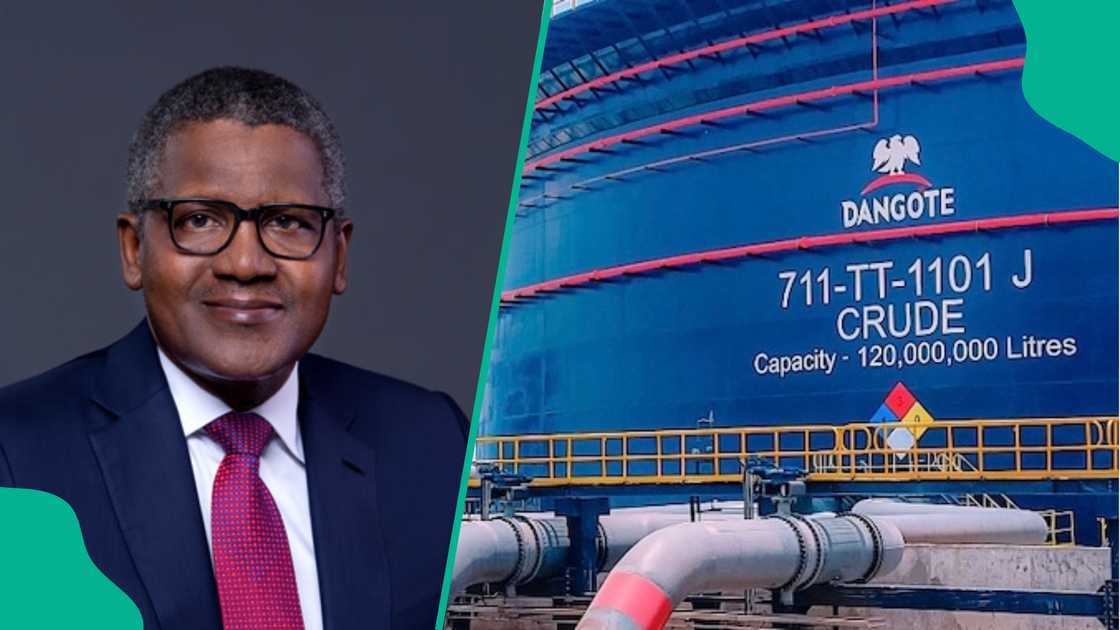
Africa’s richest man, Aliko Dangote, has said his willingness to take major business risks, particularly in the fertiliser and oil-refining sectors, has played an important role in expanding his wealth and strengthening the Dangote Group.
Dangote made the remarks during an interview with Arise News anchor Ojy Okpe as he discussed his business journey, the growth of his conglomerate and the prospects for the Dangote Petroleum Refinery.
The businessman has built a diversified industrial group with interests spanning cement, sugar, salt, fertiliser, petrochemicals and oil refining. Reuters, in a profile published on Monday, September 14, described the refinery’s planned public offering as the biggest stock-market listing in African history, with the facility valued at about $47 billion.
Dangote began his business career as a trader before expanding into manufacturing and large-scale industrial investments.
His group has grown into one of Africa’s largest business conglomerates, with operations across several countries. Cement has historically been the main driver of his fortune, but his investments in fertiliser and petroleum refining have significantly expanded the group’s industrial footprint.
Reuters reported that Dangote Industries now operates across more than a dozen African countries and that his personal fortune is estimated at between $31 billion and $35 billion.
The Dangote Fertiliser complex in Lagos is one of the group’s major investments in Nigeria’s agricultural and industrial sectors.
The facility produces urea fertiliser and was developed as part of Dangote’s strategy of investing in industries where Nigeria has traditionally depended heavily on imports.
The company’s fertiliser business has also become an important part of its broader ambition to increase domestic production and generate foreign exchange through exports.
Dangote’s biggest and most closely watched investment in recent years has been the $19 billion-plus Dangote Petroleum Refinery and petrochemical complex in Lagos.
The refinery has a capacity of about 700,000 barrels per day and is now operating at commercial scale. Dangote has continued to describe the project as a major step towards reducing Nigeria’s dependence on imported refined petroleum products.
The refinery is also at the centre of Dangote’s next major corporate move — its proposed listing on the Nigerian Exchange.
The initial public offering, which opened in September, involves the sale of 4.1 billion shares at N525 each, giving the offer a value of about N2.15 trillion if fully subscribed. Reuters reported that the refinery is expected to list in November at a valuation of about $47 billion.
Dangote’s comments highlight the scale of risk involved in building businesses of this magnitude.
Unlike conventional trading businesses, large-scale manufacturing, fertiliser production and petroleum refining require billions of dollars in capital, long construction periods and exposure to currency, commodity-price, regulatory and operational risks.
The refinery in particular took more than a decade to develop and became one of the largest private-sector infrastructure projects in Africa.
Dangote has maintained that the long-term objective of such investments is to create productive capacity within Africa rather than continue exporting raw materials and importing finished products.
Dangote’s ambitions are now extending beyond his established Nigerian businesses.
According to Reuters, proceeds from the refinery IPO are expected to support further expansion of the Nigerian refinery as well as a planned refinery project in Kenya. The businessman has said the expansion is intended to increase the Nigerian facility’s capacity substantially.
The strategy reflects Dangote’s broader argument that Africa can create greater wealth by processing its own natural resources and developing industries capable of competing in international markets.
For Dangote, the journey from commodity trading to cement, fertiliser and oil refining has therefore been more than a diversification strategy. It has been a bet that large-scale industrial production can create both wealth for investors and greater economic self-sufficiency for African countries.


-

 Football7 days ago
Banda, Chawinga make 2026 Women’s Ballon d’Or top 30 shortlist
-
 Featured7 days ago
Peter Obi, Makinde and the 2027 elections: Can unity really challenge APC?
-

 Trending Stories5 days ago
Davido, Wizkid, Burna Boy or Asake: Who is having the biggest 2026 so far?
-
 Business1 week ago
Nigeria records N12.59trn trade surplus in Q2 2026 — NBS
-
 Football5 days ago
Premier League releases 2026/27 festive fixtures, 7 matches set for Boxing Day
-

 Business3 days ago
Jetour Nigeria, dealers take dashing, other models to Abuja Experience
-

 Business4 days ago
Dangote Refinery IPO shifts spotlight to corporate governance, investor protection
-

 Crime4 days ago
Anambra Police arrest mother over alleged child sexual exploitation