The International Monetary Fund (IMF) has lowered Nigeria’s economic growth projection for 2026 by 0.3 percentage points, revising it from 4.4% to 4.1%, amid mounting global disruptions and domestic cost pressures.
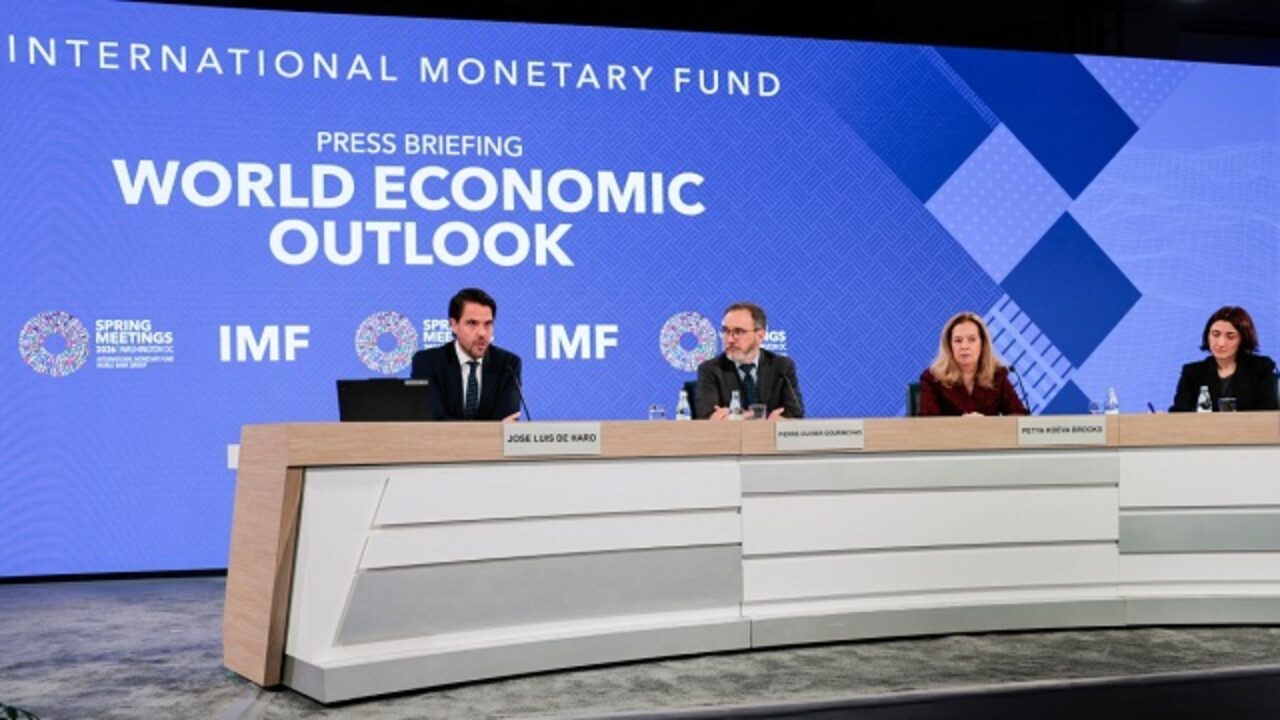
The revised outlook was disclosed during a media briefing for the launch of the IMF’s April 2026 Global Financial Stability Report, where officials said the downgrade reflects a combination of weaker global demand, rising input costs, and worsening trade conditions for oil-importing economies.
Although the new forecast is below the IMF’s January 2026 projection, it remains slightly higher than estimates released in October 2025.
Explaining the revision, Deniz Igan, Deputy Chief of the Macro-Financial Division in the IMF’s Research Department, said recent global shocks have reversed some of the economic gains recorded in Sub-Saharan Africa in 2025.
She noted that ongoing geopolitical tensions have disrupted non-oil commodity markets, weakened global growth, and increased pressure on oil-importing countries through deteriorating terms of trade.
“With the war, however, global growth has weakened, non-oil commodity prices have softened, and terms of trade have worsened for oil importers—an important source of variation across the region,” she said.
Igan also highlighted a sharp decline in development assistance, noting that bilateral aid flows fell between 16% and 28% in 2025, with expectations of continued contraction.
For Nigeria, the IMF attributed the downgrade to rising production and logistics costs, particularly higher fuel, fertilizer, and shipping expenses that are expected to weigh heavily on non-oil sectors.
However, elevated global oil prices are expected to provide some offset, supporting export earnings.
“Turning to Nigeria, we have revised growth down by 0.3 percentage points to 4.1 per cent in 2026. This reflects a balance of two forces: higher fuel and fertilizer prices, along with increased shipping costs, which are expected to weigh on non-oil activity, and some offset from higher oil prices,” the Fund said.
READ ALSO: IMF warns rising oil prices from US–Iran tensions could push global iInflation higher
Nigeria’s inflation rate stood at about 15.06% year-on-year as of February 2026, while the central bank’s benchmark interest rate remains at 26.50%, reflecting ongoing monetary tightening efforts aimed at stabilising prices.
Igan added that the combined effect of these pressures is expected to moderate growth in 2026, although a mild recovery is projected in 2027.
The IMF also pointed to a broader slowdown in global economic activity, with world output expected to ease from 3.4% in 2025 to 3.1% in 2026, before edging up slightly to 3.2% in 2027.
Advanced economies are projected to grow more slowly overall, slipping from 1.9% in 2025 to 1.8% in 2026 and 1.7% in 2027. The United States is expected to remain relatively resilient at 2.3% growth in 2026, while the United Kingdom is forecast at 0.8%.
Germany is projected to recover gradually from 0.2% growth in 2025 to 0.8% in 2026 and 1.2% in 2027.
Among major emerging economies, India remains the strongest performer with projected growth of 6.5% in 2026, while South Africa is expected to lag at just 1.0%.
Sub-Saharan Africa is projected to grow at 4.3% in 2026, slightly below 4.5% in 2025, before improving marginally to 4.4% in 2027. The IMF attributed this trend to a mix of global headwinds and persistent structural constraints across the region.
The Fund also linked its revised projections to escalating geopolitical tensions in the Middle East, particularly around the Strait of Hormuz, a critical global oil transit route.



 Latest1 week ago
 Latest1 week ago
 Football1 week ago
 Comments and Issues5 days ago
 Business5 days ago
 Crime5 days ago
 Business6 days ago
 Comments and Issues5 days ago