
Latest
Tinubu orders probe into deaths of 37 suspected illegal miners in NSCDC custody

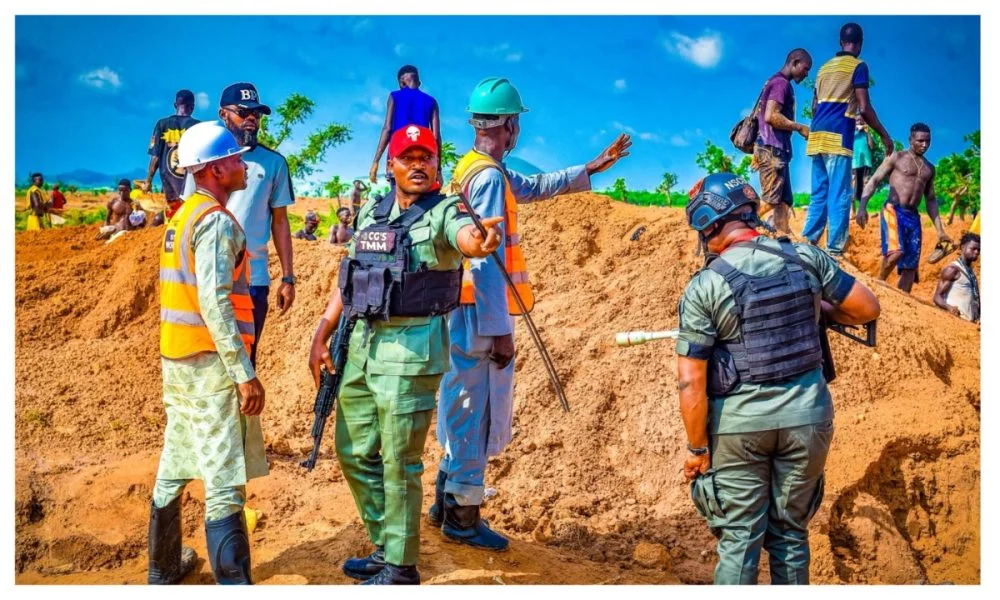
President Bola Ahmed Tinubu has ordered a comprehensive and transparent investigation into the deaths of 37 suspected illegal miners who died while in the custody of the Nigeria Security and Civil Defence Corps (NSCDC) in Minna, Niger State.
The directive came amid growing questions over the circumstances surrounding the mass deaths, including the condition in which the detainees were held, the medical attention available to them and the actual cause of death.
The incident has also triggered protests in parts of Minna, further intensifying public scrutiny of the enforcement operation.
The victims were among scores of people arrested during NSCDC enforcement operations conducted on September 15 and 16 around the M.I. Wushishi/Lukoto axis of Niger State as part of efforts to clamp down on illegal mining. The deaths were discovered in the early hours of September 17 at an NSCDC detention facility in Minna.
What the investigation must establish
Tinubu said the investigation must go beyond determining the immediate medical cause of death and establish the complete chain of events from the moment the suspects were arrested until their deaths.
Among the issues to be investigated are the circumstances of the arrests, the physical condition of the detainees when they were taken into custody, the number of people detained at the facility and the conditions under which they were held.
Investigators are also expected to examine the medical care provided to the detainees, whether officers responded appropriately to signs of illness or distress, and the events immediately preceding the deaths.
READ ALSO; FG suspends Niger NSCDC commandant over deaths of 37 detainees
The NSCDC initially described the deaths as following a suspected disease outbreak. However, its national headquarters subsequently stressed that the actual cause of death had not been established and would require medical and laboratory confirmation.
The bodies were deposited at the General Hospital, Minna, for examination.
That distinction is significant because establishing the medical cause of death is only one part of determining possible responsibility.
The investigation will also have to determine whether overcrowding, inadequate ventilation, denial or delay of medical attention, negligence, abuse or other circumstances contributed to the fatalities.
President rejects illegal-mining justification
Tinubu said the fact that the deceased were suspected of illegal mining could not be used to diminish their rights while in government custody.
“The fact that these individuals were suspected of illegal mining does not in any way remove their right to life, dignity and humane treatment while in government custody,” the President said.
He warned that the government would not tolerate deaths arising from negligence, abuse or dereliction of duty by officials entrusted with the custody of suspects.
“Government will not tolerate mass deaths arising from official negligence, dereliction of duty or failure by public officials to protect the lives placed under their care,” he said.
The President consequently directed that any official whose actions, abuse or negligence are found to have contributed to the deaths must be arrested and prosecuted where the evidence supports criminal charges.
Suspension not enough, Tinubu says
The President also drew a distinction between administrative disciplinary measures and criminal accountability.
He stressed that the suspension of officials involved in the incident must not be treated as the conclusion of the matter.
“The suspension of officers is only an administrative step and must not substitute for a proper determination of criminal responsibility where the evidence warrants prosecution,” Tinubu said.
The Federal Government had already suspended the Niger State NSCDC Commandant, Suberu Siyaka Aniviye, pending investigation into the incident.
Separately, the NSCDC Commandant-General, Ahmed Abubakar Audi, had ordered a high-powered investigative team led by the Deputy Commandant-General in charge of Intelligence and Investigation to examine the circumstances surrounding the deaths.
Tinubu maintained that the Federal Government would continue its campaign against illegal mining and other criminal activities, but insisted that security and enforcement agencies must operate within constitutional and legal boundaries.
“While the Federal Government would continue to combat illegal mining and other criminal activities across the country, enforcement operations must be conducted strictly within the law and with full respect for the dignity and fundamental rights of every person in custody,” he said.
He added: “We must never allow the pursuit of one form of illegality to create another. The government must enforce the law firmly, but it must also obey the law. The sanctity of human life is non-negotiable.”
The President directed the Ministry of Interior and NSCDC leadership to cooperate fully with the investigation and ensure that no officer interferes with the process.
He also expressed condolences to the families of the deceased and appealed for calm, assuring affected communities that the Federal Government would pursue the facts and take appropriate action based on credible evidence.


-

 Crime1 week ago
Anambra Police arrest mother over alleged child sexual exploitation
-

 Business6 days ago
Jetour Nigeria, dealers take dashing, other models to Abuja Experience
-

 Business1 week ago
Dangote Refinery IPO shifts spotlight to corporate governance, investor protection
-

 Business3 days ago
Abuja gears up for Jetour T2’s rugged-luxury experience
-

 Business4 days ago
Dangote IPO rush crashes Bamboo login as investors flood platform
-

 Business4 days ago
Nigeria Business Outlook: Dangote IPO, markets, inflation and naira in focus this week
-

 Business1 week ago
Naira gains ground as Euro holds around N1,548, reserves hit 18-year high
-

 Business1 week ago
NCAA warns United Nigeria Airlines over fleet capacity, passenger disruptions