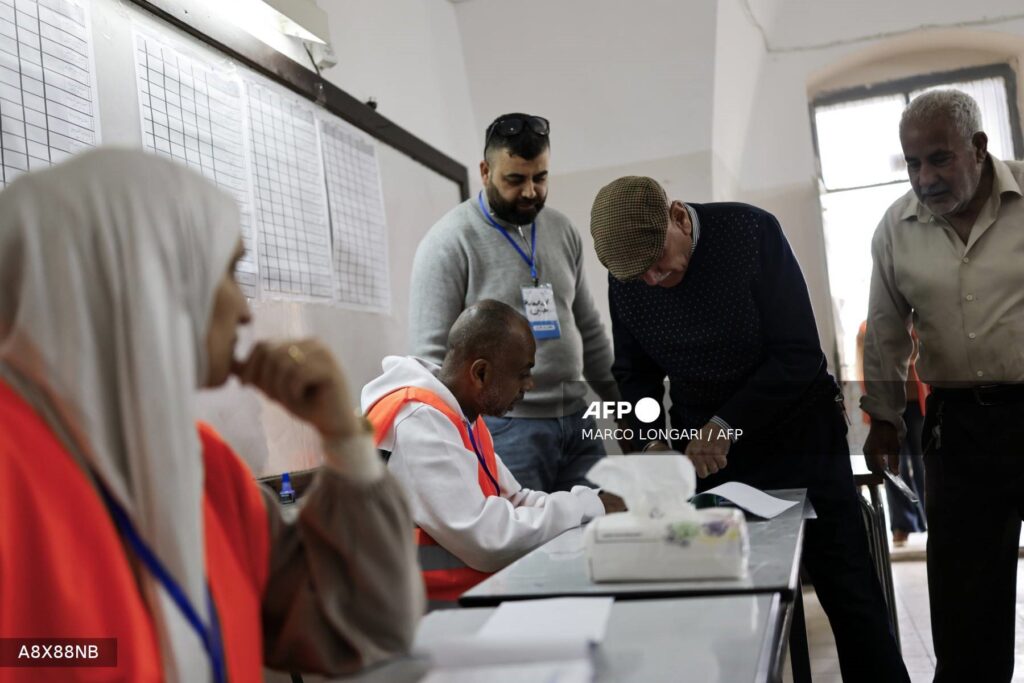
Palestinians on Saturday returned to the polls for municipal and village council elections, marking the first such vote since the outbreak of the Gaza war in late 2023.
The elections, organized by the Central Elections Commission, are taking place across the Israeli-occupied West Bank and, in a notable development, in parts of the Gaza Strip.
For the first time since 2007, voting is being conducted in Gaza under the framework of the Palestinian Authority, with polling limited to the central city of Deir al-Balah. The move is being viewed as a cautious attempt to reintroduce democratic processes in the enclave following years of political division and recent conflict.
Election officials described the Gaza participation as a pilot effort, noting that Deir al-Balah was selected due to relatively stable population conditions during the war. Reports indicate that special security arrangements were put in place to facilitate the vote, with local coordination to ensure safety around polling centers.
However, the scale of participation remains limited. While about 70,000 eligible voters are registered in Deir al-Balah, the West Bank accounts for the overwhelming majority of the electorate, with nearly 1.5 million voters.
The political landscape of the elections is largely subdued, with major factions such as Hamas and the Popular Front for the Liberation of Palestine not formally fielding party-based candidates. Instead, contests are primarily between candidates aligned with Fatah and independent, clan-backed figures.
In several key West Bank cities, including Ramallah and Nablus, only a single candidate list was submitted, resulting in uncontested victories.
The elections are being held under the campaign message “We Stay,” which officials say is meant to reinforce civic participation and resilience after years of instability. For many younger voters, the exercise represents a rare opportunity to engage in the political process.
Despite this, analysts note that public enthusiasm remains muted, with some critics questioning the broader political significance of the vote amid longstanding governance challenges and the absence of national elections.
President Mahmoud Abbas, who has led the Palestinian Authority for nearly two decades without recent national polls, has faced increasing calls for broader democratic reforms.
Observers say the outcome of the limited Gaza participation could influence plans for long-delayed legislative and presidential elections, tentatively projected for late 2026 or early 2027.
Polling in Gaza is expected to close earlier than in the West Bank due to infrastructure constraints, with vote counting to be conducted manually. Final results are anticipated by Sunday.



 Energy1 week ago
 Energy1 week ago
 Agribusiness7 days ago
 Trending Stories7 days ago

 Latest1 week ago
 Crime1 week ago
 Football1 week ago