
News
SERAP files fresh lawsuit against Buhari over social intervention programmes

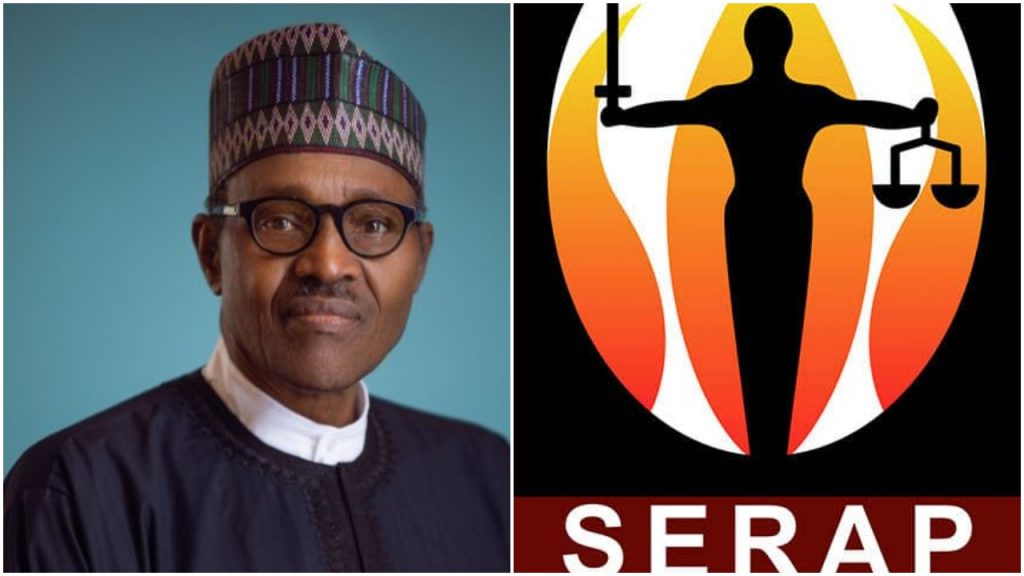
Socio-Economic Rights and Accountability Project (SERAP) has filed a lawsuit against President Muhammadu Buhari over “the failure to thoroughly, effectively and transparently investigate spending on all social safety-nets and poverty alleviation programmes and projects executed between 2015 and 2022.”
Joined in the suit as Respondent is the Attorney-General of the Federation and Minister of Justice, Abubakar Malami (SAN).
A recent report by the National Bureau of Statistics (NBS) shows damning revelations that some 133 million Nigerians are poor, despite the government reportedly spending N500 billion yearly on ‘social investment programmes.’ Half of all poor people in the country are children.
In the suit number FHC/ABJ/CS/2357/2022 filed last Friday at the Federal High Court, Abuja, SERAP is asking the court to “direct and compel President Buhari to thoroughly and transparently investigate the spending on all social safety-nets and poverty alleviation programs and projects executed between 2015 and 2022.”
SERAP is also asking the court to “direct and compel President Buhari to ensure that suspected perpetrators of corruption and mismanagement of public funds meant to take care of the poor face prosecution, as appropriate, and any stolen public funds are recovered.”
READ ALSO: SERAP urges AGF, EFCC to name, shame politicians buying PVCs from poor voters
In the suit, SERAP is arguing that, “Nigerians have the right to be free from poverty. Allegations of corruption in social safety-nets and poverty alleviation programmes pose both direct and indirect threats to human rights, and contribute to extreme poverty in the country.”
The suit filed on behalf of SERAP by its lawyers Kolawole Oluwadare, Kehinde Oyewumi, and Blessing Ogwuche, read in part: “The failure to address extreme poverty has resulted in high levels of inequality, and serious violations of economic and social rights of socially and economically vulnerable Nigerians.
“The NBS report suggests a grave violation of the public trust, and the lack of political will by the government to uphold the country’s constitutional and international human rights obligations.”
“The consequences of corruption are felt by citizens on a daily basis. Corruption exposes them to additional costs to pay for health, education and administrative services.
“Corruption undermines economic development of the country, trapping the majority of Nigerians in poverty and depriving them of employment opportunities.
“Extreme poverty is the greatest denial of the exercise of human rights, as it denies millions of Nigerians not only their economic and social rights but also civil and political rights such as the rights to life, human dignity, and political participation.
“The failure to address extreme poverty has resulted in high levels of inequality, and serious violations of economic and social rights of Nigerians, particularly the socially and economically vulnerable sector of the population.”
“Section 14(2) (b) of the Nigerian Constitution of 1999 [as amended] provides that, ‘the security and welfare of the people shall be the primary purpose of government.’”


-

 Football6 days ago
Banda, Chawinga make 2026 Women’s Ballon d’Or top 30 shortlist
-
 Featured6 days ago
Peter Obi, Makinde and the 2027 elections: Can unity really challenge APC?
-

 Business1 week ago
Nigerian Breweries’ H1 profitability strengthens as revenue hits N804bn
-
 Business1 week ago
Nigeria records N12.59trn trade surplus in Q2 2026 — NBS
-

 Trending Stories4 days ago
Davido, Wizkid, Burna Boy or Asake: Who is having the biggest 2026 so far?
-

 Football4 days ago
Premier League releases 2026/27 festive fixtures, 7 matches set for Boxing Day
-

 Business2 days ago
Jetour Nigeria, dealers take dashing, other models to Abuja Experience
-
 Latest1 week ago
Tinubu’s US legal battle: Group questions silence of elder statesmen